

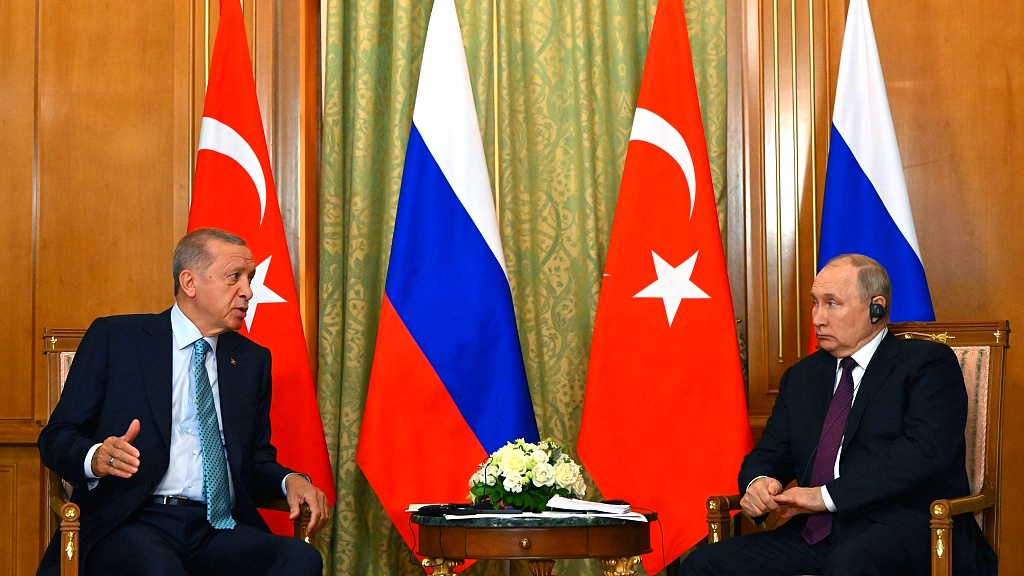
Russian President Vladimir Putin and Turkish President Recep Tayyip Erdogan called for an immediate ceasefire in the Middle East during a phone call on Friday, according to a statement from the Kremlin.
The conflict, which erupted more than a month ago following coordinated U.S.-Israeli strikes on Iranian military and nuclear facilities, has since spiraled into a regionwide war. The fighting has severely disrupted global energy supplies, triggered volatility in international markets, and displaced hundreds of thousands of civilians across several countries.
“The leaders noted their shared positions on the need for an immediate ceasefire and the development of compromise peace agreements that take into account the legitimate interests of all states in the region,” the Kremlin said in a readout of the call.
It added that both presidents stressed “that intense military action is leading to serious negative consequences not only regionally but also globally, including in the areas of energy, trade, and logistics.”
While the primary focus of the discussion was the Middle East, Putin and Erdogan also addressed escalating tensions in the Black Sea region. The Kremlin said the two leaders discussed “the importance of coordinated measures to comprehensively ensure security in the Black Sea area,” and accused Ukraine of “attempts to target gas transportation infrastructure linking Russia and Turkey.”
On Thursday, Russian forces repelled a drone attack on a key section of the TurkStream gas pipeline, which runs from southern Russia to Turkey, according to the pipeline’s operator, Gazprom. The attack caused no significant damage or disruption to flows, but raised fresh concerns about the vulnerability of critical energy infrastructure.
Several European countries, including Hungary, Slovakia, and Serbia, continue to receive natural gas via the TurkStream pipeline, which has become an increasingly vital route for Russian gas exports to Europe following the reduction of transit through Ukraine.
Russia has repeatedly accused Ukraine of targeting the pipeline, most recently in March of this year. Kyiv has not claimed responsibility for the latest incident but has consistently struck Russian energy infrastructure throughout the nearly four-year war, aiming to undermine Moscow’s ability to finance its military offensive.
In a parallel development, Russian strikes on Ukrainian energy facilities have cut power and heating to millions of people since the beginning of Moscow’s full-scale invasion in February 2022. The reciprocal attacks on energy grids have become a defining feature of the war, leaving both sides vulnerable as winter approaches.
The Kremlin did not indicate whether either leader had proposed concrete steps to de-escalate the Middle East conflict, but analysts noted that both Russia and Turkey have maintained channels of communication with Iran, Israel, and Western powers, potentially positioning them as mediators in any future peace talks.
Our Pashto-Dari Website

Support Dawat Media Center
If there were ever a time to join us, it is now. Every contribution, however big or small, powers our journalism and sustains our future. Support the Dawat Media Center from as little as $/€10 – it only takes a minute. If you can, please consider supporting us with a regular amount each month. Thank you
DNB Bank AC # 0530 2294668
Account for international payments: NO15 0530 2294 668
Vipps: #557320

Comments are closed.