
Virtual Reality Becomes a Conduit for Connection, Turning Digital Worlds into Real-World Bonds for Seniors

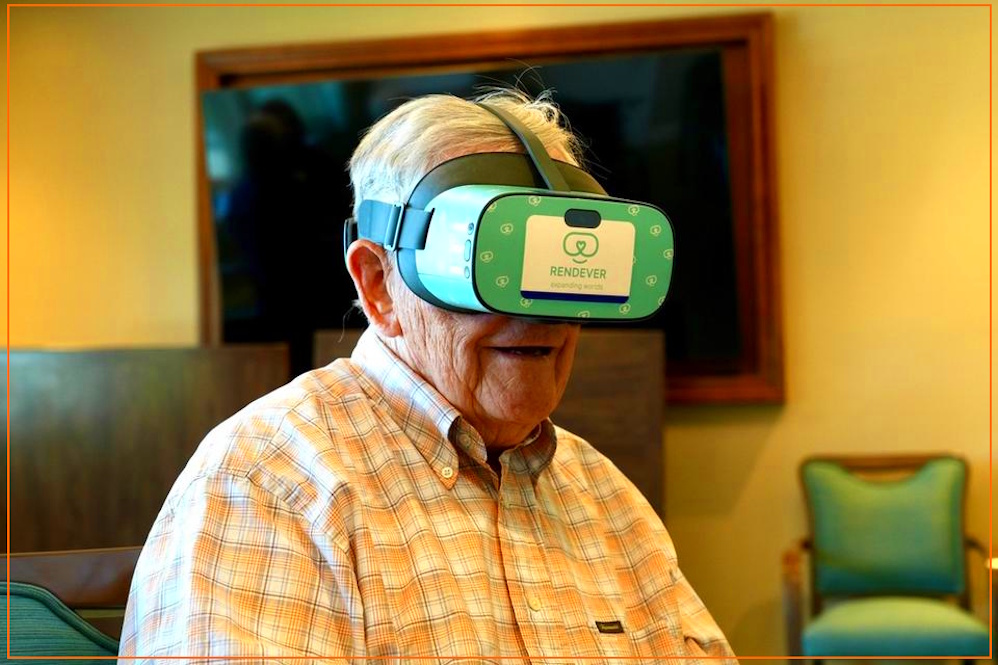
LOS GATOS, Calif. (AP) — At The Terraces, a serene retirement community nestled in the Silicon Valley foothills, the rhythm of life is often gentle. For many residents in their 80s and 90s, the days of globe-trotting travel and physical adventure are memories. Yet, increasingly, those memories are being rekindled—not through photo albums, but through virtual reality headsets that are opening digital doors to profound real-world connections.
What begins as a scheduled session of residents donning headsets transforms into something more: a catalyst for conversation, shared wonder, and cognitive stimulation. Guided by caretakers, they are transported in minutes from their chairs to the canals of Venice, the coral reefs of the Great Barrier Reef, or the peaks of the Swiss Alps, all through programming curated by Rendever, a company specializing in VR for older adults.
“We got to go underwater and didn’t even have to hold our breath!” exclaimed 81-year-old Ginny Baird after a session swimming with a pod of dolphins, her arms paddling alongside her chair. The experience, far from isolating, was a collective adventure. During a virtual hot-air balloon ride, one resident gasped, “Oh my God!” while another shuddered with visceral thrill, “It’s hard to watch!”
Rendever, now used in over 800 senior communities across the U.S. and Canada, has turned a technology often associated with solitary gaming into a tool for building community. Its platform includes not only exotic adventures but also personalized journeys back to childhood homes—a powerful emotional tool. For 84-year-old Sue Livingstone, a virtual trip to her old neighborhood in Queens, New York, unlocked a floodgate of memories. “It isn’t just about being able to see it again,” she said, “it’s about all the memories that it brings back.”
The social ripple effect is tangible. Adrian Marshall, The Terraces’ community life director, observes that VR sessions become potent conversation starters, drawing in even the most hesitant residents. “It helps create a human bridge that makes them realize they share certain similarities and interests,” Marshall said. “It turns the artificial world into reality.” The intrigue is strong enough, he notes, to pull residents away from mainstays like the popular domino game Mexican Train.
The potential of VR for aging populations is now attracting significant scientific and institutional interest. A recent grant from the National Institutes of Health awarded Rendever nearly $4.5 million to study how its platform can reduce social isolation for seniors living at home and their caregivers. This builds on existing research suggesting that structured VR use can help maintain cognitive function, polish recall, and foster social bonds.
Experts caution, however, that VR is a supplement, not a replacement, for human interaction and varied activities. “There is always a risk of too much screen time,” said Katherine “Kate” Dupuis, a neuropsychologist and professor at Canada’s Sheridan College who studies aging. “But if you use it cautiously, with meaning and purpose, it can be very helpful. It can be an opportunity for the elderly to engage with someone and share a sense of wonder.”
For many older adults, VR headsets can be more intuitive than smartphones or computers. “The stereotypes that older adults aren’t willing to try new technology needs to change,” said Pallabi Bhowmick, a researcher at the University of Illinois Urbana-Champaign examining VR and aging. “They are willing and want to adapt to technologies that are meaningful to them.” Beyond stress relief and entertainment, Bhowmick points to an intergenerational benefit: “It might help them build relationships with younger people who find out they use VR and say, ‘Grandpa is cool!’”
The drive behind Rendever is deeply personal. CEO Kyle Rand co-founded the company in 2016 after studying neuroengineering at Duke University, motivated by his own grandmother’s struggles with isolation. “What really fascinates me about humans is just how much our brain depends on social connection,” Rand said. He’s witnessed strangers bond over a 30-minute shared VR experience and then continue the conversation over lunch, forging new friendships.
The market is growing, with companies like Dallas-based Mynd Immersive also offering VR services tailored to senior living. Beyond social connection, the technology is being explored for cognitive support. At the Forum, another Silicon Valley retirement community, VR is used to engage residents with dementia. In one poignant session, Bob Rogallo, 83, who has been rendered nonverbal by dementia, smiled and nodded as he took a virtual hike through Glacier National Park—a park he and his wife, Sallie, visited often in their RV.
“It made me wish I was 30 years younger so I could do it again,” said Sallie Rogallo. “This lets you get out of the same environment and either go to a new place or visit places where you have been.”
In another room at the Forum, 93-year-old Almut Schultz laughed with pure delight, first at a virtual classical concert at Colorado’s Red Rocks Amphitheatre, and then at a puppy frolicking in her digital field of view. Removing her headset with a wide grin, she summed up the collective feeling: “That was quite a session we had there.”
For these seniors, virtual reality is proving to be far more than a technological novelty. It is a gateway—to reclaimed memories, to shared exhilaration, and ultimately, to closer connections in the tangible world they call home.
Our Pashto-Dari Website


Support Dawat Media Center
If there were ever a time to join us, it is now. Every contribution, however big or small, powers our journalism and sustains our future. Support the Dawat Media Center from as little as $/€10 – it only takes a minute. If you can, please consider supporting us with a regular amount each month. Thank you
DNB Bank AC # 0530 2294668
Account for international payments: NO15 0530 2294 668
Vipps: #557320

Comments are closed.