

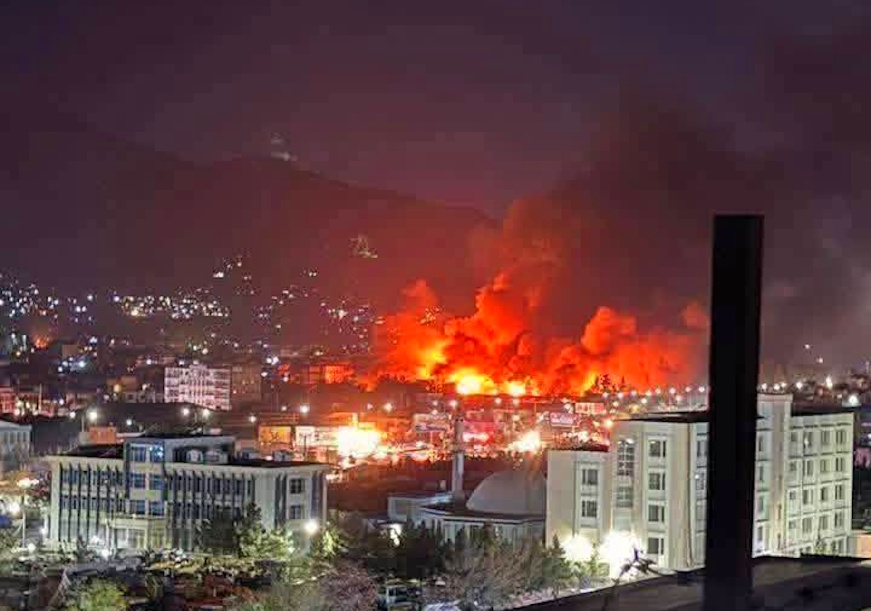
Pakistan has reportedly carried out a fresh wave of heavy airstrikes targeting Afghanistan’s capital, Kabul, along with parts of the eastern province of Nangarhar Province, marking a sharp and alarming escalation in tensions between the two neighboring countries.
According to officials of the Taliban-led government and local residents, multiple powerful explosions were heard across Kabul late Monday night, sending shockwaves through several districts of the city. Eyewitness videos circulating online appear to show large fires and plumes of smoke rising from impacted areas, intensifying fears among civilians.
Taliban spokesman Zabihullah Mujahid confirmed the strikes, alleging that Pakistani aircraft violated Afghan airspace and struck civilian infrastructure, including a major drug rehabilitation facility. He stated that the Omid Addiction Treatment Hospital—a large, 2,000-bed center—was among the primary targets hit during the bombardment.
Reports emerging from Afghan authorities paint a devastating picture. Officials claim that the death toll may have reached nearly 400 people, with around 250 others injured, many of them patients undergoing treatment at the facility. Rescue teams have been working through the night to extinguish fires and recover bodies from the rubble, as hospitals across Kabul struggle to cope with the influx of casualties.
In a strongly worded statement posted on X, Mujahid condemned the strikes, calling them a blatant violation of sovereignty and international norms. He described the attack as “a crime against humanity,” emphasizing that those killed included vulnerable individuals receiving medical care.
The incident has further inflamed an already volatile situation along the Afghanistan–Pakistan border, where tensions have been simmering over security concerns and cross-border militancy. The latest airstrikes risk pushing the conflict into a broader and more dangerous phase.
The international community has expressed growing concern. The United Nations Security Council on the same day adopted a resolution urging Afghanistan’s Taliban authorities to intensify efforts against terrorism, though it stopped short of directly addressing Pakistan’s actions.
Meanwhile, China has stepped up diplomatic efforts to defuse the crisis. Chinese Foreign Minister Wang Yi held discussions with Afghan officials, stressing that disputes should be resolved through dialogue rather than military force. Beijing also confirmed that its special envoy for Afghan affairs has been actively engaging both sides in an attempt to broker a ceasefire.
Despite these mediation efforts, the latest strikes underscore how fragile the situation remains. With civilian casualties mounting and rhetoric intensifying, prospects for immediate de-escalation appear increasingly uncertain, raising fears of a prolonged and destabilizing conflict in the region.
“The Pakistani military regime has once again violated Afghanistan’s airspace and targeted a drug rehabilitation hospital in Kabul, resulting in the death and injury of addicts who were undergoing treatment. We condemn this crime in the strongest terms and consider such an act to be against all accepted principles and a crime against humanity,” Mujahid posted on X .
Our Pashto-Dari Website
Support Dawat Media Center
If there were ever a time to join us, it is now. Every contribution, however big or small, powers our journalism and sustains our future. Support the Dawat Media Center from as little as $/€10 – it only takes a minute. If you can, please consider supporting us with a regular amount each month. Thank you
DNB Bank AC # 0530 2294668
Account for international payments: NO15 0530 2294 668
Vipps: #557320

Comments are closed.