

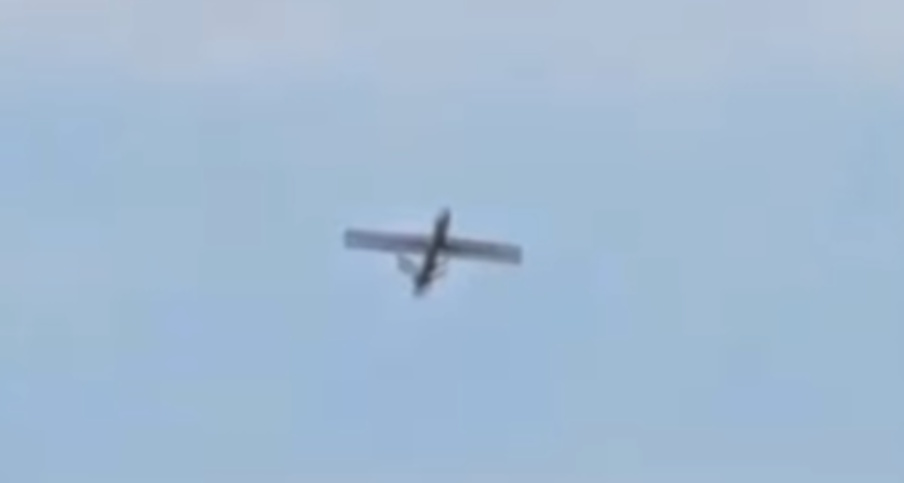
A significant and dangerous escalation in cross-border hostilities occurred on Friday as the Taliban government in Kabul claimed responsibility for drone strikes targeting Pakistani military installations. The attack, which the Taliban’s Defense Ministry described as a direct act of retaliation, follows Pakistani airstrikes inside Afghan territory that reportedly killed civilians, heightening fears of a broader conflict between the two uneasy neighbors.
Taliban’s Retaliatory Strike
In an official statement, the Taliban’s Defense Ministry announced that its forces had launched drone strikes on Pakistani military positions in the Kohat district of Khyber Pakhtunkhwa province. The ministry characterized the operation as a firm response to what it termed Pakistani aggression against Afghan soil.
According to the claim, the precision drone attack successfully struck a military fort and a divisional war command center in Kohat. The Taliban released video footage to support their assertion, which it said showed a drone aircraft maneuvering toward the targeted locations before the moment of impact. The footage, circulating on social media, could not be immediately verified by independent sources.
The ministry’s statement went further, asserting that the strikes had successfully destroyed a range of military assets, including “key military facilities, command and control centers, logistics depots, and barracks used by Pakistani forces.” It also claimed the attack inflicted “significant casualties and material losses” on the Pakistani military, though specific figures were not provided and remain impossible to verify independently.
Pakistan’s Reported Airstrikes and Civilian Casualties
The Taliban’s action was framed as a direct response to Pakistani military operations that occurred just hours earlier. On Friday, Pakistani aircraft reportedly conducted a series of airstrikes inside Afghanistan, targeting several provinces. According to statements from Taliban officials, the strikes hit locations in Kabul, Kandahar, Paktia, and Paktika provinces.
The most serious incident, and the likely catalyst for the Taliban’s retaliation, took place on the outskirts of the Afghan capital. The United Nations Assistance Mission in Afghanistan (UNAMA) released a statement confirming that it had documented civilian casualties resulting from overnight airstrikes in the Pul-e-Charkhi area of Kabul. UNAMA reported at least four civilians, including women and children, were killed, and a further 14 individuals were injured. The UN mission called for an immediate investigation into the incident and reminded all parties of their obligations under international humanitarian law to protect civilians.
While Pakistan has not officially commented on these specific airstrikes, it has a history of conducting such operations, which it says target militant groups, such as the Tehrik-i-Taliban Pakistan (TTP), also known as the Pakistani Taliban, who use Afghan soil to plan and launch attacks on Pakistani security forces.
Official Silence and Regional Fallout
As of Saturday morning, Pakistani military authorities and the Inter-Services Public Relations (ISPR) had not issued any official comment on the Taliban’s claims regarding the drone strikes in Kohat. This silence leaves a critical gap in the narrative, making it difficult to ascertain the veracity of the Taliban’s claims or the extent of any damage or casualties on the Pakistani side.
The exchange of fire marks a dramatic deterioration in relations between the interim Taliban administration in Kabul and the government in Islamabad. Since the Taliban’s takeover of Afghanistan in 2021, Pakistan has repeatedly urged them to prevent militant groups from using Afghan territory to launch cross-border attacks. The Taliban, however, maintains that it does not allow any group to threaten its neighbors, a stance increasingly at odds with the ground reality.
This latest cycle of attack and counter-attack underscores the profound fragility of the relationship. The Pakistani airstrikes, and the resulting civilian deaths, have provided the Taliban with a powerful justification for a direct military response, moving beyond diplomatic protests. The use of drones by the Taliban against Pakistani military installations, if confirmed, would represent a new and more sophisticated level of capability and a significant escalation in their retaliatory options.
The situation now poses a grave risk of a spiraling conflict, with both sides capable of inflicting damage on the other. For the people living in the border regions, the exchange of fire brings not only the immediate threat of violence but also the growing risk of being caught in the middle of an intensifying and open-ended confrontation.
Our Pashto-Dari Website


Support Dawat Media Center
If there were ever a time to join us, it is now. Every contribution, however big or small, powers our journalism and sustains our future. Support the Dawat Media Center from as little as $/€10 – it only takes a minute. If you can, please consider supporting us with a regular amount each month. Thank you
DNB Bank AC # 0530 2294668
Account for international payments: NO15 0530 2294 668
Vipps: #557320

Comments are closed.