

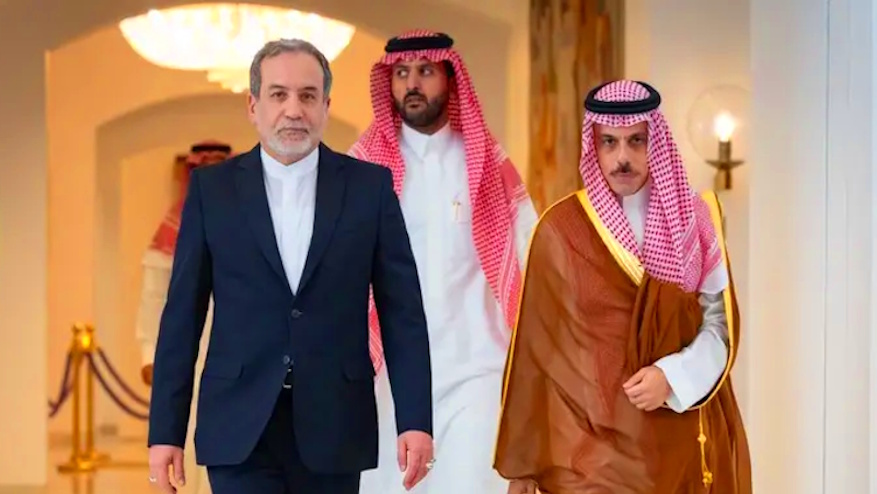
Riyadh-Tehran – Saudi Arabia’s Foreign Minister Prince Faisal bin Farhan received a phone call from his Iranian counterpart, Abbas Araghchi, on Thursday to discuss recent escalations and explore avenues for reducing tensions, according to a statement from the Saudi foreign ministry.
The readout confirmed that the two top diplomats “reviewed the latest developments and discussed ways to reduce tensions to restore security and stability in the region.” While the statement did not provide further details, the call signals a continued, albeit fragile, channel of communication between the two regional powers, who resumed diplomatic relations in March 2023 after a seven-year rift.
Background of the Escalation
The diplomatic outreach comes just one day after the United States and Iran reportedly agreed to a ceasefire. The pause follows a series of retaliatory strikes that began on February 28, when Israel and the United States launched military operations against Iranian targets. Tehran swiftly responded with attacks on Israel and several neighboring Gulf countries, raising fears of a wider regional conflagration.
While the Saudi ministry’s statement did not explicitly name the involved parties, the timing of the call less than 24 hours after the ceasefire announcement suggests urgent efforts to prevent spillover effects. Gulf nations, including Saudi Arabia, have repeatedly called for restraint, warning that any direct military confrontation involving Iran could threaten oil shipments through the Strait of Hormuz and destabilize the broader Gulf region.
Wider Implications
The Saudi-Iranian dialogue is particularly significant given their history of proxy conflicts in Yemen, Syria, and Lebanon. However, since the China-brokered rapprochement in 2023, both countries have prioritized de-escalation and economic cooperation. Thursday’s call underscores Riyadh’s balancing act: maintaining open lines with Tehran while preserving its longstanding security partnership with Washington.
Analysts note that Saudi Arabia has grown increasingly wary of being caught in the crossfire of any U.S.-Israel-Iran confrontation. The kingdom has also pushed for a nuclear diplomacy track and has urged all parties to respect the sovereignty of Gulf nations.
No Official Comment from Tehran
As of Thursday evening, Iran’s foreign ministry had not issued its own readout of the call. However, state-affiliated media in Tehran acknowledged the conversation, framing it as part of Iran’s “neighborhood policy” aimed at resolving regional disputes through dialogue rather than military confrontation.
What Comes Next?
With a fragile ceasefire in place, diplomatic efforts are likely to intensify. The Saudi-Iranian channel could serve as a crucial intermediary mechanism, especially if tensions between Tehran and Washington re-escalate. Meanwhile, Gulf leaders are expected to push for a broader regional security dialogue that includes confidence-building measures, such as mutual non-aggression pledges and transparency on military activities.
For now, the phone call between Prince Faisal and Minister Araghchi offers a small but hopeful sign that dialogue, not further escalation, may guide the region’s next steps.
Our Pashto-Dari Website

Support Dawat Media Center
If there were ever a time to join us, it is now. Every contribution, however big or small, powers our journalism and sustains our future. Support the Dawat Media Center from as little as $/€10 – it only takes a minute. If you can, please consider supporting us with a regular amount each month. Thank you
DNB Bank AC # 0530 2294668
Account for international payments: NO15 0530 2294 668
Vipps: #557320

Comments are closed.