

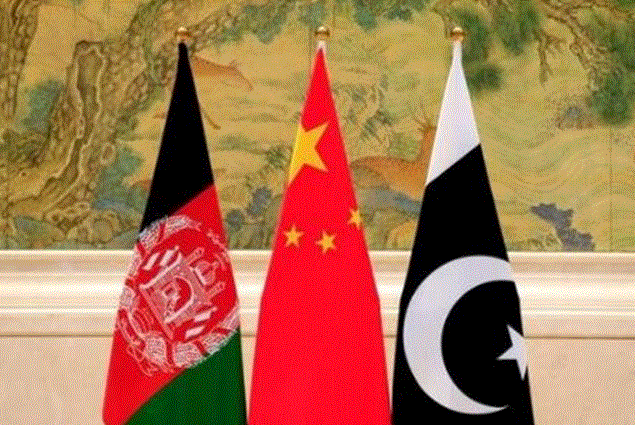
Officials from Pakistan and Afghanistan are set to meet in the Chinese city of Urumqi on Wednesday for talks mediated by Beijing, as cross-border hostilities between the two neighbors continue to escalate. The meeting marks the latest effort under a trilateral mechanism involving China, which has increasingly positioned itself as a regional mediator amid mounting concerns over instability along its western periphery.
The talks, hosted under the auspices of China’s foreign ministry, bring together Taliban and Pakistani representatives at a moment when both sides face intense pressure to de-escalate. A five-member delegation from the Islamic Emirate of Afghanistan (IEA) is scheduled to travel to Urumqi, according to a reliable source quoted by Pajhwok Afghan News. The Afghan delegation reportedly includes Mohibullah Wasiq from the foreign ministry, Interior Ministry envoy Abdul Hai Qanit, Defence Ministry representative Rohullah Omar, and Yahya Takal from the General Directorate of Intelligence.
As of early Wednesday, neither the Taliban nor Pakistani officials had publicly confirmed the full composition of their delegations, underscoring the sensitivity of the engagement. The talks follow weeks of escalating violence, including artillery duels, airstrikes, and a mounting political rift that has pushed ties between Islamabad and Kabul to their lowest point in years.
Cross-Border Violence and Deepening Rifts
The diplomatic push comes as border clashes, airstrikes, and political tensions between Kabul and Islamabad enter their fifth week. Pakistan has conducted artillery and airstrikes inside Afghan territory since February 22, saying the operations target militant groups, particularly the Tehreek-e-Taliban Pakistan (TTP), which Islamabad accuses of launching attacks from Afghan soil. Afghan forces have carried out retaliatory strikes on Pakistani military posts along the disputed Durand Line.
The violence reached a deadly peak on March 16, when a Pakistani airstrike hit a drug rehabilitation hospital in Kabul, killing at least 400 people and wounding more than 250 others, according to Afghan officials. Although both sides observed a ceasefire during the Eid-ul-Fitr holidays, Pakistan was accused by Afghan sources of violating the truce multiple times.
Relations between the Taliban and Pakistan have sharply deteriorated in recent months, despite Islamabad having once been considered one of the Taliban’s closest regional allies. The rift has been driven by mutual recriminations: Pakistan accuses the Taliban of harboring and enabling TTP fighters, while Taliban authorities deny the allegations and accuse Islamabad of violating Afghan sovereignty through repeated cross-border military actions.
China’s Mediation and Regional Stakes
China’s decision to host the talks reflects its growing unease with instability along its western border. Beijing has invested heavily in positioning itself as a stabilizing power in Central and South Asia, with a particular interest in preventing security disruptions to its Belt and Road Initiative and regional trade corridors. For China, reducing friction between Kabul and Islamabad is not only a diplomatic objective but also a strategic necessity tied to counterterrorism concerns and the security of its Xinjiang region, of which Urumqi is the capital.
The Urumqi meeting is not the first attempt at third-party mediation. Afghan and Pakistani officials have previously held talks in Turkey and Saudi Arabia, though those efforts failed to produce lasting results. Wednesday’s engagement follows a separate, unofficial gathering in Peshawar on Tuesday a joint Afghanistan-Pakistan peace jirga that included tribal elders, lawmakers, and civil society representatives from Khyber Pakhtunkhwa. However, sources said no official Afghan representatives attended, and the meeting was narrowly focused on local issues, lasting only a few hours.
Prospects for De-escalation
If the Urumqi talks proceed as planned, they could offer a rare opening for direct de-escalation after weeks of violence and diplomatic deadlock. Participants at the Peshawar jirga called for an immediate ceasefire and the resumption of formal dialogue between the Taliban and Pakistan demands that are likely to be echoed in Wednesday’s discussions.
Still, expectations for a breakthrough remain tempered. Previous rounds of mediation have foundered on mutual distrust and the unwillingness of either side to back away from security ultimatums. Whether Beijing’s leverage can help bridge the gap remains an open question, but with violence continuing to spiral and regional stability at risk, the Urumqi meeting represents one of the few viable diplomatic avenues available.
Our Pashto-Dari Website
Support Dawat Media Center
If there were ever a time to join us, it is now. Every contribution, however big or small, powers our journalism and sustains our future. Support the Dawat Media Center from as little as $/€10 – it only takes a minute. If you can, please consider supporting us with a regular amount each month. Thank you
DNB Bank AC # 0530 2294668
Account for international payments: NO15 0530 2294 668
Vipps: #557320

Comments are closed.