
Fighting Along Durand Line Leaves Thousands of Afghan Children Without Access to Education

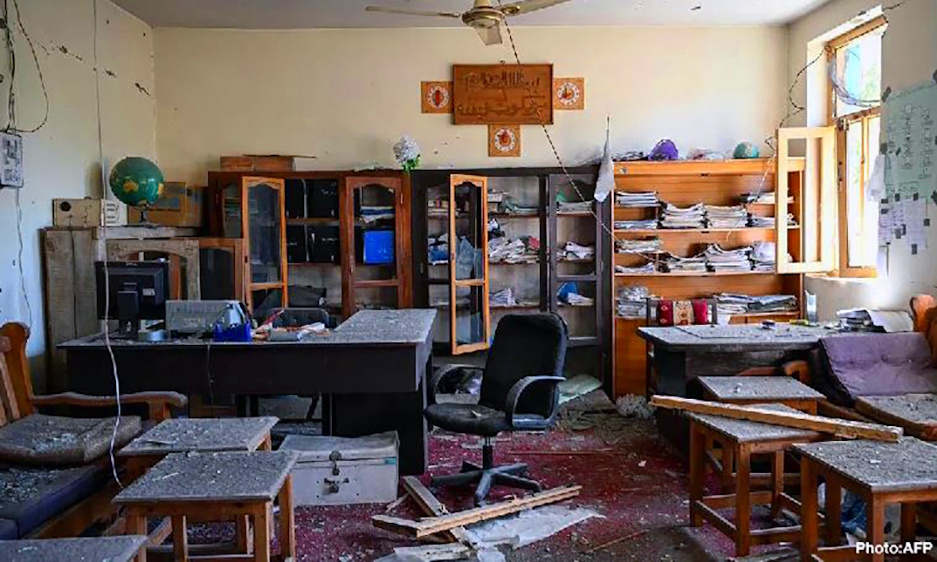
Local authorities report that many schools remain closed due to ongoing insecurity and overcrowding in refugee settlements, compounding an already severe education crisis.
Recent clashes along the Durand Line between Afghanistan and Pakistan have left thousands of Afghan children without access to education, according to reports from AFP. The escalation in violence—particularly in northeastern Afghanistan—has not only displaced large numbers of families but also caused widespread destruction of educational infrastructure, further deepening the humanitarian crisis.
In Kunar province, one of the hardest-hit areas, the impact has been especially severe. In the village of Barikot, schools were directly struck by shelling, destroying classrooms and forcing residents to flee for safety. Witnesses described scenes of devastation, with books scattered among rubble and laboratories and classroom equipment left in ruins. For many, the damage represents more than the loss of buildings it is the loss of opportunity. “This is the school where I studied. I feel very sad,” one local resident told AFP, capturing the emotional toll on communities that have already endured years of conflict.
According to the United Nations Office for the Coordination of Humanitarian Affairs (OCHA), at least 22 schools in northeastern Afghanistan now require urgent reconstruction. As a result, approximately 12,000 students have been deprived of education, interrupting their learning at a critical time and increasing the risk of long-term setbacks such as child labor, early marriage, and reduced future employment prospects.
The crisis extends far beyond the classroom. More than 94,000 people have reportedly been displaced by the recent clashes, many of whom are now living in overcrowded and under-resourced temporary settlements. Conditions in these camps are dire, with limited access to clean water, healthcare, and basic sanitation. Humanitarian organizations warn that without immediate assistance, the situation could deteriorate further, particularly for vulnerable groups such as children and women.
Education services in displacement settings remain extremely limited. Local authorities note that some schools have been unable to reopen due to persistent insecurity, while others are overwhelmed by the influx of displaced students. Makeshift learning spaces, where they exist, often lack trained teachers, supplies, and safe environments conducive to learning.
Efforts are underway to relocate displaced families into more organized camps and to restore some level of educational access. However, progress has been slow, hindered by ongoing instability and limited resources. Aid agencies are calling for increased international support to rebuild schools, provide emergency education programs, and ensure that children do not lose years of schooling.
As the conflict continues, residents and aid workers alike are increasingly concerned about the long-term consequences. Prolonged disruption to education not only affects individual futures but also undermines the broader prospects for stability and development in the region. For thousands of Afghan children, the loss of education today may shape the trajectory of their lives for years to come.
Our Pashto-Dari Website

Support Dawat Media Center
If there were ever a time to join us, it is now. Every contribution, however big or small, powers our journalism and sustains our future. Support the Dawat Media Center from as little as $/€10 – it only takes a minute. If you can, please consider supporting us with a regular amount each month. Thank you
DNB Bank AC # 0530 2294668
Account for international payments: NO15 0530 2294 668
Vipps: #557320

Comments are closed.