

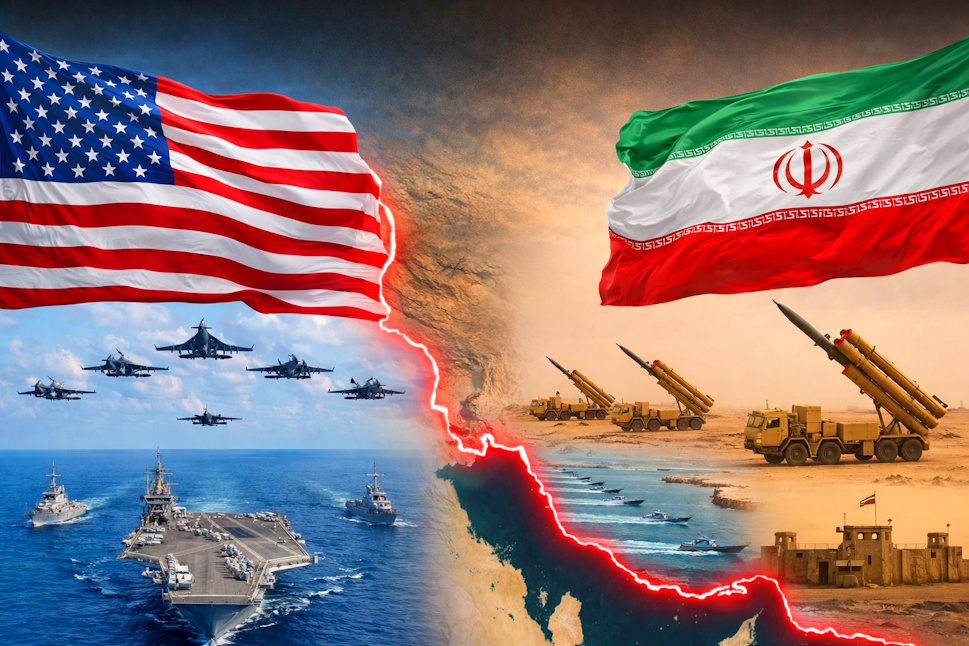
Iran’s senior negotiator and Foreign Minister arrived in Doha on Monday for critical talks with Qatar’s prime minister as diplomatic efforts intensified to broker a possible agreement with the United States aimed at ending the three-month-long conflict. The visit comes amid cautious optimism, though both Washington and Tehran have downplayed expectations of an immediate breakthrough.
According to an official briefed on the discussions, the meetings focused on a framework that could de-escalate hostilities and pave the way for broader negotiations over Iran’s nuclear program, regional security issues, and economic sanctions.
Speaking to reporters earlier in New Delhi, US Secretary of State Marco Rubio said Washington remains committed to exhausting diplomatic options before considering any alternative course of action.
“There is a pretty solid proposal on the table regarding Iran’s ability to reopen the Strait of Hormuz, restore secure passage through the waterway, and enter into a serious, time-limited negotiation on the nuclear issue,” Rubio said. “Hopefully, we can pull it off.”
US President Donald Trump echoed cautious optimism in a lengthy post on Truth Social, saying negotiations with Tehran were “going nicely,” while warning that failure to reach an agreement could trigger renewed military action.
“It will only be a great deal for all, or no deal at all,” Trump wrote, signaling Washington’s insistence on strict terms.
Key Issues on the Table
Iranian Foreign Ministry spokesperson Esmaeil Baghaei confirmed that progress had been made on several major issues but stressed that this did not mean an agreement was close.
“Conclusions have been reached on many topics, but significant differences remain,” Baghaei said during a press briefing.
Sources familiar with the Doha talks told Reuters that discussions centered primarily on two of the most sensitive issues: the future status of the Strait of Hormuz and Iran’s stockpile of highly enriched uranium.
Iran’s central bank governor also reportedly joined the delegation to discuss mechanisms for releasing billions of dollars in frozen Iranian assets held abroad—an issue Tehran considers essential to any final settlement.
Baghaei emphasized that nuclear matters would only be addressed in detail once both sides agree on a broader political framework.
Trump has repeatedly stated that his administration’s principal objective is to prevent Iran from developing nuclear weapons capability. Tehran has consistently denied pursuing such ambitions, maintaining that its nuclear program is solely for peaceful purposes.
Regional Disputes Remain Major Obstacles
Despite progress in some areas, major sticking points persist. These include Iran’s demands for comprehensive sanctions relief, the release of tens of billions of dollars in blocked oil revenues, and broader regional tensions particularly Israel’s ongoing conflict in Lebanon with the Iranian-backed militant group Hezbollah.
Meanwhile, Iran signaled its military readiness by announcing it had successfully shot down what it described as a “hostile stealth drone” using a newly deployed air-defense system.
Iranian state-affiliated news agency Fars quoted unnamed officials as saying:
“This is a signal that no stealth drone can now penetrate Gulf airspace undetected.”
The report did not specify the drone’s origin or the location of the interception.
Strait of Hormuz at the Center of Negotiations
Baghaei clarified that the proposed agreement contains no finalized operational details concerning the management of the Strait of Hormuz, through which roughly one-fifth of global oil and liquefied natural gas supplies typically pass.
He said Iran does not intend to impose direct tolls on vessels but could charge fees for navigational assistance, environmental protection measures, and maritime security services under a future protocol to be coordinated with Oman, which shares control of the strategic waterway.
Since the US and Israel launched coordinated strikes against Iranian targets on February 28, commercial traffic through the strait has dropped dramatically. Daily vessel traffic has fallen from the usual 125–140 ships to only a fraction of that number.
Iranian state television reported that 32 vessels and five oil tankers transited the strait during the past 24 hours, all authorized by the naval forces of Iran’s Revolutionary Guards.
The disruption has sharply driven up global oil prices and increased costs for fuel, fertilizer, and food worldwide. However, oil prices fell more than 4 percent on Monday to two-week lows amid renewed hopes for a diplomatic resolution.
Political Pressure Mounts on Trump and Netanyahu
The conflict has also intensified domestic political pressure on Trump, whose approval ratings have suffered due to rising US energy prices and congressional efforts to limit his war powers.
Analysts suggest the White House is eager to secure a diplomatic victory that could stabilize markets ahead of key political deadlines.
Separately, two sources close to Israeli Prime Minister Benjamin Netanyahu said he has privately acknowledged that Israel now has limited leverage over Trump’s decision-making regarding the conflict, signaling a potential shift in the regional balance of influence as negotiations continue.
For now, the world watches Doha closely, where the outcome of these talks could determine whether the region moves toward peace or a broader and more dangerous escalation.
Our Pashto-Dari Website

Support Dawat Media Center
If there were ever a time to join us, it is now. Every contribution, however big or small, powers our journalism and sustains our future. Support the Dawat Media Center from as little as $/€10 – it only takes a minute. If you can, please consider supporting us with a regular amount each month. Thank you
DNB Bank AC # 0530 2294668
Account for international payments: NO15 0530 2294 668
Vipps: #557320

Comments are closed.