

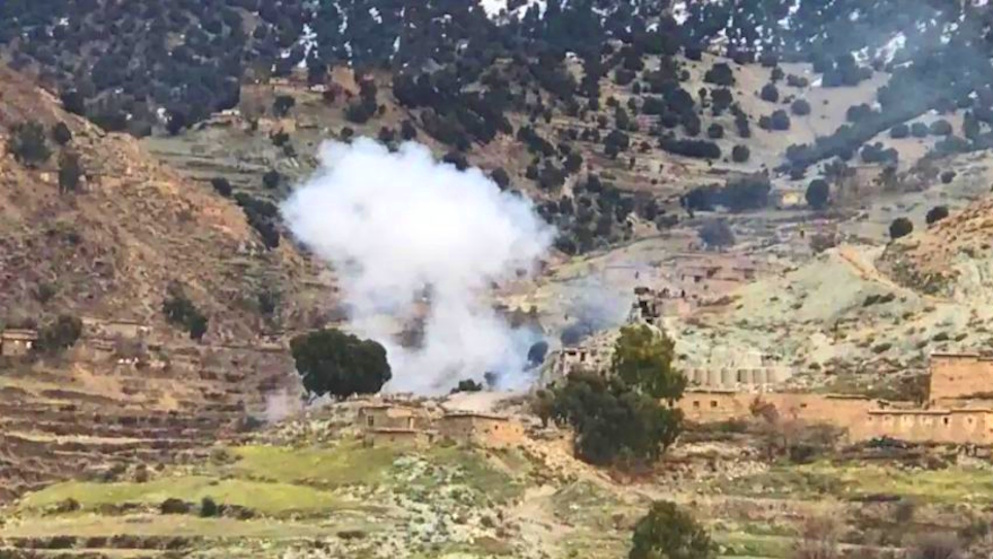
Pakistan has significantly expanded its military operations inside Afghanistan as cross-border violence, airstrikes and diplomatic tensions between the two neighboring countries continue to escalate, according to a report published Thursday by The New York Times.
The newspaper said relations between Islamabad and the Taliban administration in کابل have sharply deteriorated despite ongoing diplomatic efforts led by China to ease tensions and prevent wider regional instability.
According to the report, the Pakistani government earlier this year effectively declared what officials described as an “open war” against militant threats linked to Afghanistan after a sharp rise in deadly attacks inside Pakistani territory. Islamabad has repeatedly accused armed groups based in Afghanistan of orchestrating attacks against Pakistani security forces and civilians.
The report noted that both sides continue exchanging accusations over cross-border militancy while showing little willingness to compromise, despite several rounds of high-level diplomatic talks hosted by China in recent months.
Pakistani Prime Minister Shehbaz Sharif recently vowed that military operations against militant groups allegedly operating from Afghan territory would continue “with full resolve,” insisting that Pakistan would not tolerate attacks launched across the border.
Taliban officials in Afghanistan, however, rejected the allegations and denied responsibility for attacks carried out by Tehrik-i-Taliban Pakistan (TTP). Taliban representatives argued that Pakistan’s worsening security crisis is an internal matter and accused Islamabad of attempting to shift blame for its domestic failures.
According to The New York Times, Pakistani forces conducted dozens of airstrikes targeting Afghan cities, border areas and military-related infrastructure during March as fighting intensified along the frontier. Although the scale of clashes has fluctuated in recent weeks, tensions remain dangerously high.
The violence has reportedly caused heavy civilian casualties. Citing figures from the United Nations Assistance Mission in Afghanistan (UNAMA), the report said at least 372 Afghan civilians have been killed and nearly 400 others wounded during recent airstrikes and border clashes.
One of the deadliest incidents reportedly took place in Kabul in March when Pakistani airstrikes struck a drug rehabilitation center, killing at least 269 people and injuring more than 170 others, according to UN figures referenced by the newspaper.
The escalating conflict has also inflicted serious damage on Afghanistan’s already fragile economy. Repeated closures of major border crossings have disrupted trade routes, delayed imports and exports, and severely affected the movement of commercial goods between the two countries.
Afghan business owners and pharmacists interviewed by the newspaper warned of worsening shortages of medicines, food supplies and construction materials. Taliban authorities have reportedly sought alternative trade and supply routes through Russia and India in an attempt to reduce the economic pressure caused by the ongoing border disruptions.
China, which maintains close ties with both Islamabad and the Taliban administration, has intensified diplomatic efforts to prevent the conflict from spiraling further. Beijing recently hosted meetings between Pakistani and Taliban officials in the Chinese city of Urumqi in an attempt to encourage negotiations and restore cooperation.
However, according to the report, those talks were overshadowed by deep mistrust between both sides. Pakistani officials demanded stronger Taliban action against militant groups allegedly operating inside Afghanistan, while Taliban representatives accused Pakistan of deliberately attempting to destabilize their administration through military pressure and economic restrictions.
Since the Taliban returned to power in Afghanistan in 2021, relations between Kabul and Islamabad have steadily deteriorated over issues including border security, militant safe havens, refugee deportations and disputes surrounding the Durand Line frontier.
Regional analysts warn that continued escalation between the two countries could further destabilize the region, worsen Afghanistan’s humanitarian crisis and increase security risks across South and Central Asia.
Our Pashto-Dari Website

Support Dawat Media Center
If there were ever a time to join us, it is now. Every contribution, however big or small, powers our journalism and sustains our future. Support the Dawat Media Center from as little as $/€10 – it only takes a minute. If you can, please consider supporting us with a regular amount each month. Thank you
DNB Bank AC # 0530 2294668
Account for international payments: NO15 0530 2294 668
Vipps: #557320

Comments are closed.