

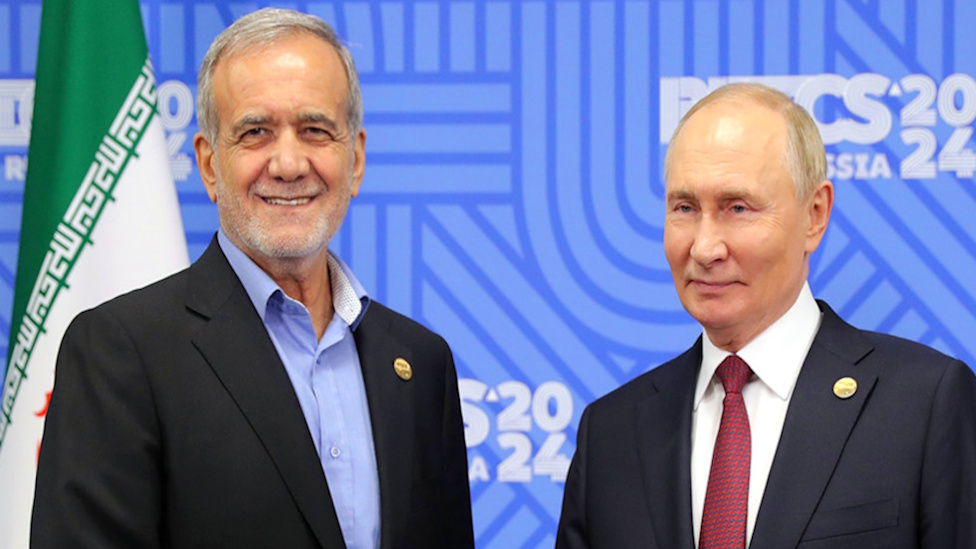
The ongoing American-Israeli attacks on Iran, accompanied by the assassination of its Supreme Leader, have sparked a wave of apprehension in the corridors of Moscow. Russian commentators from the “hawkish” camp have gone so far as to suggest that their country could face a similar scenario, despite its massive nuclear arsenal. They cite recurring Western statements about an imminent conflict with Russia as proof of premeditated intentions.
Despite the anxiety Moscow displays, it finds in the targeting of Iran a validation of its geopolitical strategy and an indirect justification for its war in Ukraine. In Moscow’s view, the events reinforce the Kremlin’s long-held perception of the West, led by Washington, as a rogue actor lacking rationality .
For President Vladimir Putin, the war on Iran echoes the events of 2011 in Libya, which profoundly shaped his understanding of existential threats. Back then, NATO’s military intervention led to the ouster of Libyan leader Muammar Gaddafi.
The NATO offensive, which was facilitated by then-Russian President Dmitry Medvedev (Putin’s ally) through Russia’s abstention in the UN Security Council vote, was a pivotal factor that solidified Putin’s decision to return to the presidency.
In October 2011, a month after Putin agreed to run for a new term, Gaddafi was killed in a violent manner, and images of his demise spread across the digital space. That end, celebrated by the West, did not bequeath Libya democracy or prosperity but left it prey to civil war and political fragmentation.
For Putin, that scene served as a stark omen of what his personal fate and Russia’s future could be if he acquiesced to the neoliberal “democracy” campaigns led by an arrogant and overconfident West.
In December of the same year, protests erupted in Moscow against the fairness of the legislative elections, presenting another red flag in the Kremlin’s calculations.
Putin hesitated for months before firmly suppressing those protests just before his inauguration in May 2012. This marked a turning point in Russia’s domestic and foreign policy, which later led to its intervention in the “Maidan” unrest in Ukraine less than two years later.
Today, as he watches the rapid events in Iran, Putin feels a sense of vindication for his vision regarding the “inevitability” of his actions in Ukraine. He also commends his Soviet predecessors who built the largest nuclear arsenal, which secured Russia’s tangible sovereignty and shielded his personal regime from penetration.
Despite waging a fierce war against his closest European neighbors, Putin still views himself as the guardian of the crumbling post-World War II order. Its collapse, from his perspective, is due to American arrogance and unbridled Western recklessness.
The idea of transferring the battle to the enemy’s territory is rooted in Soviet doctrine from the 1930s. Ukraine and Georgia became “enemy territory” following NATO’s 2007 decision to open its doors to their membership—a doctrine first tested for its effectiveness in the brief 2008 conflict in Georgia.
The Kremlin has framed its actions in Ukraine in 2014, and subsequently the 2022 invasion, as “preemptive strikes” to prevent a repeat of the military intervention scenarios that befell Iraq, Libya, and Syria, and which Iran is facing today.
By making Ukraine the decisive arena for confrontation with the West, the Kremlin managed to shield the vast majority of the Russian people from the war’s direct consequences, having successfully sold it to society as an “inevitable fate.”
The Complex Russian-Iranian Relationship: From Historical Rivalry to Wartime Partnership
A History Forged in Conflict and Distrust
The relationship between Russia and Iran is long and complex, marked by centuries of rivalry and suspicion that continue to color their current partnership. In the 18th and 19th centuries, the Russian Empire fought wars with Persia, capturing significant territories in the Caucasus. In the early 20th century, Russian troops occupied parts of northern Iran, and during World War II, the Soviet Union and Britain jointly invaded Iran—an event that still evokes painful memories in Tehran .
During the Cold War, relations were tense as Iran was a key U.S. ally under the Shah. Following the 1979 Islamic Revolution, Iran’s leader, Ayatollah Khomeini, famously denounced the United States as the “Great Satan” and the Soviet Union as the “Lesser Satan” . This deep-seated mistrust meant that even as ties warmed after the Soviet Union’s collapse in 1991, with Moscow becoming a crucial trade partner and weapons supplier, many Iranians remained wary of Russia’s intentions .
Forging a Strategic Partnership in the Shadow of War
The landscape of this relationship shifted dramatically following Russia’s full-scale invasion of Ukraine in 2022. Isolated from the West, Moscow increasingly turned to Tehran, forging what the U.S. described as a “full-scale defense partnership” . For Iran, also laboring under severe international sanctions, the partnership offered a lifeline to a major power .
-
Military Cooperation: This cooperation became highly visible on the battlefield. The West alleges that in 2022, Russia and Iran signed a $1.7 billion deal for Shahed drones . These one-way attack drones were shipped across the Caspian Sea and quickly became a central tool in Russia’s campaign against Ukrainian infrastructure . Iran also reportedly provided artillery shells and, by 2024, ballistic missiles . Beyond the hardware, Iranian officials reportedly trained Russian soldiers in using the drones and, crucially, helped Russia set up its own manufacturing plant for Shahed-type drones in Tatarstan, localizing the technology . In return, Iran sought advanced Russian weaponry to modernize its aging, sanctions-hobbled military, including Su-35 fighter jets, Mi-28 attack helicopters, and air defense systems. While some Yak-130 trainer jets and air defense systems were delivered, the delivery of the most advanced systems has been slow, a source of frustration for Tehran .
-
Economic Ties and Sanctions Evasion: The partnership extended deep into the economic sphere. Trade turnover grew significantly, from a pre-war average of $1.9 billion to around $5 billion . Both nations, being major oil and gas exporters, began coordinating to manage global energy markets and, more importantly, to build a “shadow fleet” of tankers to circumvent Western oil sanctions . They also worked to de-dollarize their trade, conducting transactions in rubles and rials . This cooperation culminated in the signing of a “comprehensive strategic partnership” treaty in January 2025, covering everything from energy and transportation to defense and counterterrorism .
-
Internal Security: An often-overlooked aspect of the relationship is Russia’s role in helping Iran maintain internal stability. Experts suggest that Moscow has become a key provider of tools and know-how for quashing domestic dissent. This includes supplying communication interception systems, monitoring tools, and training for suppressing unrest, with Iranian security forces employing tactics reminiscent of Russian electronic warfare doctrine during crackdowns on anti-regime protests .
An Asymmetric Alliance Under Pressure
Despite the deepening ties, the relationship is fundamentally asymmetric, with Iran largely in the junior role . This became starkly evident during the current crisis. While Iran was under direct attack, Russia’s response was limited to diplomatic support and condemnation, offering no military assistance . This mirrors Moscow’s inaction during previous Israeli strikes on Iranian assets in Syria and the fall of its own ally, Bashar al-Assad, in late 2024 .
This reluctance stems from several factors. Russia is fully committed to and struggling with its war in Ukraine, lacking the resources to open another front . Its “strategic partnership” treaty with Iran is explicitly not a mutual defense pact . Furthermore, Moscow maintains a pragmatic unofficial “non-aggression” understanding with Israel and is wary of provoking the United States under President Trump, who has been seeking to mediate an end to the Ukraine war .
This dynamic has sowed discontent within Iran. Leaked audio recordings have revealed frustration within Iran’s powerful Revolutionary Guard, with a general blaming Russia for Iran’s setbacks in Syria . The perception that Russia is an unreliable protector feeds the deep-seated historical mistrust that still lingers beneath the surface of their strategic partnership.
Putin’s Strategic Calculus: Benefiting from Iran’s Ordeal
And so, even as he watches the potential collapse of a key partner, Putin finds a grim validation of his own strategy. The war on Iran, which Moscow is unwilling or unable to prevent, paradoxically serves several of Russia’s immediate interests.
-
Economic Gains: The conflict has injected fresh life into Russia’s wartime economy. Fears of a wider war have spiked global energy prices, directly benefiting Russia, one of the world’s largest oil and gas exporters . With Iran’s energy infrastructure potentially offline, Russia can capture a larger share of key markets like China and India, providing crucial funds for its budget deficit and war effort .
-
Pressure on the West: The new theater of conflict diverts the attention and resources of the United States and its allies. Ukraine explicitly fears that vital military aid, particularly air defense missiles like those for Patriot systems, could be redirected to the Middle East, weakening its ability to defend against Russian strikes . This strategic distraction gives Moscow potential leverage in any future negotiations.
-
Domestic Consolidation: Internally, the images of destruction in Iran are powerful propaganda tools for the Kremlin. They reinforce the narrative of a hostile and aggressive West, legitimizing the “besieged fortress” mentality that has consolidated public support for Putin’s rule. The scenes serve as a stark warning of the alternative to his strong-handed leadership, portraying him as the indispensable protector of the nation .
In a final twist of irony, the attack on Iran has also removed a major point of friction in Russia’s relations with the West, particularly with the Trump administration, which Moscow hopes to engage with over Ukraine. And while the fall of Iran would be a strategic setback, Russia has, over three years of war, diversified its supply chains and domestic production, meaning it no longer relies on Tehran to sustain its military machine .
Ultimately, for Putin, watching the destruction of his ally is not a defeat, but a confirmation. It is a brutal, real-time demonstration of the lawlessness of a world he believes is ruled by American force, a vindication of his decision to meet perceived threats with preemptive force in Ukraine, and a stark warning to his own people of the fate that awaits if they ever waver in their support for him. The war in Iran, in his eyes, proves that his paranoid vision of the world is not paranoia at all it is simply reality.

Support Dawat Media Center
If there were ever a time to join us, it is now. Every contribution, however big or small, powers our journalism and sustains our future. Support the Dawat Media Center from as little as $/€10 – it only takes a minute. If you can, please consider supporting us with a regular amount each month. Thank you
DNB Bank AC # 0530 2294668
Account for international payments: NO15 0530 2294 668
Vipps: #557320

Comments are closed.