
Between Victory and Survival: The Politics Behind the Competing Iran Peace Plans
Ahmad Fawad Arsala


The diplomatic proposals now circulating to end the escalating war involving Iran, the United States, and Israel appear at first glance to be irreconcilable. Washington has presented a 15-point framework that focuses heavily on limiting Iran’s strategic capabilities, while Tehran has countered with a 10-point peace proposal centered on sovereignty, security guarantees, and compensation for wartime damage. Taken literally, the two plans seem to exist in different universes. Yet in international diplomacy, particularly during wartime, such proposals are rarely intended as final agreements. They are opening bids designed to shape the negotiating environment, influence domestic audiences, and test the balance of power on the battlefield.
Understanding whether a compromise is possible requires examining not only the contents of the two plans but also the political logic behind them and the internal dynamics shaping decision-making in Tehran.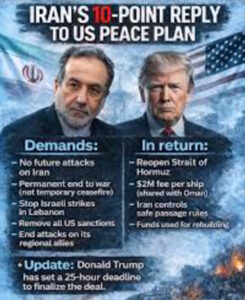
At its core, the U.S. proposal reflects a classic post-conflict containment strategy. The 15-point plan emphasizes restrictions on Iran’s nuclear program, limitations on ballistic missile development, the reopening of the Strait of Hormuz to international shipping, and mechanisms for long-term monitoring. Sanctions relief is offered, but only in exchange for verifiable compliance with these restrictions. The strategic objective is clear: to translate military pressure into structural limits on Iran’s future power.
From Washington’s perspective, the war provides an opportunity to achieve goals that diplomacy alone struggled to secure for years. Limiting Iran’s nuclear threshold capability and constraining its missile arsenal have been longstanding objectives of U.S. and Israeli policy. The proposal therefore reads less like a ceasefire agreement and more like a framework for a strategic settlement that would reshape Iran’s regional posture.
Tehran’s 10-point plan, by contrast, reflects a very different political imperative. Rather than focusing on military restrictions, Iran’s proposal emphasizes immediate cessation of hostilities, guarantees against future attacks, removal of sanctions, and compensation for damages inflicted during the war. It also includes demands related to sovereignty in the Strait of Hormuz.
These priorities reveal the central goal of Iran’s leadership: regime preservation without accepting terms that could be framed domestically as surrender. By demanding reparations and security guarantees, Tehran seeks to reposition itself not as a defeated power but as a state defending its sovereignty against external aggression.
The gap between these two frameworks is substantial. Washington’s proposal requires Iran to limit strategic capabilities that Tehran considers essential to its deterrence. Iran’s proposal, meanwhile, demands compensation and guarantees that are politically impossible for any U.S. administration to accept. On paper, the two documents appear roughly sixty to seventy percent incompatible.
Yet diplomacy rarely begins where compromise ultimately ends.
Despite their differences, several areas of potential convergence exist. Both sides implicitly recognize the importance of restoring stability in the Strait of Hormuz, through which a significant portion of the world’s oil supply flows. Both acknowledge that sanctions relief will ultimately play a role in any settlement. And both appear to accept that negotiations could occur in phases rather than through a single comprehensive agreement.
The most plausible path toward compromise would therefore involve a staged process rather than a single grand bargain.
The first phase would focus on immediate stabilization measures: reopening the Strait of Hormuz, halting major airstrikes, and establishing humanitarian corridors. These steps would not resolve the deeper issues but would reduce the risk of escalation and create space for negotiations.
A second phase could address technical issues such as nuclear monitoring, enrichment limits, and restrictions on certain missile activities. In exchange, limited sanctions relief could be introduced gradually, providing economic incentives for compliance.
Only in a later phase would broader regional security arrangements emerge, potentially involving Gulf states and international monitoring frameworks. Such an approach would allow both sides to present the agreement domestically as a measured diplomatic success rather than a capitulation.
However, the feasibility of such a compromise depends less on the details of the proposals than on the internal political dynamics within Iran.
The Iranian political system is not monolithic. Decision-making involves a complex interaction between ideological hardliners, pragmatic political figures, and technocratic elites concerned with economic stability.
Hardline factions closely aligned with Supreme Leader Mujtaba Khamenei and elements of the Islamic Revolutionary Guard Corps view concessions on nuclear or missile capabilities as unacceptable. For them, the war reinforces a narrative of resistance against Western pressure, and a prolonged confrontation may even strengthen their political position.
A second bloc, often described as pragmatic conservatives, takes a more cautious view. Figures associated with this camp—including political leaders such as parliamentary speaker Mohammad Bagher Ghalibaf, are deeply aware of the economic costs of sustained conflict. Iran’s economy has already endured years of sanctions, and the damage inflicted during the current war risks pushing the system toward deeper instability. For this group, negotiations that preserve the regime while stabilizing the economy may be a rational strategic choice.
A third camp, represented by technocrats and former diplomats, has historically favored negotiated solutions that balance national pride with economic reintegration. Their influence has fluctuated over time but could grow if the economic consequences of the war become severe.
Which of these factions ultimately shapes Tehran’s negotiating position will depend heavily on the battlefield situation.
If military pressure significantly damages Iran’s oil infrastructure or constrains its ability to project power regionally, pragmatic voices may gain influence and push for negotiations. If, on the other hand, Iran successfully imposes costs on its adversaries—through disruptions to shipping or regional escalation—the leadership may believe it can negotiate from a stronger position.
The most common outcome in conflicts of this kind is neither decisive victory nor immediate compromise, but rather a prolonged period of strategic stalemate. When both sides conclude that further escalation will not significantly improve their position, the political space for diplomacy expands.
For now, the two peace proposals should therefore be understood not as genuine settlement frameworks but as instruments of strategic signaling. Washington is signaling that military pressure will translate into demands for structural constraints on Iran’s power. Tehran is signaling that it will not negotiate under terms that imply defeat.
Between these positions lies the space where real diplomacy may eventually unfold.
If a compromise emerges, it will likely resemble neither the American 15-point plan nor Iran’s 10-point proposal. Instead, it will take the form of a hybrid arrangement combining limited strategic concessions from Tehran with phased economic relief and security assurances from Washington.
Such outcomes are rarely elegant, but they are often the way wars end.
For now, the most important question is not which proposal is stronger on paper. The real question is which political forces inside Iran, and which military realities on the ground, will ultimately shape the moment when negotiation becomes unavoidable.
Pressure on Tehran: War, Leadership Divisions, and the Limits of Iran’s Partition
Our Pashto-Dari Website

Support Dawat Media Center
If there were ever a time to join us, it is now. Every contribution, however big or small, powers our journalism and sustains our future. Support the Dawat Media Center from as little as $/€10 – it only takes a minute. If you can, please consider supporting us with a regular amount each month. Thank you
DNB Bank AC # 0530 2294668
Account for international payments: NO15 0530 2294 668
Vipps: #557320

Comments are closed.