

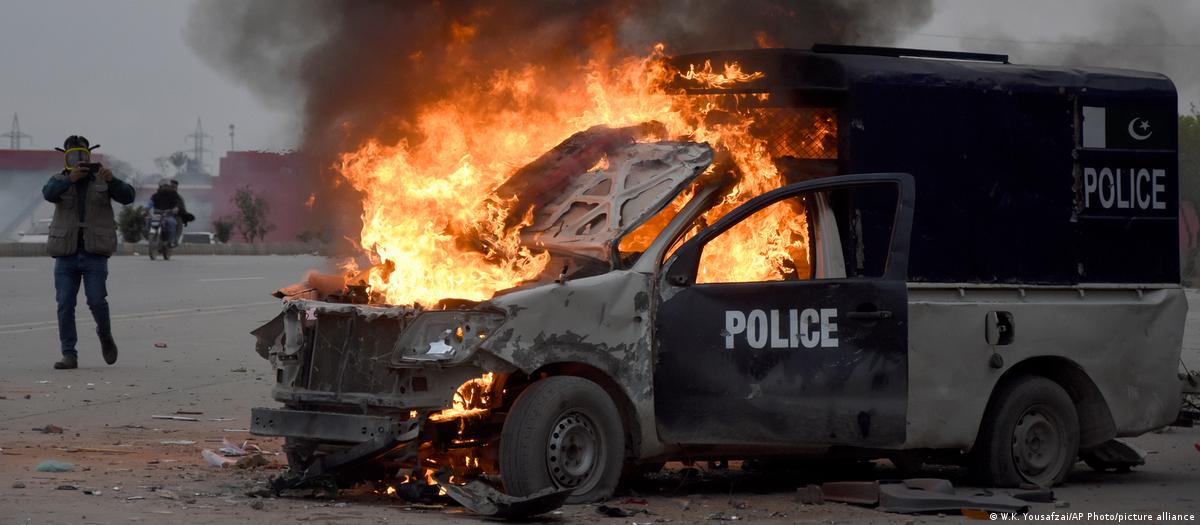
February 2026 will be remembered as one of the bloodiest months in Pakistan’s recent history. The blood, however, was not spilled by a foreign invader, but by the catastrophic failure of the state’s own praetorian guard the Pakistani military to protect the very citizens it is constitutionally sworn to defend. A horrific suicide bombing at a Shia mosque in Islamabad on February 6th shattered the capital’s fragile peace, killing at least 36 worshippers and wounding over 170. This was not an anomaly. It was the brutal crescendo of a sustained pattern of security lapses, including a deadly attack in Bajaur that killed 11 soldiers and subsequent bombings in the Bannu region of Khyber Pakhtunkhwa. Faced with a surge of public outrage and uncomfortable questions about its competence, the military establishment, led by Chief of Army Staff (COAS) General Syed Asim Munir, reverted to its oldest and most reliable instinct: fabricating an external crisis to overshadow its internal failures.
The immediate aftermath of the Islamabad attack was telling. As thousands of grieving citizens buried their dead and openly condemned the security forces’ negligence, reports emerged that Pakistani authorities had received advance intelligence of an imminent threat and failed to act. The chorus of criticism pointed to a root cause: the military’s decades-old policy of nurturing jihadist proxies, a hydra that has now turned its many heads to devour its creator. Critics argue that General Munir’s tenure, marked by rhetorical rebranding of certain militant outfits, has done little to dismantle this ecosystem. Instead, it has been accompanied by inflammatory, racially charged rhetoric that fuels the very extremism the state claims to fight, exposing his own ideological leanings and those of the institution he commands.
Then, on the night of February 21st, the script flipped. The Pakistan Air Force conducted airstrikes across the Afghan provinces of Nangarhar, Paktika, and Khost, claiming to target hideouts of the Tehreek-e-Taliban Pakistan (TTP) and Islamic State Khorasan Province (ISKP). But what followed was not a precision counterterrorism operation; it was theatre. It was a military institution performing strength for a domestic audience, desperate to reclaim a heroic narrative. Afghan authorities reported at least 18 people killed, including women and children, in Paktika province alone. The United Nations Assistance Mission in Afghanistan (UNAMA) independently confirmed at least 13 civilian deaths and seven injuries. This was not collateral damage, but a foreseeable and accepted consequence of striking a defenseless neighbor, knowing the visceral optics of “retaliation” would dominate Pakistani news channels and drown out the uncomfortable questions from Rawalpindi.
This escalation reflects a documented, aggressive shift in Pakistan’s cross-border posture. Yet, what many analysts have been reluctant to state plainly is this: the strikes were launched precisely because the military could not answer for its domestic debacle. Following the Islamabad bombing, the distance between the site of the massacre and the army’s General Headquarters (GHQ) in Rawalpindi is a mere eleven miles a symbolic distance that represents a chasm of accountability. The airstrikes provided a perfect narrative redirect. Pakistan was no longer a failing security state unable to protect worshippers in its own capital; it was now the aggrieved, muscular nation heroically striking at “terrorist havens” on foreign soil.
The manufactured crisis escalated with alarming speed. By February 27th, Defense Minister Khawaja Asif declared Pakistan was in a state of “open war” with Afghanistan, claiming Islamabad’s patience was exhausted. Subsequent strikes reportedly hit areas near Kabul and other provinces. Afghan Deputy Spokesman Hamdullah Fitrat accused Pakistan of deliberately targeting civilian residences, stating the majority of casualties were women and children. The UN-affiliated group Diplomats Without Borders warned that the confrontation risked broader regional destabilization, noting with alarm that the international community’s attention was fixed elsewhere, leaving this tinderbox unattended.
This calculated violence against Afghans does not emerge from a vacuum. It is the foreign extension of an institutional culture already well-practiced in the arbitrary application of force at home. The military’s conduct toward Afghan civilians is a mirror reflecting its conduct toward its own citizens. According to the Baloch Yakjehti Committee, a staggering 1,223 Baloch individuals were forcibly disappeared in 2025 alone, including 18 women. More than 200 cases of extrajudicial killings by security forces were reported during the same period. In February 2026, as the military rained bombs on Afghanistan, multiple enforced disappearances and deaths in custody were documented in Balochistan, with recovered bodies bearing visible signs of severe torture. UN Special Rapporteurs have characterized these practices as serious human rights violations and potential international crimes, urging Pakistan to establish independent investigative mechanisms. The message from the GHQ is clear: the lives of Baloch, Pashtun, and now Afghan civilians are expendable in the service of institutional power.
This institutional disregard has long shaped Pakistan’s brutal treatment of Afghan refugees. Under the guise of “repatriation,” Pakistani police have conducted mass forced evictions, confiscated property, and denied refugees due process, including the right to present documentation or legal representation. An estimated USD 4 billion in Afghan-owned assets and property have reportedly been seized. Between September 2023 and February 2026, Pakistan forcibly deported over one million Afghan nationals, a flagrant violation of the international principle of non-refoulement. Afghans who spent decades building lives in Pakistan have watched their homes and savings stripped away by the same security establishment now cynically presenting itself to the world as Afghanistan’s aggrieved and innocent neighbor.
This contradictory posture—belligerent abroad, brutal at home is the hallmark of General Munir’s tenure. His administration conspicuously projects strength on the international stage, posturing aggressively toward Afghanistan while simultaneously waging a ruthless campaign against domestic political rivals, most notably former Prime Minister Imran Khan. His much-touted “hard state” policy has not been applied to militant proxies, but to local armed groups, minority communities, and political dissent, generating deepening resentment across the country. The army continues to disappear students, silence lawyers, and conduct deadly operations in its own villages, all while Munir courts foreign dignitaries for photo-ops, a generalissimo presiding over a crumbling fortress.
Unsurprisingly, this edifice is cracking. Domestic opposition is growing and increasingly visible. Chants of “Murdabad” (death to) directed at both General Munir and Prime Minister Shehbaz Sharif erupted recently in Pakistan-administered Gilgit-Baltistan, following the killing of civilians by security forces during local protests. On social media, hashtags like #ResignAsimMunir, #PakistanUnderMilitaryFascism, and #BoycottMilitaryBusinesses trend with regularity, as citizens document brutal crackdowns and the stifling of free expression. In Afghanistan, public anger is equally pronounced, with demonstrators in multiple provinces taking to the streets to condemn what they describe as Pakistani state terrorism against a defenseless civilian population. The military’s record over the past two years has been, by any objective measure, abysmal. The active military conflict with Afghanistan is not a solution to terrorism; it is a deliberate strategy of manufactured instability, a transparent ploy to divert public attention from the fundamental failures of a state captured by its own army. The question is not whether Pakistan can win a war with Afghanistan, but whether its people will continue to accept a peace at home built on the corpses of accountability.
Our Pashto-Dari Website

Support Dawat Media Center
If there were ever a time to join us, it is now. Every contribution, however big or small, powers our journalism and sustains our future. Support the Dawat Media Center from as little as $/€10 – it only takes a minute. If you can, please consider supporting us with a regular amount each month. Thank you
DNB Bank AC # 0530 2294668
Account for international payments: NO15 0530 2294 668
Vipps: #557320

Comments are closed.