

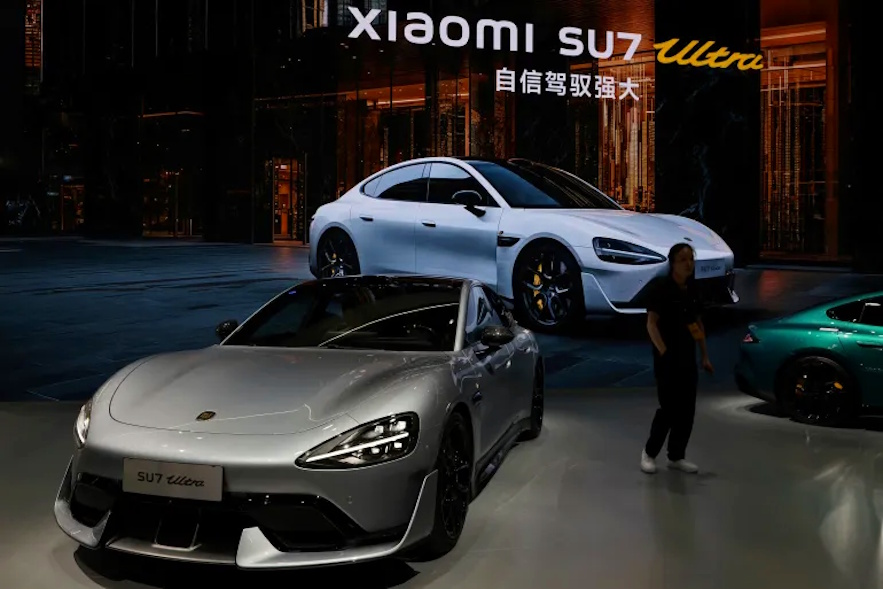
In a move that has drawn sharp rebuke from Washington, Canadian Prime Minister Mark Carney announced a landmark trade agreement with China that will significantly lower tariffs on Chinese electric vehicles (EVs) and Canadian canola. The deal, struck during Carney’s visit to Beijing—the first by a Canadian premier since 2017—marks a deliberate effort to rebuild economic ties and diversify trade amidst strained relations with the United States.
The Core of the Deal
Under the new agreement, Canada will permit the import of up to 49,000 Chinese-made EVs at a reduced Most-Favoured-Nation tariff rate of 6.1%. This stands in stark contrast to the 100% punitive tariff imposed by the previous Trudeau government in 2024, which mirrored U.S. policy. In 2023, China exported 41,678 EVs to Canada.
In return, China has committed to slashing its combined tariffs on Canadian canola seed from approximately 84% to about 15% by March 1. The agreement also removes retaliatory tariffs on Canadian canola meal, lobsters, crabs, and peas. Prime Minister Carney stated these measures would unlock nearly $3 billion in export orders for Canadian farmers and processors.
U.S. Reaction: Warnings and Disapproval
The announcement prompted immediate and critical responses from senior U.S. officials in the Trump administration, who framed the decision as a security and economic misstep.
-
Transportation Secretary Sean Duffy was unequivocal: “I think they’ll look back at this decision and surely regret it to bring Chinese cars into their market,” he said during an event at a Ford factory in Ohio.
-
U.S. Trade Representative Jamieson Greer called the decision “problematic,” emphasizing U.S. protective measures. “There’s a reason why we don’t sell a lot of Chinese cars in the United States. It’s because we have tariffs to protect American auto workers,” he stated in a CNBC interview. Greer also cited stringent U.S. cybersecurity regulations for connected vehicles as a major barrier for Chinese EVs in the American market.
-
Bipartisan political opposition was echoed by Ohio Senator Bernie Moreno (R), who declared to applause, “As long as I have air in my body, there will not be Chinese vehicles sold in the United States of America—period.”
Despite the strong rhetoric, Greer downplayed the immediate competitive threat, noting the limited quota “would not disrupt American supply into Canada” and that the vehicles were destined for Canada, not the U.S.
Canada’s Strategic Calculus
For Ottawa, the deal represents a pragmatic pivot to secure markets and investment amid turbulent trade relations with its southern neighbor. The U.S. under President Trump has imposed tariffs on some Canadian goods and engaged in aggressive trade rhetoric.
Prime Minister Carney defended the agreement as a necessary step for Canada’s economic future. “For Canada to build its own competitive EV sector, we will need to learn from innovative partners, access their supply chains, and increase local demand,” he argued. He expects the pact to drive “considerable” Chinese investment into Canada’s auto sector and accelerate its transition to a net-zero economy.
Carney also highlighted a renewed predictability in relations with Beijing, stating, “In terms of the way our relationship has progressed in recent months with China, it is more predictable, and you see results coming from that.” The visit also yielded commitments to restart high-level economic dialogues and enhance cooperation in green energy, with Carney noting opportunities for Chinese partnership in offshore wind and LNG exports to Asia.
Domestic and International Implications
The deal has sparked domestic debate. Doug Ford, Premier of Ontario—Canada’s automotive heartland—criticized the federal government for inviting “a flood of cheap made-in-China electric vehicles” without guaranteed reciprocal investments in Canada’s industrial base.
Internationally, analysts view the rapprochement as a nuanced development in the broader Sino-U.S. rivalry. While Canada remains a core U.S. security ally, its pursuit of autonomous economic policy provides Beijing with a counter-narrative to U.S.-led decoupling efforts. As Even Rogers Pay of Trivium China noted, “It’s difficult for Washington to criticise Carney for striking a beneficial trade deal when Trump himself just did so in October,” referencing the U.S.-China trade agreement reached last fall.
A Reshaped Landscape
The agreement signifies a recalibration of North American trade dynamics. While the U.S. intensifies its protectionist stance, Canada is seeking to carve a more independent path, leveraging its resources and clean-energy ambitions to engage with China. This move does not signify a strategic realignment away from Washington but underscores Ottawa’s desire for diversified, resilient trade partnerships. The long-term repercussions for the North American auto sector and the Western alliance’s economic cohesion vis-à-vis China remain critical questions as this new chapter unfolds.
Our Pashto-Dari Website


Support Dawat Media Center
If there were ever a time to join us, it is now. Every contribution, however big or small, powers our journalism and sustains our future. Support the Dawat Media Center from as little as $/€10 – it only takes a minute. If you can, please consider supporting us with a regular amount each month. Thank you
DNB Bank AC # 0530 2294668
Account for international payments: NO15 0530 2294 668
Vipps: #557320

Comments are closed.