
Climate Disasters Deepen Afghanistan’s Humanitarian Crisis, IOM Warns, as Returns and Funding Gaps Compound the Emergency

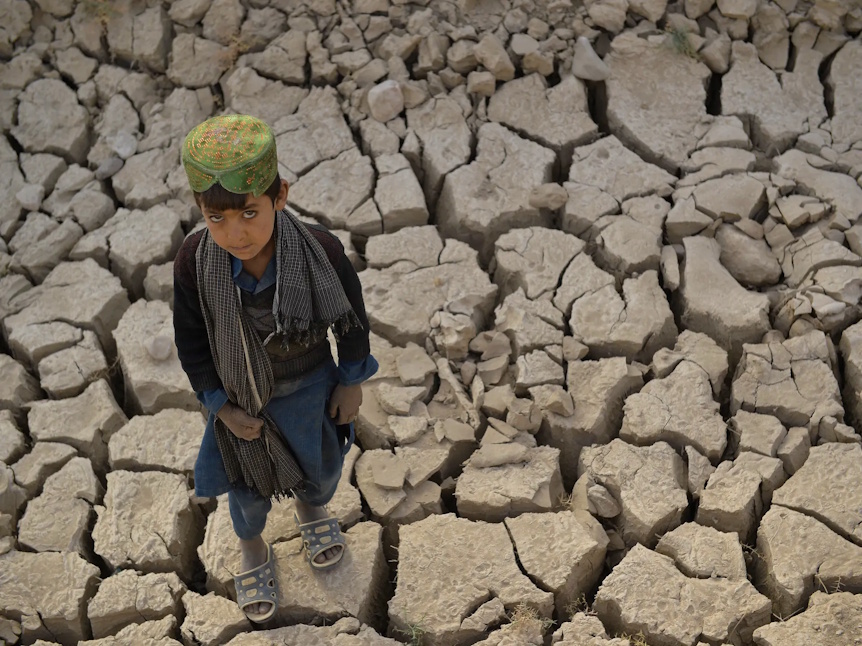
The International Organization for Migration (IOM) has issued an urgent warning that climate change is rapidly intensifying Afghanistan’s already dire humanitarian crisis. Repeated floods, prolonged droughts, and increasingly erratic extreme weather events are not only destroying lives and livelihoods but also swelling the ranks of vulnerable people in need of life-saving assistance just as the capacity to help them shrinks.
In a new assessment, IOM noted that climate-related disasters have triggered an unprecedented surge in humanitarian needs across nearly all 34 provinces. Yet at the same time, humanitarian organisations on the ground are struggling with severe funding shortfalls, logistical constraints, and reduced operational reach, leaving millions without adequate shelter, food, or clean water.
“The climate shock is no longer a distant threat it is a daily reality for Afghan families,” an IOM spokesperson said. “We are seeing entire villages washed away by flash floods one season, then parched by drought the next. These are communities that had already been pushed to the edge by decades of conflict and economic collapse.”
The impacts are most acute in rural areas, where more than 80% of the population depends on agriculture and livestock. Recurring climate shocks have eroded topsoil, killed herds, and destroyed irrigation systems, forcing many farming families to abandon their land and migrate to urban centres or across borders in search of work. Food insecurity has soared, with the World Food Programme estimating that nearly 16 million Afghans are now facing acute hunger, a figure that continues to climb with each dry season.
Compounding this environmental catastrophe is a parallel human displacement crisis. Over the past year, Afghanistan has witnessed the large-scale forced and voluntary return of Afghan migrants from neighbouring Iran and Pakistan, where tightening residency rules and economic pressures have pushed hundreds of thousands to leave. Many of these returnees arrive with few possessions and no safety net, only to find that their home communities are already overwhelmed by poverty, unemployment, and depleted public services.
Humanitarian agencies report that returnees are increasingly settling in climate-vulnerable belts arid lowlands, flood-prone river valleys, and regions with known water scarcity—because land and housing are marginally cheaper there. This dangerous convergence means that a single drought or flash flood can now devastate both long-residing families and newly arrived returnees simultaneously, multiplying the scale of displacement and need.
“We are witnessing a perfect storm,” said a senior aid coordinator in Kabul. “Climate shocks, mass returns, economic freefall, and a collapsing health system all happening at once. And the funding we have is less than half of what we need for even basic winterisation and food aid.”
The strain on Afghanistan’s fragile economy is palpable. Local markets are volatile, remittances have dropped, and employment opportunities especially for youth and women remain critically scarce. Host communities, themselves struggling with debt and rising food prices, are finding it increasingly difficult to absorb returnees without sparking social tensions or further depleting shared resources like water and grazing land.
In response, IOM says it is scaling up emergency operations in the hardest-hit districts, prioritising cash-for-work programmes, emergency shelter kits, and water trucking for drought-stricken villages. The agency is also working with local authorities and international partners to rehabilitate small-scale irrigation systems and introduce climate-resilient farming techniques, such as drought-tolerant seed varieties and rainwater harvesting. However, these efforts remain modest compared to the growing need.
“We are racing against time, but our resources are stretched thin,” the IOM spokesperson added. “Without a significant boost in donor support and a shift toward longer-term adaptation planning, we risk losing a whole generation to malnutrition, displacement, and despair.”
The agency has reiterated its call for increased international solidarity not just in emergency funding, but in building durable solutions that address the root causes of vulnerability. This includes investing in early-warning systems, reforestation, sustainable water management, and social safety nets that can cushion the poorest families against climate volatility.
Humanitarian organisations have repeatedly flagged that Afghanistan remains one of the world’s most climate-vulnerable countries, despite contributing minimally to global emissions. Yet, as donor fatigue sets in and global attention pivots to other crises, aid budgets for Afghanistan have been steadily slashed. The UN’s 2026 Humanitarian Response Plan for Afghanistan is currently less than 45% funded a shortfall that has already forced agencies to cut rations, close mobile health clinics, and reduce protection services for women and children.
“Afghanistan is a living case study of climate injustice,” said a humanitarian policy analyst. “The people who did the least to cause the climate crisis are bearing its heaviest consequences and they are being asked to survive with diminishing global support. That is not only unsustainable; it is indefensible.”
As the next planting season approaches, and with forecasts predicting another year of erratic rainfall, the window for preventive action is narrowing. For millions of Afghans whether they never left their villages or have just returned to them the difference between survival and catastrophe now rests on whether the world chooses to act, and act fast.
Our Pashto-Dari Website

Support Dawat Media Center
If there were ever a time to join us, it is now. Every contribution, however big or small, powers our journalism and sustains our future. Support the Dawat Media Center from as little as $/€10 – it only takes a minute. If you can, please consider supporting us with a regular amount each month. Thank you
DNB Bank AC # 0530 2294668
Account for international payments: NO15 0530 2294 668
Vipps: #557320

Comments are closed.