
Abdul Ahad Momand, Afghanistan’s First and Only Astronaut, Dies in Germany at 67

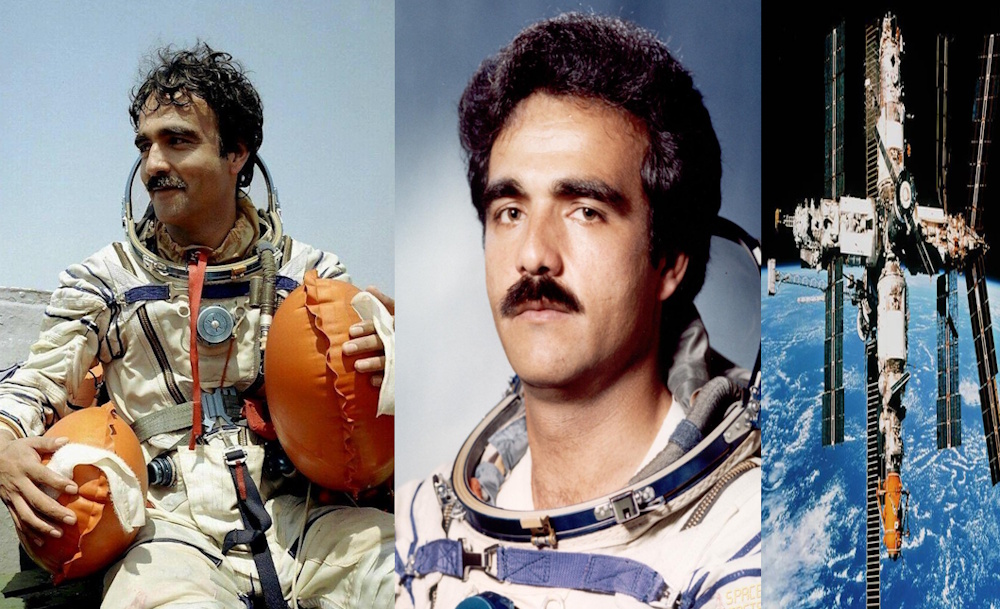
Abdul Ahad Momand, the first and to date only Afghan to travel to space, passed away on Sunday in Germany at the age of 67, following a prolonged battle with cancer, his family confirmed. He died in Stuttgart, where he had lived in exile for more than two decades.
A relative told local media that Momand had been undergoing treatment for some time after his diagnosis, but his condition deteriorated in recent weeks. Funeral arrangements and memorial ceremonies will be announced by his family in the coming days. He is survived by two daughters and a son.
A Historic Flight Aboard Soyuz TM-6
Momand etched his name into the annals of space exploration on August 29, 1988, when he launched aboard the Soviet Soyuz TM-6 mission as a research cosmonaut. The spacecraft docked with the Mir space station, where Momand conducted a series of scientific experiments including observations of the Afghan landscape and studies on the effects of microgravity before returning to Earth after 8 days, 20 hours, and 26 minutes in orbit. His mission made him not only the first Afghan in space but also the fourth Muslim astronaut to journey beyond Earth’s atmosphere, following Saudi Prince Sultan bin Salman Al Saud and Syrian Muhammed Faris.
From Ghazni to the Stars
Born in 1958 in the Andar district of Ghazni province, Momand grew up in a country with little infrastructure for advanced science or aviation. He trained as a military pilot in the Afghan Air Force and was later handpicked for the Soviet Intercosmos program a Cold War-era initiative that allowed allied nations to send cosmonauts on Soviet missions. His selection came after rigorous physical and technical training in Star City, near Moscow, where he spent nearly two years preparing alongside Soviet cosmonauts.
His journey into space remains one of Afghanistan’s most celebrated scientific and national achievements a rare moment of unity and pride in a country long scarred by war, political upheaval, and foreign intervention.
Life in Exile, A Voice for Education
Following the collapse of Afghanistan’s Soviet-backed government in 1992 and the subsequent rise of factional fighting, Momand relocated to Germany. He settled in Stuttgart, where he lived quietly with his family, rarely seeking public attention but remaining a symbolic figure for Afghans both at home and in the diaspora. On anniversaries of his spaceflight, his story would resurge in Afghan media as a reminder of what his nation was once capable of achieving.
In rare interviews, Momand did not shy away from criticizing Afghanistan’s trajectory. He consistently described the country as severely underdeveloped and repeatedly called for massive, sustained investment in primary education and higher learning. He believed that science, not warfare, should define Afghanistan’s future. “A nation that does not educate its children,” he once said, “has no claim to the stars.”
A Bitter Irony in His Homeland
Momand’s death coincides with a grim milestone for Afghan education: for the fifth consecutive year, Afghan girls have been barred from attending secondary schools and universities under the current de facto authorities. The ban widely condemned internationally stands in stark contrast to everything Momand represented. In his lifetime, he often expressed deep sorrow over the erasure of women from public life and the systematic denial of learning to half the population.
As tributes pour in from Afghan communities worldwide, many are reflecting on the bitter irony: the man who once looked down on Earth from the heavens could not, in his final years, witness his own country lift its daughters toward even a basic education.
Legacy
Though he never returned to Afghanistan after his exile, Momand’s legacy endures as a beacon of what Afghans can achieve when given opportunity and peace. His space suit and mission memorabilia have been displayed in exhibitions in Europe and Central Asia, and his name is etched in the memories of those who remember a time when Afghanistan reached beyond its borders and beyond the sky.
He is gone, but the question he leaves behind is as urgent as ever: Can a nation that once touched the stars now find the will to educate all of its children?
Our Pashto-Dari Website
Support Dawat Media Center
If there were ever a time to join us, it is now. Every contribution, however big or small, powers our journalism and sustains our future. Support the Dawat Media Center from as little as $/€10 – it only takes a minute. If you can, please consider supporting us with a regular amount each month. Thank you
DNB Bank AC # 0530 2294668
Account for international payments: NO15 0530 2294 668
Vipps: #557320

Comments are closed.