

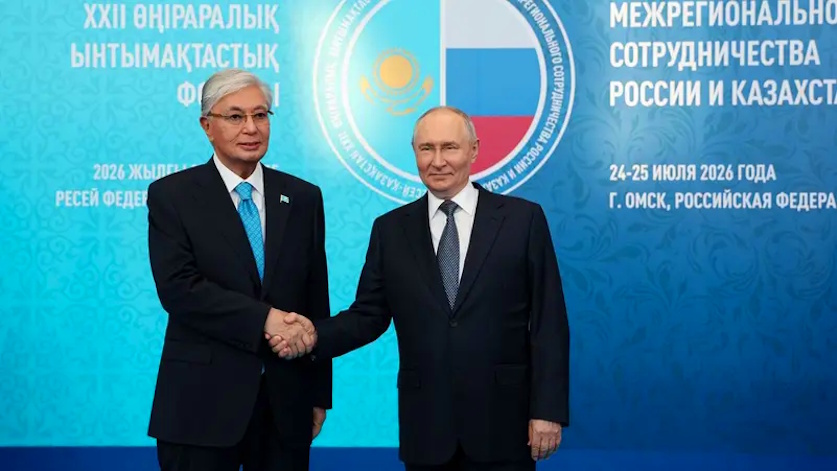
In an extraordinary display of diplomatic candor, Kazakhstan’s President Kassym-Jomart Tokayev on Saturday called for a freeze in the Ukraine conflict, urging Russia and Ukraine to return to the negotiating table—while standing shoulder-to-shoulder with Russian President Vladimir Putin.
Speaking at a Russia-Kazakhstan forum in the Siberian city of Omsk, Tokayev offered what he called a “modest opinion” on the war, now in its fourth year. He praised Putin’s “utmost diplomatic flexibility” but did not shy away from voicing frustration over the protracted bloodshed.
“If I may offer my humble opinion, since I have been asked, perhaps it is time to freeze this conflict and return to the Istanbul formula 2.0,” Tokayev said, referring to a framework that emerged from early peace talks between Moscow and Kyiv.
Those discussions took place in Istanbul shortly after Russia’s full-scale invasion began in early 2022, and again in 2025, though neither round yielded a lasting breakthrough. Tokayev suggested that a renewed push, backed by security guarantees from major powers including Russia itself could pave the way toward a durable settlement.
“With guarantees from the great powers, including Russia, we could move forward toward a long-awaited peace,” he said. “This must be brought to an end. It is a shame; young people are dying. All of this has to be stopped.”
A Rare Rebuke from a Russian Ally
Tokayev’s comments were striking not only for their content but for their setting. Kazakhstan is a formal ally of Moscow and a member of the Russian-led Eurasian Economic Union and Collective Security Treaty Organization. Yet Astana has consistently refrained from endorsing Russia’s invasion—a stance that has unsettled the Kremlin and rattled other Central Asian partners wary of Moscow’s revisionist ambitions.
Sitting beside Putin, Tokayev acknowledged the difficulty of understanding the war’s origins. “The roots of this conflict are not completely understandable for many, including for us,” he said. By contrast, he noted, the causes of the Armenia-Azerbaijan wars over Nagorno-Karabakh were “clear,” but “here it is very difficult to understand.”
His remarks subtly underscored a growing unease among Russia’s neighbors, who have watched the war drain Russian resources and destabilize the broader post-Soviet space. For Kazakhstan, which shares the world’s longest continuous land border with Russia, the conflict poses both economic and security risks, from Western sanctions to potential spillover effects.
Putin’s Response and the Stalled Diplomatic Path
Putin, who listened impassively, responded by saying he would brief Tokayev further on the war during their private meeting. But the Russian leader has shown little appetite for compromise in public; he has repeatedly stated that Moscow intends to seize the entirety of eastern Ukraine’s Donbas region by force, and Kremlin officials have dismissed territorial concessions as non-negotiable.
Meanwhile, Kyiv insists on the full restoration of its 1991 borders, including Crimea, which Russia annexed in 2014. With both sides entrenched, diplomatic efforts have largely stalled, and frontline fighting has ground into a war of attrition punctuated by drone strikes and artillery duels.
Tokayev’s intervention while unlikely to shift Putin’s calculus marks one of the few times a sitting head of state has openly pressed the Russian president for a ceasefire in a public forum. It also reflects a broader, if muted, push from Central Asian and Global South nations for de-escalation, even as Western military aid to Ukraine continues.
What the ‘Istanbul Formula 2.0’ Could Mean
The original Istanbul accords, proposed in March 2022, envisioned a neutral Ukraine with limited military capacity, in exchange for international security guarantees. That framework collapsed amid mutual distrust and Russia’s subsequent annexation of four Ukrainian regions. A “2.0” version, as Tokayev suggested, would likely require updated terms potentially including a demilitarized zone, phased ceasefires, and binding commitments from both the U.S. and China as guarantors.
Whether such a plan is viable remains deeply uncertain. But Tokayev’s public nudge serves as a reminder that even Russia’s closest allies are growing impatient with a war that has no clear end in sight and that the cost of continued stalemate is measured not only in territory, but in lives.
Our Pashto-Dari Website
Support Dawat Media Center
If there were ever a time to join us, it is now. Every contribution, however big or small, powers our journalism and sustains our future. Support the Dawat Media Center from as little as $/€10 – it only takes a minute. If you can, please consider supporting us with a regular amount each month. Thank you
DNB Bank AC # 0530 2294668
Account for international payments: NO15 0530 2294 668
Vipps: #557320

Comments are closed.