
Afghanistan Achieves Trade Milestone with First $100,000 Natural Stone Export to the United States

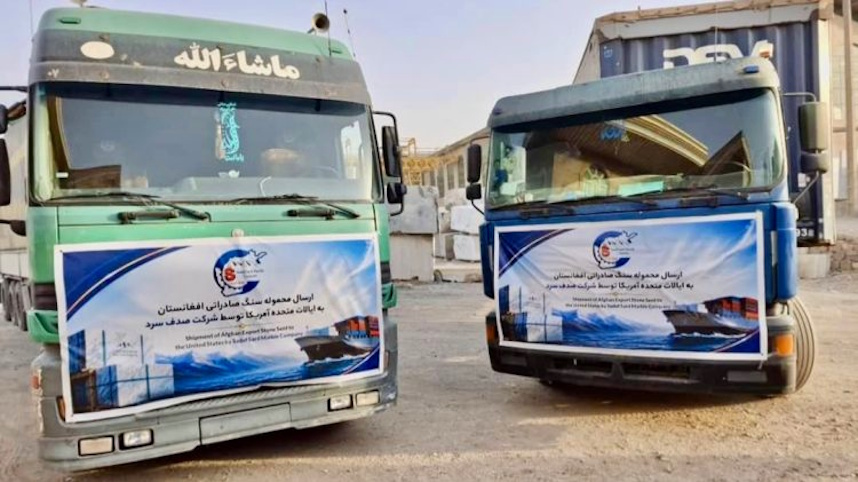
In a landmark development for Afghanistan’s struggling economy, the country has successfully exported its first-ever commercial shipment of natural stone to the United States. The consignment, valued at $100,000, marks a tentative but symbolic step toward integrating Afghan mineral resources into Western supply chains and diversifying the nation’s narrow export base.
According to a statement released Wednesday by the Herat provincial governor’s office, the shipment consists of high-quality black decorative stone quarried from the Zendajan district in western Herat. The export was facilitated by a private Afghan company and coordinated through the Herat Chamber of Industries, which handled the logistical and regulatory processes required to reach the U.S. market. While the volume of the shipment remains modest, officials are framing it as a proof-of-concept that Afghan stone can meet international quality and compliance standards.
“This is not just about $100,000 it’s about opening a door,” said a senior trade official from Herat, speaking on condition of anonymity. “For years, our stone went only to Pakistan, India, and a few Gulf states. The U.S. market has rigorous specifications, and meeting them demonstrates our capacity to compete globally.”
Herat’s Industrial Backbone and Regional Significance
Herat province has long been recognized as an industrial and commercial hub in western Afghanistan, owing to its proximity to Iran and its well-established network of marble and stone processing facilities. The region is home to dozens of small and medium-sized enterprises that have supplied decorative stone to regional construction markets for decades. However, limited access to high-value export markets and a lack of modern processing equipment have historically constrained profitability.
Industry representatives in Herat view the U.S. shipment as a potential catalyst for upgrading local production. “If this trade route stabilizes, we will see immediate pressure on quarry owners to adopt better extraction techniques and on factories to improve finishing quality,” said a board member of the Herat Chamber of Industries. “That means more jobs not just in mining, but in transport, cutting, polishing, and packaging.”
Afghanistan’s Mineral Wealth: Potential vs. Reality
Afghanistan is widely believed to sit atop mineral reserves worth trillions of dollars, including marble, gemstones, copper, iron ore, lithium, and rare earth elements resources that could fundamentally alter the country’s economic trajectory. A 2010 U.S. Geological Survey estimate suggested that the country’s mineral deposits could be valued at $1 trillion or more. Yet, decades of successive conflicts, dilapidated transport networks, unreliable electricity, and a chronic lack of processing and smelting capacity have left the sector operating at a fraction of its potential.
Unlike bulk commodities such as copper or iron, decorative stone offers a more accessible entry point for export because it requires less heavy infrastructure and can be shipped in smaller, higher-value containers. This makes it a strategic priority for the Taliban administration, which has prioritized mining revenue as a source of hard currency to offset collapsing aid flows.
Taliban Administration’s Push for Mining Revenue
Since regaining control of the country in August 2021, the Taliban-led government has aggressively courted foreign investors particularly from China, Turkey, and the United Arab Emirates to develop large-scale mining projects. Notable deals include an extraction agreement for the Mes Aynak copper deposit and preliminary discussions over the Hajigak iron ore reserve. However, most of these projects remain stalled due to security concerns, technical challenges, and the lack of a clear legal framework for revenue sharing.
The administration has also ramped up smaller-scale mining tenders and export permits, viewing the sector as a cornerstone of self-reliance. In official statements, Taliban officials have repeatedly stressed that mining revenues could reduce Afghanistan’s dependence on humanitarian aid, which has plummeted since the withdrawal of international forces and the freezing of central bank assets.
Persistent Headwinds: Sanctions, Banking, and Recognition
Despite the optimism surrounding this single shipment, the broader trade environment remains fraught with obstacles. Afghanistan’s banking sector is effectively cut off from the global SWIFT system, and most international transactions must be routed through third-country intermediaries, adding costs and delays. Furthermore, the Taliban administration is not formally recognized by any foreign government, which complicates the signing of bilateral trade agreements, customs cooperation, and investment protection treaties.
International sanctions targeting Taliban leaders and affiliated entities also create legal risks for foreign companies considering long-term partnerships. As a result, many potential buyers and investors continue to adopt a wait-and-see approach, limiting Afghanistan’s ability to scale up exports beyond niche, pilot-level shipments.
Economic Crisis and the Human Dimension
The stone export also arrives against the backdrop of a profound humanitarian and economic crisis. According to the United Nations, over 23 million Afghans more than half the population require urgent humanitarian assistance in 2026. Unemployment hovers near 30%, and foreign aid, which once financed over 75% of public spending, has been drastically reduced. In this context, every new source of legitimate foreign currency earnings carries outsized significance.
Economists caution, however, that niche exports alone cannot reverse the country’s fiscal freefall. “A $100,000 shipment is a welcome signal, but it is a drop in the ocean,” said a Kabul-based economic analyst. “To achieve sustainable growth, Afghanistan needs functional ports, reliable power, vocational training, and—most critically a predictable banking and legal environment. None of that can be built overnight.”
Looking Ahead: A Test Case for Global Markets
Officials in Herat have expressed hope that this initial consignment will serve as a calling card for U.S. architects, construction firms, and interior designers who may be seeking unique, high-end stone varieties. They note that black decorative stone from Zendajan is prized for its fine grain, deep luster, and durability qualities that could command premium prices in luxury residential and commercial projects.
The Herat Chamber of Industries has already begun compiling quality certifications and documentary evidence to facilitate future orders. If follow-up shipments materialize, the province could see increased investment in quarry mechanization, quality control labs, and export logistics creating a virtuous cycle of job creation and skill development.
For now, the $100,000 consignment remains a small but tangible symbol of what Afghanistan could achieve with stable governance, international cooperation, and private-sector initiative. Whether it marks the beginning of a broader trade renaissance or remains an isolated success story will depend on factors far beyond the stone quarries of Zendajan.
Our Pashto-Dari Website

Support Dawat Media Center
If there were ever a time to join us, it is now. Every contribution, however big or small, powers our journalism and sustains our future. Support the Dawat Media Center from as little as $/€10 – it only takes a minute. If you can, please consider supporting us with a regular amount each month. Thank you
DNB Bank AC # 0530 2294668
Account for international payments: NO15 0530 2294 668
Vipps: #557320

Comments are closed.