
Expanding Conflict Forces Over Half a Million to Flee as Cambodia-Thailand Border Crisis Escalates

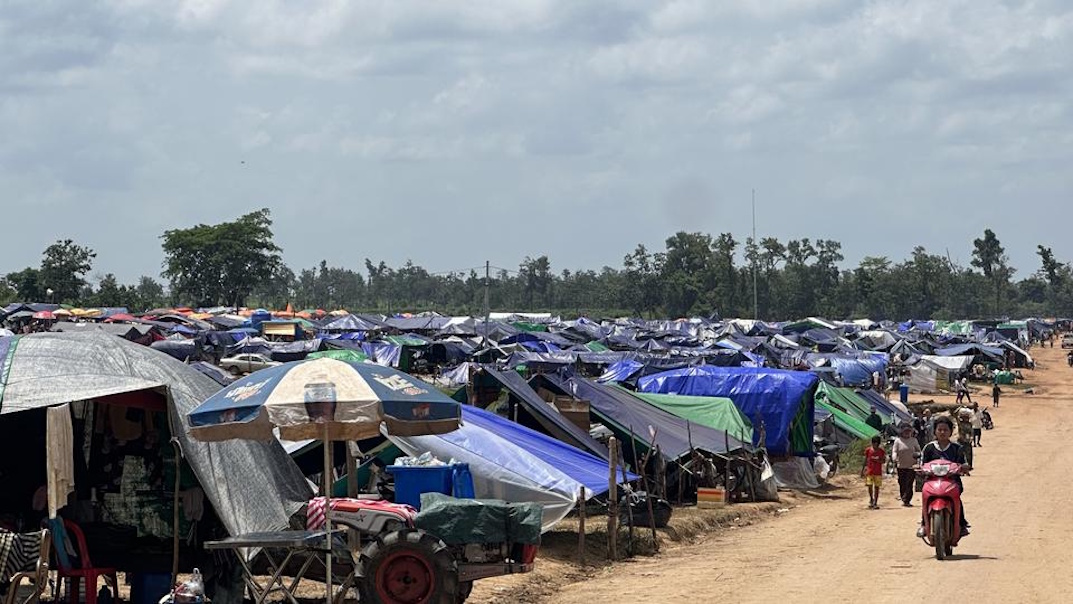
More than half a million civilians have been displaced on both sides of the volatile Cambodia-Thailand border, officials from the two nations confirmed Wednesday, as a reignited territorial conflict escalated into the deadliest fighting since July. The total number of displaced—surpassing 500,000—has now exceeded the scale of the earlier crisis, signaling a dangerous new phase in the long-running dispute.
In Thailand, authorities reported a massive evacuation effort. “We have assessed an imminent threat to civilian safety, leading to the relocation of more than 400,000 people to secured shelters across seven provinces,” stated Thai Defense Ministry spokesperson Surasant Kongsiri. “Our priority is to avoid a repeat of the tragic civilian casualties suffered in July 2025.”
Cambodian officials provided concurrent figures, with Defense Ministry spokeswoman Maly Socheata reporting that “101,229 people have been evacuated to safe shelters or relatives’ homes in five provinces” as of Tuesday evening. The combined official tally points to a rapid and severe humanitarian crisis unfolding along the 800-kilometer (500-mile) frontier.
Roots of the Conflict and Expanding Frontlines
The core of the conflict lies in competing claims over stretches of border originally demarcated during the French colonial era, with particular tension surrounding the sovereignty of several ancient temple sites. These historical disputes have repeatedly spilled into armed confrontation.
This week’s violence marks a significant escalation. According to an AFP tally of official accounts, clashes expanded sharply on Tuesday, spreading across five provinces in both Thailand and Cambodia. The fighting involves sustained artillery duels and reported incursions by ground forces, drawing in wider military assets than the previous skirmishes.
The current clashes are the most severe since a five-day bout of fighting in July 2025, which killed dozens of soldiers and displaced approximately 300,000 people. That earlier crisis was temporarily halted by a fragile truce brokered after direct intervention by U.S. President Donald Trump. The collapse of that ceasefire has deepened international concern.
Mutual Accusations and Humanitarian Peril
As in past confrontations, both governments accuse the other of instigating the renewed violence. Thai authorities claim Cambodian forces fired first into disputed zones, while Cambodia alleges repeated Thai violations of its sovereignty.
The human cost is mounting rapidly. Aid agencies on the ground report overcrowded and under-resourced shelters, with urgent needs for food, clean water, medical supplies, and sanitation facilities. “The speed and scale of this displacement is overwhelming local capacity,” said a representative from the Thai Red Cross, speaking on condition of anonymity. “We are particularly worried about the elderly, children, and those with chronic illnesses.”
The conflict also threatens regional stability and economic corridors. Key border trade points, vital to both nations’ economies, have been shuttered, disrupting supply chains and local livelihoods.
International Reaction and Calls for Restraint
The international community has issued urgent calls for de-escalation. ASEAN chair Vietnam stated it is “monitoring the situation with grave concern” and offered to facilitate dialogue. The United Nations Secretary-General has appealed for an immediate ceasefire and full humanitarian access, while the United States and China—both with significant influence in the region—are reportedly engaging in behind-the-scenes diplomacy.
Analysts warn that the failure of the previous truce and the expanded geographical scope of the fighting indicate a conflict that is becoming increasingly entrenched. “There is a palpable risk of a prolonged stalemate,” said Dr. Linh Pham, a Southeast Asia security analyst at the Institute for Strategic Studies. “Without a credible, third-party mediated process to address the root border issues, we are likely to see a cycle of ceasefires and violent flare-ups continuing indefinitely, with civilians paying the highest price.”
As artillery fire continued to echo in border districts Wednesday evening, the primary focus remains on the safety of the displaced hundreds of thousands, whose return home appears contingent on a diplomacy that has, so far, proved elusive.
Our Pashto-Dari Website


Support Dawat Media Center
If there were ever a time to join us, it is now. Every contribution, however big or small, powers our journalism and sustains our future. Support the Dawat Media Center from as little as $/€10 – it only takes a minute. If you can, please consider supporting us with a regular amount each month. Thank you
DNB Bank AC # 0530 2294668
Account for international payments: NO15 0530 2294 668
Vipps: #557320

Comments are closed.