

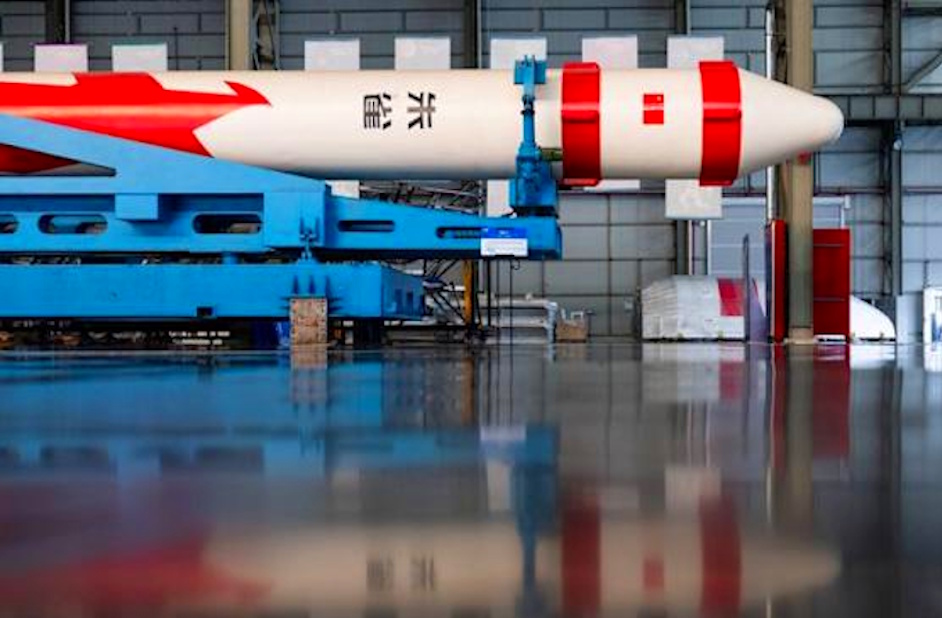
China’s private aerospace company LandSpace is positioning itself as a potential challenger to SpaceX in the rapidly evolving global market for reusable rockets, a sector that is transforming the economics of satellite launches and space access. The company’s efforts reflect Beijing’s broader push to expand commercial space capabilities and support the deployment of massive satellite constellations in the coming decades.
Earlier this month, Beijing-based LandSpace conducted the maiden flight of its Zhuque-3 reusable launch vehicle, marking the first attempt by a Chinese private firm to test a reusable orbital-class rocket. Although the test flight ended in failure during the landing phase, the launch itself represented a significant technological milestone for China’s commercial space sector.
According to Zhuque-3’s chief designer, Dai Zheng, LandSpace aims to provide a low-cost launch service comparable to SpaceX’s Falcon 9, which has reshaped the global launch market through reusability and high launch frequency. LandSpace’s long-term vision aligns with China’s plans to deploy as many as 10,000 satellites for communications, navigation, and Earth observation, a goal that will require frequent and affordable launch services.
To support these ambitions, LandSpace has opened its rocket engine manufacturing facilities to the media, signaling growing confidence in its technology and operations. The company is also preparing for new fundraising rounds and a potential initial public offering (IPO), seeking capital to accelerate development and scale production. Company executives have openly acknowledged learning from SpaceX’s trajectory, particularly its willingness to accept early failures as part of rapid technological iteration.
SpaceX founder Elon Musk has publicly commented on the Zhuque-3 design, noting that it appears to combine elements of SpaceX’s Starship program with the overall architecture of the Falcon 9. While Musk emphasized that Starship remains in a class of its own, his remarks highlighted the extent to which SpaceX’s designs have become a global reference point for reusable launch systems.
Despite the unsuccessful landing attempt, LandSpace remains confident and is planning another test launch in the near future. Company officials point to SpaceX’s own early struggles, noting that Falcon 9 achieved its first successful booster landing only after two failed attempts. This comparison underscores a broader shift in mindset within China’s private space industry, where failure is increasingly viewed as a learning opportunity rather than a setback.
China’s commercial space sector has expanded rapidly since regulatory reforms in 2014 allowed private capital to enter the launch industry. Startups such as LandSpace and iSpace are now challenging traditional state-owned aerospace enterprises, introducing greater competition, faster development cycles, and a culture of innovation and risk-taking in a field long dominated by cautious, government-led programs.
On a global scale, reusable rockets are reshaping satellite deployment by dramatically lowering launch costs and increasing mission flexibility. These advances benefit not only governments but also commercial operators involved in telecommunications, broadband internet, and Earth observation, intensifying competition among launch providers worldwide.
Analysts argue that LandSpace’s persistence in the face of early technical failures reflects a deeper transformation in China’s innovation ecosystem. If the company can successfully master reusable launch technology and secure sustained access to capital markets, it could emerge as a key pillar of China’s commercial space ambitions and a more visible player in the international satellite launch market.
Ultimately, observers note that LandSpace’s ability to learn quickly from early setbacks—combined with financial backing and regulatory support—will be critical in determining whether it can narrow the gap with SpaceX and compete effectively with other established and emerging aerospace firms.
Our Pashto-Dari Website


Support Dawat Media Center
If there were ever a time to join us, it is now. Every contribution, however big or small, powers our journalism and sustains our future. Support the Dawat Media Center from as little as $/€10 – it only takes a minute. If you can, please consider supporting us with a regular amount each month. Thank you
DNB Bank AC # 0530 2294668
Account for international payments: NO15 0530 2294 668
Vipps: #557320

Comments are closed.