

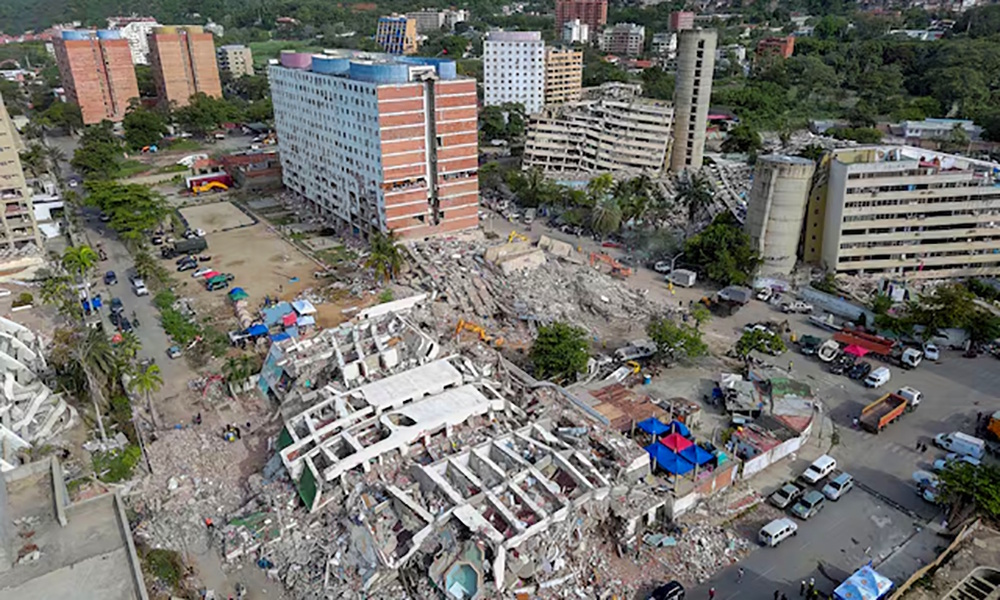
The death toll from the twin earthquakes that struck Venezuela on June 24 has climbed to 4,333, according to National Assembly President Jorge Rodriguez, who addressed reporters on Saturday. In the same briefing, Rodriguez announced that the distribution of emergency housing to displaced families will commence next week, as reported by Reuters. Of the confirmed fatalities, 315 victims remain unidentified, and officials are working with forensic teams to expedite DNA testing and cross-reference missing-person reports.
The official count of injured individuals stands at 16,740, a figure that has remained unchanged since the previous update. Rescue teams have successfully pulled 6,462 survivors from the rubble, while an estimated 17,000 people have been rendered homeless, many of whom are currently sheltering in temporary camps, schools, and community centers across the hardest-hit regions.
Rodriguez confirmed that acting President Delcy Rodriguez will oversee the initial allocation of 200 housing units to affected families beginning next week. However, he offered no further specifics regarding the location, size, or eligibility criteria for these homes, leaving many questions unanswered about the long-term resettlement strategy.
The earthquake’s destructive force left 856 buildings damaged, according to Rodriguez, with 190 structures suffering either total collapse or severe structural failure. Engineers and urban search-and-rescue specialists continue to assess the stability of partially damaged buildings, as aftershocks remain a persistent concern.
Preliminary government assessments indicate that at least 25,000 new homes will be required to accommodate all displaced residents. In response, authorities have identified approximately 40 plots of land, covering a combined area of roughly 584,000 square meters, for future housing developments in the coastal towns of Osma and Chuspa. Environmental and geological surveys are reportedly underway to ensure the selected sites are safe for reconstruction.
Despite the mounting challenges, Rodriguez emphasized that search-and-rescue operations are far from over. “As long as there is life, there is hope,” he told journalists. “We still have one or two active sites where the situation remains uncertain—locations where we continue to search for survivors.” He added that international rescue teams and sniffer dogs are still deployed at these sites, working around the clock in the hope of finding additional survivors, even as the window for rescue narrows with each passing day.
Our Pashto-Dari Website

Support Dawat Media Center
If there were ever a time to join us, it is now. Every contribution, however big or small, powers our journalism and sustains our future. Support the Dawat Media Center from as little as $/€10 – it only takes a minute. If you can, please consider supporting us with a regular amount each month. Thank you
DNB Bank AC # 0530 2294668
Account for international payments: NO15 0530 2294 668
Vipps: #557320

Comments are closed.