
India Rejects Pakistan’s “Baseless” Claims of Indian Hand in Balochistan Attacks; Advises Focus on “Internal Failings” Rejects Pakistan’s “Baseless” Claims of Indian Hand in Balochistan Attacks

India Rejects Pakistan’s “Baseless” Claims of Indian Hand in Balochistan Attacks; Advises Focus on “Internal Failings”
New Delhi, February 2, 2026: In a sharp diplomatic rebuttal, India has categorically rejected Pakistan’s allegations of Indian involvement in the recent wave of deadly insurgent attacks in Balochistan. The Ministry of External Affairs (MEA) dismissed the claims as a “baseless” attempt by Islamabad to deflect attention from its own governance failures in the restive province.
The strong response from New Delhi came after senior Pakistani officials, including Interior Minister Mohsin Naqvi and the country’s military, alleged that the attackers responsible for the coordinated violence had received support from India.
“We have seen the statements. India categorically rejects these baseless allegations. Such accusations are nothing but Pakistan’s habitual, desperate tactics to externalize blame and divert international attention from its own serious internal failings and the legitimate grievances of the people of Balochistan,” stated MEA spokesperson Randhir Jaiswal.
Jaiswal further advised Pakistan to look inward. “Instead of parroting frivolous claims each time there is a violent incident, it would do better to focus on addressing the long-standing political, economic, and social demands of its own people in the region. Pakistan’s well-documented record of suppression, brutality, and systemic human rights violations in Balochistan is the core issue,” he added.
Deadly Flare-up in Balochistan
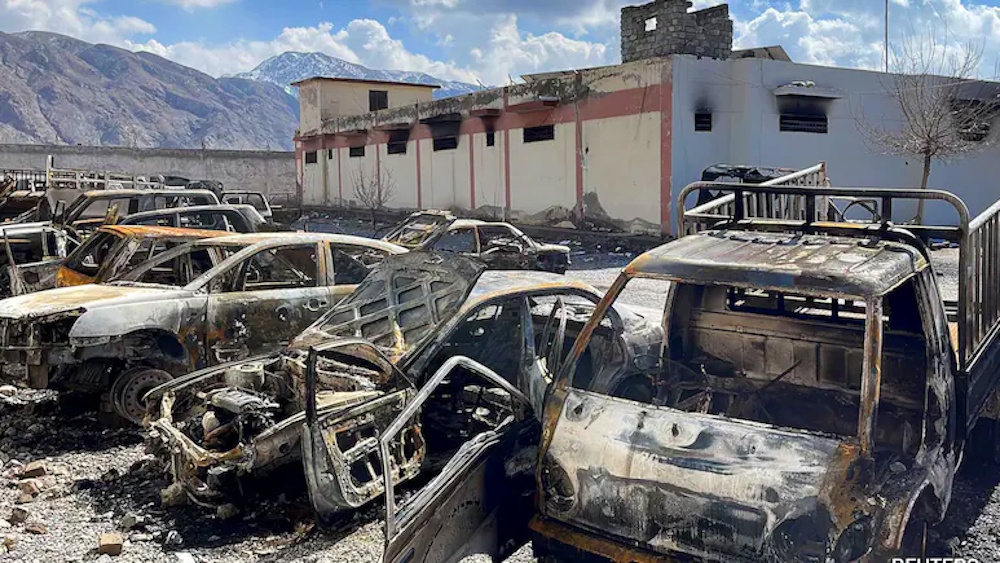
The diplomatic exchange follows one of the deadliest flare-ups in years in Pakistan’s southwestern province. Over the weekend, a series of coordinated insurgent assaults targeted security installations, civilians, and infrastructure across multiple districts, including Quetta, Gwadar, Mastung, and Noshki.
According to Pakistani officials, attackers disguised as civilians entered hospitals, schools, banks, and markets, opening fire indiscriminately and, in some cases, using civilians as human shields. The attacks prompted large-scale counter-operations by the army, police, and counterterrorism units.
Balochistan’s Chief Minister, Sarfraz Bugti, reported that at least 48 people were killed, including 17 security personnel and 31 civilians. Pakistan’s military stated that 133 separatist fighters were killed in the ensuing clashes on Friday and Saturday—a figure described by Bugti as the highest in such a short span since the insurgency intensified.
Defence Minister Khawaja Asif noted a disturbing trend, revealing that two of the attacks involved female perpetrators and that insurgents were increasingly targeting civilians, labourers, and low-income communities.
Separatist Group Claims “Operation Herof”
The Baloch Liberation Army (BLA), a major separatist group, claimed responsibility for the coordinated offensive, which it dubbed “Operation Herof” or “Black Storm.” The group claimed to have killed 84 Pakistani security force members and captured 18, though these claims could not be independently verified by NDTV.
A Decades-Long Conflict
The violence underscores the persistent instability in Balochistan, Pakistan’s largest yet poorest province, rich in natural resources like gas and minerals. The region has been gripped by a decades-long insurgency led by ethnic Baloch separatists who demand greater political autonomy and a larger share of the province’s resource wealth. They accuse the central government in Islamabad and the Punjabi-dominated establishment of economic exploitation and political marginalization.
India’s statement directly references these long-standing local grievances, framing the conflict as a internal Pakistani issue stemming from its failure to address Baloch concerns, rather than a matter of foreign interference. The exchange marks yet another moment of heightened tension between the two nuclear-armed neighbours, whose relationship remains fraught over issues of terrorism, Kashmir, and regional influence.
Our Pashto-Dari Website

Support Dawat Media Center
If there were ever a time to join us, it is now. Every contribution, however big or small, powers our journalism and sustains our future. Support the Dawat Media Center from as little as $/€10 – it only takes a minute. If you can, please consider supporting us with a regular amount each month. Thank you
DNB Bank AC # 0530 2294668
Account for international payments: NO15 0530 2294 668
Vipps: #557320

Comments are closed.