
Egypt Unveils Two Major Archaeological Treasures: A Lost Byzantine City and Ancient Tombs on the Mediterranean

In a double announcement that has captivated historians and travelers alike, Egypt’s Ministry of Tourism and Antiquities revealed on Saturday the discovery of a remarkably well-preserved Byzantine-era residential city in the Western Desert, alongside a cluster of ancient tombs near the Mediterranean coast. The findings are the latest in a series of high-profile archaeological successes as Cairo intensifies efforts to rejuvenate its tourism industry a critical pillar of the national economy.
The discoveries come at a pivotal moment for Egypt, which has seen a steady rebound in visitor numbers after years of pandemic-related disruption and political instability. With tourism and the Suez Canal serving as the country’s primary sources of foreign currency, each new archaeological revelation is wielded not only as a scientific triumph but also as a strategic tool to lure global travelers back to its sun-scorched temples and museums.
A Byzantine Metropolis in the Sands of Dakhla Oasis
The first and most striking find lies deep within the Dakhla Oasis, part of Egypt’s vast New Valley Governorate in the Western Desert. According to the ministry, the site offers an unprecedented snapshot of urban life in the 4th century CE, when Egypt was a prosperous province of the Byzantine Empire. Unlike many desert ruins that have been reduced to rubble, this settlement remains strikingly intact, with streets, public squares, and domestic structures still clearly legible in the sand.
Hisham el-Leithy, Secretary-General of the Supreme Council of Antiquities, described a sophisticated urban grid: north-south thoroughfares intersected by east-west streets, creating a formal layout of open plazas and neighborhood blocks. At the heart of the city stands a basilica church dating to the mid-4th century—one of the earliest Christian places of worship found in the region which would have dominated the skyline and overseen the main commercial arteries. Flanking the settlement’s perimeter are the remnants of two watchtowers, suggesting a community mindful of both defense and territorial control.
Mahmoud Massoud, head of the archaeological mission, noted that the city was heavily fortified with thick defensive walls, a testament to the precarious nature of desert life during late antiquity. Within those walls, archaeologists have uncovered a variety of residential compounds, including houses with vaulted roofs and formal reception halls indicative of a stratified society with distinct domestic and civic architecture.
One of the most evocative discoveries is the so-called “House of Tisous,” identified as the residence of a church deacon and dated to the second half of the 4th century. Researchers believe this dwelling initially served as a house church a clandestine or semi-private place of worship before the construction of the larger basilica, offering rare insight into the spread of early Christianity in rural Egypt.
Daily life in this desert city was vividly illuminated by the excavation of bread ovens, communal kitchens, and limestone grinding tools, pointing to a localized food-production economy. But it is the numismatic and epigraphic finds that have truly excited scholars. The team recovered a trove of well-preserved bronze coins bearing the portraits of Byzantine emperors, Latin inscriptions, and Christian symbols. Alongside these were a cluster of gold coins from the reign of Roman Emperor Constantius II (r. 337–361 CE), a ruler known for his complex religious policies during the transition from paganism to Christianity.
Perhaps most tantalizing are the roughly 200 pottery shards, or ostraca, unearthed at the site. According to Diaa Zahran, head of the Islamic, Coptic, and Jewish Antiquities Department, these fragments were used as inexpensive writing material and are inscribed with Greek and Coptic texts detailing commercial transactions, personal correspondence, and administrative records. They promise to yield a rich documentary archive of everyday economic and social life—a kind of ancient ledger of the desert’s lost city.
The Dakhla Oasis has long been recognized for its archaeological significance and is already on UNESCO’s Tentative List, a preliminary step toward full World Heritage status. This new discovery only strengthens its case for international protection and recognition.
Tombs of the Golden Tongue at Marina el-Alamein
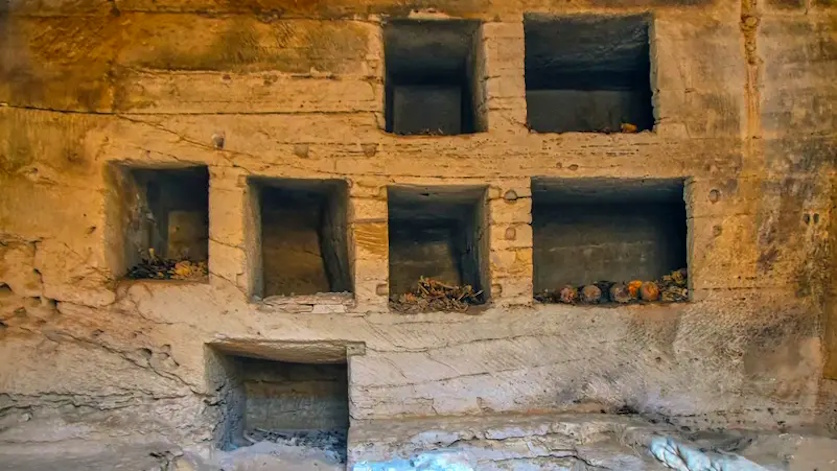
Separately, on the opposite side of the country, a team working at the Marina el-Alamein archaeological site roughly 100 kilometers (62 miles) west of Alexandria has uncovered 18 additional tombs, bringing the total number of known burials at the site to 48. The newly found graves include 11 rock-cut tombs, some plunging to depths of 8 meters, and seven surface structures built from limestone masonry.
The site, first unearthed in 1986, is widely believed to be the ancient Greco-Roman port city of Leukaspis, which flourished from the 2nd century CE until its decline in the 4th century. Positioned on Egypt’s northern coast, it served as a maritime gateway between Alexandria and the wider Mediterranean world.
Among the most spectacular finds is a 2.5-meter-long granite sarcophagus, still containing skeletal remains that are currently undergoing osteological analysis. Close to the sarcophagus, excavators discovered the fragmented remains of a plaster sphinx statue an emblematic fusion of Egyptian and Hellenistic artistic traditions that underscores the cultural syncretism of the era.
But the discovery that has captured the popular imagination is the presence of four small gold foil pieces, each placed inside the mouths of certain deceased individuals. This funerary practice, often colloquially referred to as the “golden tongue,” was intended to ensure that the dead could speak eloquently in the afterlife—a belief rooted in both Egyptian and Greco-Roman mortuary traditions. Such amulets are rare and highly evocative, suggesting that the buried individuals held significant social or religious status.
Alongside these human remains, the mission led by Eman Abdel-Khaliq recovered a wealth of grave goods, including pottery vessels, amphorae for storing wine or oil, lamps, plates, altars, and limestone basins, all of which paint a picture of a prosperous port community with robust trade connections.
Tourism on the Rise
The Egyptian government has been quick to highlight these discoveries as part of a broader narrative of cultural rediscovery. After a decade of political upheaval and the crippling effects of the COVID-19 pandemic, the country’s tourism sector is finally regaining momentum. Official figures show that a record 19 million tourists visited Egypt in 2025 a 21% increase over the previous year and the first four months of 2026 have already welcomed 6.1 million visitors, up from 5.7 million during the same period in 2025.
With major projects like the Grand Egyptian Museum gradually opening its doors and new finds being announced with increasing frequency, Egypt is betting that its ancient heritage can once again become a modern engine of prosperity. For now, the sands of the Western Desert and the shores of the Mediterranean continue to yield secrets that bridge the gap between empire and everyday life and between a turbulent past and an optimistic future.
Our Pashto-Dari Website

Support Dawat Media Center
If there were ever a time to join us, it is now. Every contribution, however big or small, powers our journalism and sustains our future. Support the Dawat Media Center from as little as $/€10 – it only takes a minute. If you can, please consider supporting us with a regular amount each month. Thank you
DNB Bank AC # 0530 2294668
Account for international payments: NO15 0530 2294 668
Vipps: #557320

Comments are closed.