
Ukrainian Drone Barrage Kills 7, Wounds Dozens in Overnight Strikes Deep Inside Russia

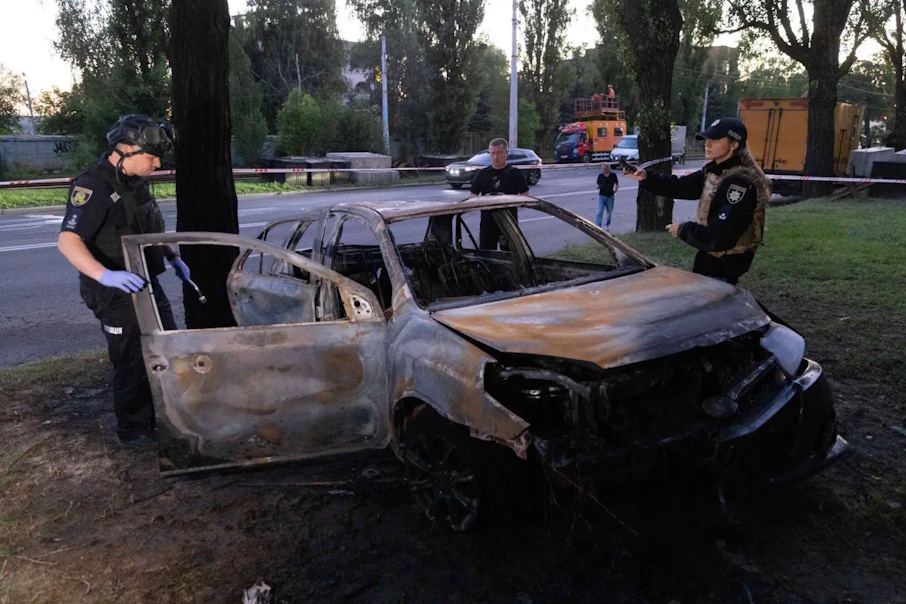
A massive wave of Ukrainian drone strikes across multiple Russian regions killed at least seven people and wounded 51 others overnight into Saturday, Russian officials reported, marking one of the most extensive cross-border aerial assaults since the war entered its fifth year. The attacks targeted not only military-logistical hubs but also commercial infrastructure and energy facilities, signaling Kyiv’s determination to project power far beyond the front lines and bring the reality of prolonged conflict closer to Russia’s civilian and economic heartland.
The deadliest strike occurred in the Tambov region, some 360 kilometers (about 220 miles) from Ukraine’s border, where two sprawling warehouses belonging to Wildberries Russia’s largest online retailer were hit. In the town of Kotovsk, seven night-shift employees were killed and 25 others injured, according to Tambov regional governor Yevgeny Pervyshov. The second warehouse, located in the city of Elektrostal just 50 kilometers (roughly 30 miles) east of Moscow saw 24 people wounded, Moscow region governor Andrei Vorobyov confirmed. A further two people were injured in Noginsk, north of Elektrostal, where an oil depot caught fire after a drone strike, prompting the evacuation of a nearby maternity hospital and one residential building as a precautionary measure.
In a separate incident, the city of Vladimir approximately 180 kilometers (over 110 miles) east of the capital reported a drone hitting a residential building, igniting a brief fire. No casualties were recorded there, said governor Alexander Avdeyev, though the episode underscored the widening geographic scope of Ukraine’s campaign, which has increasingly penetrated areas previously considered safe from direct attack.
Ukrainian President Volodymyr Zelenskyy addressed the strikes in a Telegram post on Saturday, framing them as precise counter-logistics operations rather than indiscriminate terror. He stated that Ukrainian long-range drones had successfully struck “two significant logistical facilities in the Moscow and Tambov regions,” which he alleged were being used by Russian forces to store and distribute sanctioned components for drone production and navigation equipment items critical to sustaining Moscow’s offensive capabilities. Additionally, he confirmed that an oil facility was hit, though he did not specify its exact location. The Associated Press quoted him as saying that Ukrainian special operations forces also conducted coordinated strikes against targets in the Sea of Azov and in temporarily occupied territories, though further details were not immediately released.
The overnight assault represents a notable escalation in both scale and sophistication. According to Russia’s Ministry of Defense, air defense systems intercepted a staggering 379 Ukrainian drones across 19 Russian regions, as well as over the illegally annexed Crimean Peninsula, the Sea of Azov, and the Black Sea. If accurate, that figure would make this one of the largest single-wave drone offensives of the entire war, reflecting Ukraine’s growing domestic production capacity and its willingness to absorb high attrition rates in exchange for strategic disruption.
For Kyiv, these deep-strike missions serve multiple purposes: degrading Russian military logistics, hampering fuel supply chains, complicating Moscow’s air-defense resource allocation, and perhaps most crucially demonstrating to the Russian public that the war is not confined to occupied eastern and southern Ukraine. By hitting commercial warehouses tied to a major retailer like Wildberries, Ukraine also appears to be targeting nodes of economic normalcy, subtly amplifying domestic unease about the conflict’s sustainability. At the same time, Russia has consistently used such incidents to galvanize patriotic sentiment and frame Ukraine as a terrorist state, even as it struggles to shield its vast territory from an increasingly nimble adversary.
The human toll, while still relatively low compared to front-line casualties, carries outsized symbolic weight. The deaths of civilian warehouse workers far from the battlefield highlight the blurring lines between military and civilian infrastructure in modern drone warfare a trend that has drawn concern from international humanitarian groups, though neither side has shown willingness to de-escalate. In Kotovsk, local emergency services worked through the night to extinguish fires and search for survivors, while in Elektrostal, hospitals reported treating victims with shrapnel wounds and blast injuries, many of them in serious condition.
Moscow has yet to announce any retaliatory measures specifically linked to this attack, but past patterns suggest an intensification of missile and drone strikes on Ukrainian cities, particularly energy infrastructure, in the days ahead. Meanwhile, Ukraine continues to press its case for longer-range Western weapons, arguing that its own domestically produced drones while effective cannot fully replace the firepower needed to dismantle Russian supply networks at their deepest points.
As dawn broke over the affected regions, residents grappled with a grim new reality: no corner of Russia, not even the outskirts of Moscow, now feels entirely beyond the reach of Ukraine’s reach. For the Kremlin, the challenge is twofold bolstering air defenses across a sprawling territory while maintaining public morale in a war that shows no sign of abating. For Ukraine, the calculus is starker: every drone sent across the border is a reminder that, in its view, survival requires taking the fight to the aggressor’s doorstep, no matter the cost.
Our Pashto-Dari Website

Support Dawat Media Center
If there were ever a time to join us, it is now. Every contribution, however big or small, powers our journalism and sustains our future. Support the Dawat Media Center from as little as $/€10 – it only takes a minute. If you can, please consider supporting us with a regular amount each month. Thank you
DNB Bank AC # 0530 2294668
Account for international payments: NO15 0530 2294 668
Vipps: #557320

Comments are closed.