

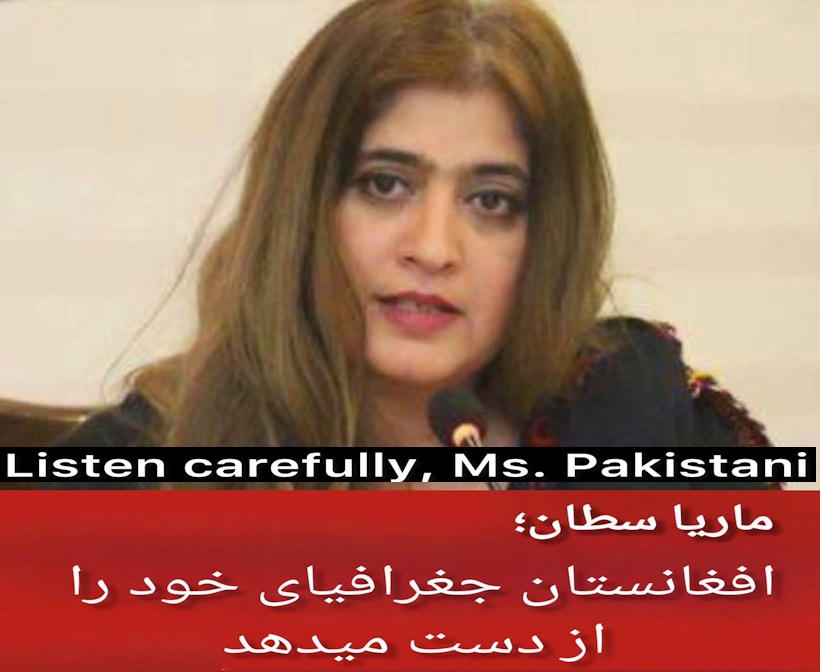
Ms. Pakistani,
Before you speak about Afghanistan, it would be better for you to first look, in the mirror of reality, at the country you yourself come from.
A country that was not founded on history, identity, or civilization, but on a political engineering project drawn up in the offices of the British Colonial Ministry.
A country that, from the very first day, was defined not on the basis of a nation, but on the basis of the needs of an empire.
This bitter truth may be heavy for you, but reality cannot be covered with slogans.
To compare Afghanistan with such a decayed, rotten and shaky structure (Pakistan) is not only a mistake, it is a form of historical ignorance.
Afghanistan is a land with 5,000 years of continuous history, a land over which empires have passed, yet the land itself has remained.
Afghanistan had built civilization, created culture, and written history long before many of today’s states even had a name.
This land has been built with blood, with resistance, and with identity.
In contrast, the country you are defending (Pakistan) is today passing through one of the most critical and turbulent phases of its history:
an economic crisis, a crisis of political legitimacy, a security crisis, an identity crisis, an ethnic and communal crisis, and a profound crisis of public trust.
These are not personal opinions; they are reflected in official global reports.
A country that, after seven decades, still has not been able to define what a “nation” is, what “identity” is, and on what basis its “borders” rest, would do well to clarify its own situation before speaking about others.
Ms. Pakistani,
you need not worry about Afghanistan.
Afghanistan has passed through trials such that, if even one hundredth of them had fallen upon your British‑made state, nothing of it would remain today.
Afghanistan has endured the invasions of Alexander, the Mongols, the British Empire, and the storms of proxy wars, and yet it still stands.
Because Afghanistan was made by history, not by colonialism.
But your country, which is the direct product of the policy of “divide and rule,” now faces fundamental questions:
Can it survive without foreign aid?
If Washington and London stop paying the salaries and rations of your ruthless and violent army, do you know what will happen?
Can it manage its internal crises?
Can it build a shared, cohesive identity?
Can it prevent economic collapse?
Can it resolve ethnic and sectarian tensions without violence?
These are questions that have no clear answer and that is precisely the sign of an artificial structure.
So, instead of prescribing remedies for Afghanistan, think about that very country which today is on the verge of economic, political, and social disintegration.
Afghanistan does not need your sympathy.
A land that has endured for five thousand years will not fall because of a single century of crisis.
But a country that is barely seventy‑five years old, and half of which is already in a state of collapse, should be worried about its own future, not the future of others.
Afghanistan will remain because it has roots.
But countries without roots, sooner or later, return to dust.
Once again, let me emphasize:
Ms. Pakistani,
your main problem is not that you do not know Afghanistan; your problem is that you do not even know the reality of your own country.
A state that, after seven decades, has still failed to forge a common identity now dares to prescribe solutions for a country with five thousand years of history.
This is precisely the point at which one does not know whether to laugh or to feel pity.
You speak from a country that trembles from within almost every decade not because of an external enemy, but because of its internal contradictions, its artificial structures, and its unresolved historical crises.
A country that still does not know what “nation” is, what “border” is, and on what foundation its “identity” stands, should, before speaking of my ancient homeland Afghanistan, look carefully at its own rotten and decaying roots.
Afghanistan does not need your advice.
A land that has passed through Alexander, Genghis Khan, Tamerlane, British colonialism, the Soviet Union, NATO, the United States, and proxy wars, and still stands, will not be shaken by a few shallow and trivial sentences from you.
Afghanistan was made by history, not by colonialism.
Afghanistan was built by its people, not by the desks of colonial ministries.
But (British‑made) Pakistan your country which is the direct product of the policy of “divide and rule,” now stands in a position where any impartial analyst places it among the states destined for inevitable collapse.
Collapse is the inescapable fate of your state.
This bitter reality may be heavy for you, but truth is always heavy.
So, before you speak about Afghanistan, think of that country which today is wrestling with economic crisis, a crisis of legitimacy, a security crisis, an ethnic crisis, and an identity crisis.
A state that does not know what its tomorrow will look like has no right to speak about a country that has five thousand years of yesterday and ten thousand years of tomorrow.
Afghanistan will remain because it has roots.
But artificial structures, sooner or later, will crumble.
Our Pashto-Dari Website

Support Dawat Media Center
If there were ever a time to join us, it is now. Every contribution, however big or small, powers our journalism and sustains our future. Support the Dawat Media Center from as little as $/€10 – it only takes a minute. If you can, please consider supporting us with a regular amount each month. Thank you
DNB Bank AC # 0530 2294668
Account for international payments: NO15 0530 2294 668
Vipps: #557320

Comments are closed.