

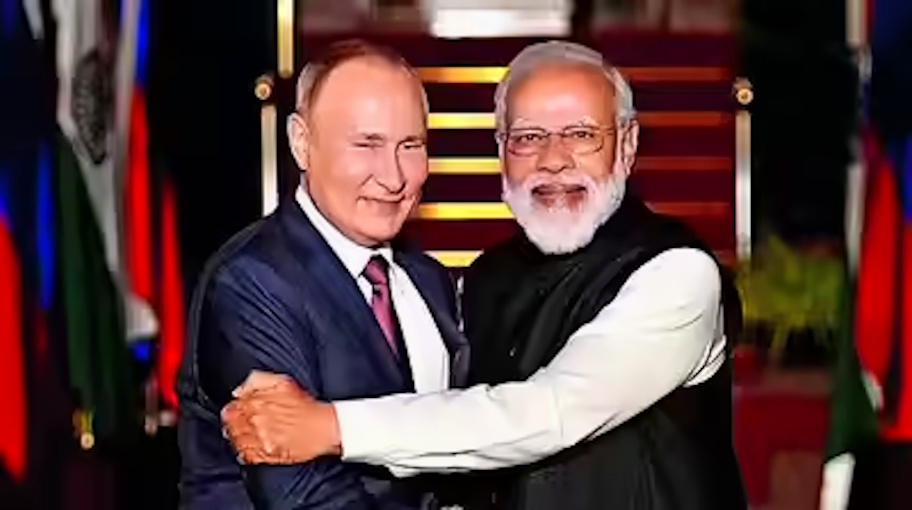
NEW DELHI — Russian President Vladimir Putin arrived in India on Thursday for his first visit since launching the full-scale invasion of Ukraine in 2022, a high-stakes diplomatic mission aimed at reinforcing a critical partnership as both nations navigate escalating pressure from the United States.
The two-day visit, centered on an annual summit with Indian Prime Minister Narendra Modi, underscores the resilience and complexity of the Russia-India relationship. While Western sanctions have isolated Moscow, its ties with New Delhi—a key U.S. strategic partner in the Indo-Pacific—remain a geopolitical cornerstone for the Kremlin.
Agenda: Defense, Trade, and Geopolitical Signaling
Putin, traveling with a high-level delegation including new Defense Minister Andrei Belousov, is scheduled for a private dinner with Modi on Thursday, followed by formal summit talks and business engagements on Friday.
Kremlin spokesman Dmitry Peskov confirmed that military cooperation will be central, specifically citing Russia’s S-400 Triumf air defense systems. India has received three of the five units ordered in a $5.4 billion deal, with final deliveries delayed by sanctions and war-related supply chain issues. The two sides are expected to discuss timelines for completing the contract.
Media reports and analysts suggest the summit may also revive a long-delayed deal for additional Sukhoi Su-30MKI fighter jets and potentially advance discussions on the joint production of Russia’s fifth-generation Su-57 fighter in India. Despite India’s push for domestic manufacturing and diversification toward Western and Israeli suppliers, Russia remains the primary source for spare parts and maintenance for its extensive, Soviet-era military inventory.
“The defense relationship is symbiotic at this stage,” said Sameer Patil, Senior Fellow at the Observer Research Foundation in Mumbai. “India needs assured spares and upgrades, while Russia needs to retain its largest export market and demonstrate it is not a pariah state.”
The Shadow of Washington
The visit occurs amidst acute friction between India and the United States. Just days ago, the Trump administration imposed sweeping 50% tariffs on most Indian exports, citing India’s continued purchases of discounted Russian crude as indirect support for Moscow’s war effort.
Since 2022, India has become a top buyer of Russian oil, saving billions and refining it for both domestic use and export. However, recent U.S. secondary sanctions targeting Russian shipping and insurers have forced Indian refiners to scale back purchases, creating a delicate balancing act for New Delhi.
Indian officials privately express concern that major new announcements with Moscow could trigger further U.S. retaliation, potentially disrupting ongoing trade negotiations. Peskov, in remarks to Indian media, dismissed these worries: “What matters to us is maintaining and increasing our business with India without interference.”
An Asymmetric Economic Partnership
Bilateral trade has soared to a record $68.7 billion in 2024-25, a nearly six-fold increase from pre-pandemic levels. However, this balance is heavily skewed: Indian exports account for less than $5 billion, dominated by agricultural products and pharmaceuticals. The vast majority comprises Russian oil, coal, and fertilizer.
Indian diplomats have been pressing Moscow to address this imbalance by opening markets for Indian pharmaceuticals, automobiles, IT services, and agricultural goods. Progress on a Free Trade Agreement with the Eurasian Economic Union is also on the agenda, though moving slowly.
“The trade relationship is unsustainable in its current form,” said Nandan Unnikrishnan, a Russia expert at the Observer Research Foundation in New Delhi. “India will seek concrete mechanisms to reduce the deficit, but the strategic imperative of the relationship will ultimately prevail.”
A Message of Strategic Autonomy
Analysts view the summit as a powerful symbol for both leaders. For Modi, hosting Putin reinforces India’s longstanding principle of “strategic autonomy” and independent foreign policy, even as it deepens ties with the U.S.-led Quad grouping.
For Putin, who now travels rarely, the trip to a major non-Western power signals diplomatic reach and the failure of efforts to fully isolate Russia. The leaders are also expected to align positions on multilateral forums like the BRICS grouping and the Shanghai Cooperation Organisation.
“For India, the optics underscore a commitment to a multi-polar world order,” said Harsh V. Pant, a professor of international relations at King’s College London. “For Putin, this is a showcase visit to demonstrate that Russia retains influential friends and remains a pivotal actor in Asia.”
A senior Indian Foreign Ministry official, speaking on condition of anonymity, framed the meeting as routine. “This is among the most stable relationships in modern times,” the official said. “View it in its bilateral context—as two old friends taking stock of a steady partnership.”
The outcomes of the summit will be closely scrutinized in Washington and European capitals, testing the limits of India’s multi-alignment diplomacy and the durability of the Russia-India partnership in an increasingly polarized world.
Our Pashto-Dari Website

Support Dawat Media Center
If there were ever a time to join us, it is now. Every contribution, however big or small, powers our journalism and sustains our future. Support the Dawat Media Center from as little as $/€10 – it only takes a minute. If you can, please consider supporting us with a regular amount each month. Thank you
DNB Bank AC # 0530 2294668
Account for international payments: NO15 0530 2294 668
Vipps: #557320

Comments are closed.