

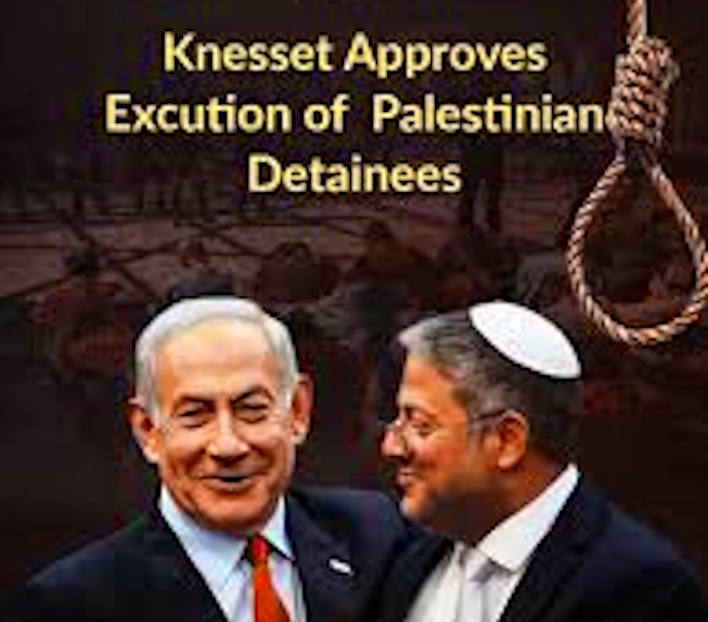
Human rights organisations, Palestinian leaders, and international officials have strongly condemned Israel’s approval of a new law enabling the use of the death penalty against Palestinians convicted of deadly attacks, warning that the measure violates international law and risks further inflaming tensions.
The legislation, passed on Monday by Israel’s parliament, the Knesset, establishes execution by hanging as the default punishment for Palestinians in the occupied West Bank found guilty of killing Israelis. Critics say the law is unprecedented in its explicit targeting of one population group and could pave the way for broader use of capital punishment.
The bill was championed by far-right National Security Minister Itamar Ben-Gvir, who celebrated its passage in parliament. In a defiant social media post, he dismissed international criticism, declaring: “We made history… We are not afraid, we will not submit.”
The move comes amid heightened violence in the occupied West Bank, including intensified Israeli military operations, increased settler attacks, and mass arrests. It also unfolds against the backdrop of Israel’s ongoing war in Gaza, which has drawn widespread international scrutiny. The Association for Civil Rights in Israel has already filed an appeal with Israel’s Supreme Court, arguing the law is unconstitutional and discriminatory.
Palestinian and regional responses
The Palestinian Ministry of Foreign Affairs described the law as a “dangerous escalation,” stressing that Israel has no legal sovereignty over occupied Palestinian territory. In a statement, it accused Israel of attempting to legitimise extrajudicial killings “under legislative cover.”
The group Hamas called the measure a “dangerous precedent” that threatens Palestinian prisoners and reflects what it described as Israel’s disregard for international humanitarian norms. It urged intervention from bodies such as the United Nations and the International Committee of the Red Cross.
Prominent Palestinian politician Mustafa Barghouti warned that the law could be used to target political prisoners and activists, describing it as evidence of a “fascist shift” within Israel’s political system.
The Palestinian Centre for Human Rights said the law entrenches what it called a longstanding policy of extrajudicial execution, warning that international inaction risks further eroding the global rules-based order.
International condemnation
The UN Human Rights Office urged Israel to repeal the legislation immediately, reiterating the UN’s opposition to the death penalty “under all circumstances.” It warned that the law could amount to cruel, inhuman, or degrading punishment and deepen what it described as discriminatory legal practices.
Amnesty International issued one of the strongest rebukes, calling the law “a public display of cruelty, discrimination and utter contempt for human rights.” Senior official Erika Guevara-Rosas argued that the measure formalises a pattern of alleged unlawful killings and impunity.
From Europe, Alain Berset of the Council of Europe described the development as a “serious regression,” emphasising that capital punishment is incompatible with modern human rights standards particularly when applied in a discriminatory manner.
Irish Foreign Minister Helen McEntee echoed these concerns, stressing that the right to life is fundamental and urging Israel not to implement the law. Similarly, Italian Foreign Minister Antonio Tajani revealed that Italy, alongside Germany, France, and the United Kingdom, had pressed Israel to withdraw the bill, citing international commitments to a global moratorium on the death penalty.
Broader implications
Legal experts and rights advocates warn that the law could have far-reaching consequences, not only for Palestinian detainees but also for Israel’s international standing. Critics argue it risks deepening accusations of unequal legal treatment in the occupied territories and may invite further diplomatic pressure or legal challenges in international forums.
Supporters of the law, however, frame it as a necessary deterrent against attacks, reflecting a broader shift in Israeli domestic politics toward more hardline security measures.
As legal challenges proceed and international scrutiny intensifies, the future implementation of the law and its potential human and political consequences remains uncertain.
Our Pashto-Dari Website

Support Dawat Media Center
If there were ever a time to join us, it is now. Every contribution, however big or small, powers our journalism and sustains our future. Support the Dawat Media Center from as little as $/€10 – it only takes a minute. If you can, please consider supporting us with a regular amount each month. Thank you
DNB Bank AC # 0530 2294668
Account for international payments: NO15 0530 2294 668
Vipps: #557320

Comments are closed.