
Former Emir of Qatar Sheikh Hamad bin Khalifa Al Thani Dies at 74

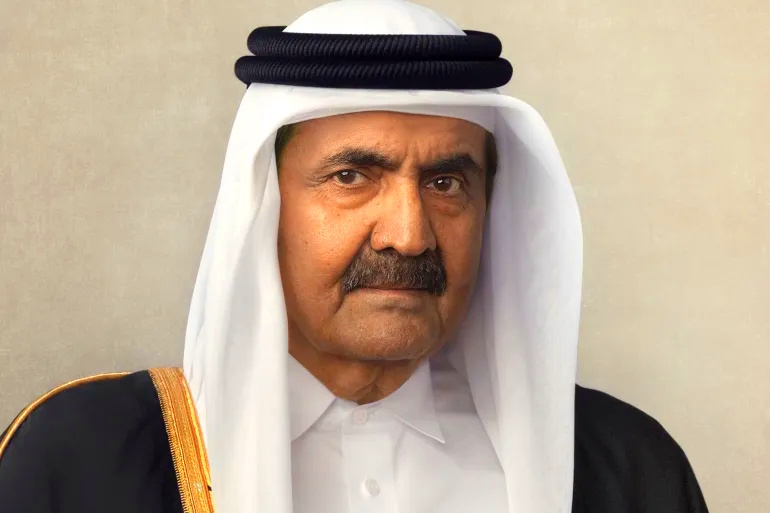
The Architect of Modern Qatar Passes Away, Leaving a Legacy of Transformation
DOHA, Qatar — Sheikh Hamad bin Khalifa Al Thani, the former Emir of Qatar who transformed the small Gulf nation into a global economic and diplomatic powerhouse, has died at the age of 74. The Amiri Diwan, Qatar’s royal court, announced his passing on Sunday, triggering an outpouring of grief across the country and tributes from world leaders.
“With hearts steadfast in faith in God’s decree and destiny, the Amiri Diwan mourns the great loss to the nation of the late may God have mercy on him His Highness the Father Amir Sheikh Hamad bin Khalifa Al Thani, who passed away this morning,” the official statement read.
The government declared a four-day period of public mourning beginning Monday, with work suspended at government agencies and public bodies. Flags across the country will be lowered to half-mast as the nation honors the man widely credited with orchestrating Qatar’s meteoric rise from a quiet pearl-diving backwater to one of the world’s wealthiest and most influential nations.
A Visionary Leader Who Reshaped a Nation
Sheikh Hamad, who ruled Qatar from 1995 to 2013, was the primary architect of the energy-rich country’s modern identity. During his 18-year reign, he orchestrated a remarkable transformation that touched every facet of Qatari life economic, social, cultural, and political while elevating the nation’s stature on the international stage.
When he assumed power on June 27, 1995, following a peaceful palace coup against his father, Sheikh Hamad inherited a country with modest ambitions and limited global recognition. By the time he voluntarily abdicated in favor of his son on June 25, 2013, Qatar had become a formidable regional player with global reach, its influence extending across North Africa, the Middle East, and Asia.
Economic Revolution: From Pearls to LNG Giant
Perhaps Sheikh Hamad’s most enduring legacy lies in the economic transformation he engineered. Recognizing the vast potential of Qatar’s North Field the world’s largest non-associated natural gas field he invested heavily in liquefied natural gas (LNG) infrastructure when many questioned the viability of such ambitious projects.
His bet paid off spectacularly. In 1996, Qatar began exporting LNG, with its first shipment bound for Japan. By 2006, the country had become the world’s largest LNG exporter, and by 2010, production capacity had reached 77 million tonnes per annum. Today, Qatar’s LNG exports represent approximately 20 percent of the global market.
The economic impact was staggering. Under Sheikh Hamad’s leadership, Qatar’s gross domestic product (GDP) grew more than 24-fold, transforming the small nation of nearly 2.5 million people into one of the highest per capita income countries in the world. In October 2001, he established the Supreme Council for Economic Affairs and Investment to diversify the economy, oversee foreign investments, and reduce dependence on hydrocarbon revenues a vision that has proven increasingly prescient.
Media Revolution: The Al Jazeera Phenomenon
Few decisions shaped Qatar’s global image more dramatically than Sheikh Hamad’s establishment of Al Jazeera Media Network in 1996. Just months after taking power, he abolished censorship of the local press, signaling a commitment to media freedom that would soon reverberate across the Arab world.
Al Jazeera’s launch heralded “a new dawn” in Arab and international media, according to the Amiri Diwan. The network quickly became known for its fearless coverage of controversial topics, its willingness to air dissenting viewpoints, and its ability to give voice to marginalized communities. The channel’s influence during the Arab Spring uprisings proved particularly significant, as its reporting brought global attention to protests across the Middle East and North Africa.
Today, Al Jazeera stands as one of the world’s most prominent and influential news organizations, its reach extending far beyond the Arab world a testament to Sheikh Hamad’s audacious vision.
Institutional and Democratic Reforms
Sheikh Hamad’s modernization agenda extended well beyond economic and media development. In March 1999, he introduced municipal elections that allowed women to vote and stand as candidates—a groundbreaking step in the conservative Gulf region. On June 8, 2004, he led Qatar to adopt its first permanent constitution, which established the foundations of democratic governance and guaranteed the rights and freedoms of citizens.
The same year, he launched the Qatar National Vision 2030, a comprehensive long-term strategy designed to transform the country into a knowledge-based economy and achieve sustainable development across education, healthcare, and infrastructure. The vision outlined ambitious goals for human development, social progress, economic diversification, and environmental sustainability.
In August 1995, Sheikh Hamad founded the Qatar Foundation for Education, Science and Community Development, which has since become a cornerstone of the country’s efforts to build a world-class education system and foster innovation. The foundation established Education City, a sprawling campus that hosts branch campuses of leading international universities and research institutions.
Diplomatic Powerhouse: Mediation and Global Influence
Under Sheikh Hamad’s leadership, Qatar developed an increasingly active and assertive foreign policy, positioning itself as a diplomatic mediator capable of engaging with conflicting parties that others would not touch. His vision transformed the small Gulf state into an indispensable diplomatic broker.
Qatar’s mediation efforts under his rule spanned numerous conflicts and crises:
-
The Hanish Islands dispute between Eritrea and Yemen in 1995
-
The Yemen war between 2007 and 2010
-
The Lebanese political crisis in 2008
-
The Darfur peace process between 2010 and 2011
-
The conflict in Sudan’s Darfur region
-
Lebanese factional feuding
-
The rift between Palestinian groups Hamas and Fatah
Perhaps his most consequential diplomatic initiative came when Qatar formally opened an office for the Taliban at the request of the United States. This decision set the stage for negotiations between Washington and the Afghan group that ultimately led to the US withdrawal from Afghanistan in 2021 a move that continues to shape the geopolitics of the region.
During the Arab Spring uprisings, Qatar aligned itself with popular movements demanding change. Sheikh Hamad initially attempted to persuade Syrian President Bashar al-Assad to step down in the face of mass protests, and Qatar ultimately severed ties with Damascus over the regime’s violent crackdown on demonstrators. In Libya, Qatar went further, supporting the NATO military mission that led to the overthrow of Muammer Gaddafi.
Champion of the Palestinian Cause
The cause closest to Sheikh Hamad’s heart was the Palestinian liberation struggle. His unwavering support for the Palestinian people distinguished him among Arab leaders and earned him deep respect throughout the region.
In October 2012, Sheikh Hamad became the first Arab leader to visit Gaza since Hamas assumed control of the territory in 2006. He arrived with 90 tonnes of humanitarian aid and pledged $400 million for housing and infrastructure projects. His embrace of Hamas’s leadership broke the isolation of the Palestinian movement, a gesture that dismayed Israel and its allies but resonated deeply with Palestinians.
The depth of his commitment is reflected in the naming of towns in both Gaza and southern Lebanon after Sheikh Hamad an enduring honor that testifies to his legacy in the region.
A Historic Abdication
On June 25, 2013, Sheikh Hamad made a decision that was virtually unprecedented among hereditary Gulf rulers: he voluntarily abdicated in favor of his son and heir apparent, Sheikh Tamim bin Hamad Al Thani, who was then 33 years old.
“The future lies ahead of you, the children of this homeland, as you usher into a new era where young leadership hoists the banner,” Sheikh Hamad said in his abdication address, articulating a vision of generational renewal that defied regional norms.
This peaceful, carefully crafted transfer of power served as a model for succession in the Gulf region and demonstrated Sheikh Hamad’s commitment to institutional governance and orderly transition.
His son, Sheikh Tamim, has since continued his father’s legacy, navigating the country through challenging regional dynamics—including a blockade by neighboring Gulf states from 2017 to 2021—while maintaining Qatar’s position as a regional power and global player.
Tributes Pour In
News of Sheikh Hamad’s passing prompted an immediate wave of condolences from world leaders, dignitaries, and citizens across the Arab world and beyond.
Abdulla Banndar el Etaibi, Assistant Professor in International Affairs at Qatar University, described Sheikh Hamad as someone who “left a legacy all over the world, not only on Qatar.”
“We’re talking about someone who turned Qatar from a normal country into a prominent and extraordinary country,” El Etaibi told Al Jazeera. “He had so many dreams of so many things. He invested a lot in LNG. This helped Qatar develop even more.”
Legacy: The Father Emir’s Enduring Impact
Sheikh Hamad bin Khalifa Al Thani’s passing marks the end of an era in Qatar’s modern history. His 18-year reign was characterized by audacious vision, bold risk-taking, and an unwavering commitment to transforming his homeland. He took a small, little-known Gulf nation and elevated it to global prominence through economic foresight, media innovation, diplomatic acumen, and a willingness to challenge regional conventions.
The Father Emir, as he came to be known, leaves behind a nation that bears the unmistakable imprint of his leadership. From the gleaming towers of Doha to the world-class institutions of Education City, from the global influence of Al Jazeera to the diplomatic heft of Qatari mediation, the evidence of his transformative vision is everywhere.
As flags fly at half-mast and Qatar enters a period of mourning, the nation reflects on a man who dreamed beyond the boundaries of the small country he led—and brought those dreams to life. His passing, like his life, will be felt across the region and beyond.
“He had so many dreams of so many things,” El Etaibi reflected. Those dreams are now Qatar’s enduring reality.
Sheikh Hamad bin Khalifa Al Thani: A Life in Brief
-
Born: January 1952, Doha, Qatar
-
Education: Graduated from the British Royal Military Academy at Sandhurst, 1971
-
Military Career: Joined Qatar armed forces, reached rank of major-general
-
Heir Apparent & Defence Minister: Appointed May 31, 1977
-
Chairman of Supreme Council for Planning: Appointed May 10, 1989
-
Emir of Qatar: June 27, 1995 – June 25, 2013
-
Key Achievements: Launched Al Jazeera (1996), introduced municipal elections with women’s participation (1999), promulgated Qatar’s permanent constitution (2004), launched Qatar National Vision 2030, made Qatar world’s largest LNG exporter, secured 2022 FIFA World Cup hosting rights
-
Abdication: Voluntarily handed power to son Sheikh Tamim, June 25, 2013
-
Died: July 2026, age 74
Our Pashto-Dari Website
Support Dawat Media Center
If there were ever a time to join us, it is now. Every contribution, however big or small, powers our journalism and sustains our future. Support the Dawat Media Center from as little as $/€10 – it only takes a minute. If you can, please consider supporting us with a regular amount each month. Thank you
DNB Bank AC # 0530 2294668
Account for international payments: NO15 0530 2294 668
Vipps: #557320

Comments are closed.