

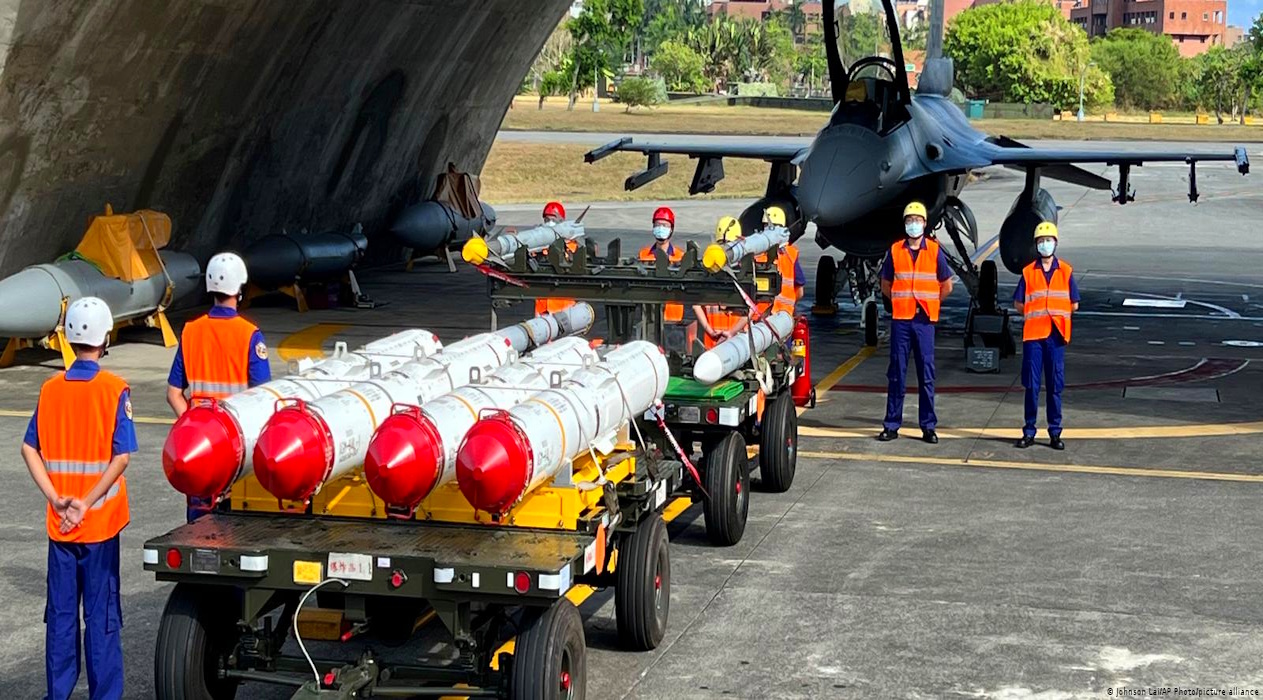
TAIPEI: The United States has approved a major arms sale worth approximately $11 billion to Taiwan, Taipei announced on Thursday, marking one of the largest weapons packages for the self-ruled island in decades as it seeks to strengthen deterrence against a potential Chinese invasion.
The proposed sale comes at a time of intensifying military pressure from Beijing, which considers Taiwan part of its territory and has not ruled out the use of force to bring it under its control. While Washington has long been Taiwan’s most important arms supplier, recent remarks by US President Donald Trump have raised questions about the depth of American commitment to defending the democratic island, prompting renewed pressure on Taipei to boost its own defense capabilities.
Over the past decade, Taiwan has steadily increased defense spending in response to China’s expanding military presence and increasingly aggressive posture in the region. Trump’s administration, particularly during his return to office in January, has urged Taiwan to take greater responsibility for its own security by investing more heavily in military preparedness.
The arms package announced on Thursday—still subject to approval by the US Congress—would be the second arms sale to Taiwan since Trump began his second term, following a $330 million deal for spare parts and components approved in November.
According to Taiwan’s Ministry of Foreign Affairs, the latest and much larger package includes HIMARS rocket systems, howitzers, anti-tank missiles, drones, and other advanced military equipment designed to enhance Taiwan’s asymmetric warfare and deterrence capabilities.
“This is the second arms sale to Taiwan announced during the Trump administration’s second term, once again demonstrating the United States’ firm commitment to Taiwan’s security,” the ministry said in a statement.
In scale, the proposed deal rivals the $18 billion arms package authorized under former US President George W. Bush in 2001, though that agreement was later reduced following commercial negotiations. Ultimately, Bush approved weapons sales totaling $15.6 billion to Taiwan over his eight years in office.
During Trump’s first term, Washington approved roughly $10 billion in arms sales to Taiwan, including an $8 billion deal for advanced fighter jets. Analysts expect the latest package to receive swift approval in Congress, where there is strong bipartisan support for bolstering Taiwan’s defenses amid growing concerns over China’s regional ambitions.
Despite maintaining a domestic defense industry, Taiwan remains vastly outmatched by China’s military size and resources, making continued reliance on US arms a cornerstone of its security strategy.
Taiwan’s Ministry of National Defense said the latest sale underscores Washington’s continued support for Taipei’s efforts to “rapidly build robust deterrence capabilities” in the face of escalating threats.
President Lai Ching-te’s administration has pledged to significantly increase defense spending, targeting more than three percent of GDP next year and five percent by 2030, in line with US expectations. The government also plans to seek up to NT$1 trillion (about $31 billion) in special funding to upgrade air defense systems and expand ammunition production and storage.
However, these proposals must still pass Taiwan’s opposition-controlled legislature, where budget negotiations are expected to be contentious.
Meanwhile, China continues to intensify military activities around the island. Beijing routinely deploys warplanes and naval vessels near Taiwan in what analysts describe as “grey-zone operations”—coercive actions designed to intimidate without triggering open conflict.
Taipei’s defense ministry reported that 40 Chinese military aircraft, including fighter jets, helicopters, and drones, along with eight naval vessels, were detected operating around Taiwan during a 24-hour period ending early Thursday.
Earlier this week, Taiwan also confirmed that China’s newest aircraft carrier, the Fujian, transited through the Taiwan Strait, a move widely seen as a signal of Beijing’s growing naval capabilities and its willingness to assert pressure on the island.
Our Pashto-Dari Website


Support Dawat Media Center
If there were ever a time to join us, it is now. Every contribution, however big or small, powers our journalism and sustains our future. Support the Dawat Media Center from as little as $/€10 – it only takes a minute. If you can, please consider supporting us with a regular amount each month. Thank you
DNB Bank AC # 0530 2294668
Account for international payments: NO15 0530 2294 668
Vipps: #557320

Comments are closed.