

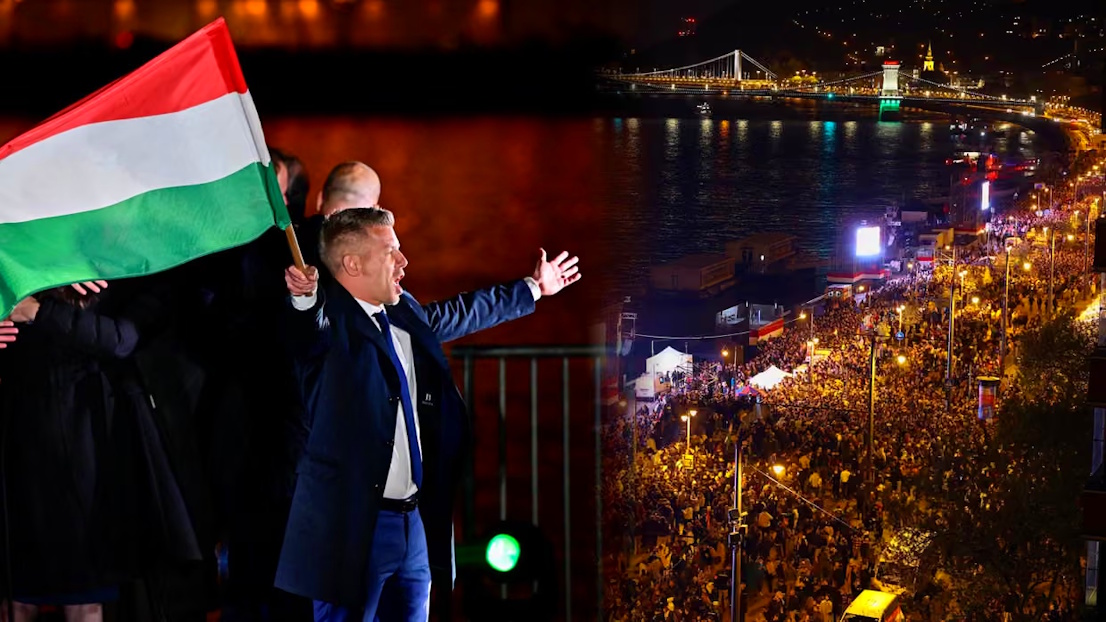
Péter Magyar’s Tisza party wins election as prime minister concedes defeat, in result likely to reshape ties with EU and rattle global far-right movements
Hungary’s opposition Tisza party, led by Péter Magyar, has won a landmark parliamentary election, bringing an end to Viktor Orbán’s 16-year grip on power. The result is expected to recalibrate Budapest’s fraught relationship with the European Union, shift the country’s stance on the war in Ukraine, and deal a symbolic blow to right-wing populist movements worldwide that had long looked to Orbán as a template.
Less than three hours after polls closed on Sunday, Orbán conceded defeat, describing the outcome as “painful but unambiguous.”
“I congratulated the victorious party,” the right-wing populist told supporters in Budapest. “We are going to serve the Hungarian nation and our homeland from opposition as well.”
With 98.74% of the vote counted, Magyar’s Tisza party was projected to have won 138 of the 199 seats in parliament a super-majority capable of amending the constitution and key laws. That majority would enable the new government to reverse many of Orbán’s signature changes, dismantle parts of the controversial legal system built by Fidesz, and potentially unlock billions in frozen EU funds.
Fidesz won 55 seats, while the extreme-right Mi Hazánk party took six.
Magyar, 45, a former insider-turned-critic of Orbán’s inner circle, ran on a platform vowing to repair Hungary’s strained ties with Brussels, crack down on endemic corruption, and channel funds into long-neglected public services such as healthcare and education.
“My fellow Hungarians, we have done it!” he told tens of thousands of jubilant supporters who had gathered along the banks of the Danube River in Budapest. “Tonight, truth prevailed over lies. Today, we won because Hungarians didn’t ask what their homeland could do for them they asked what they could do for their homeland. You found the answer. And you followed through.”
A global test for the MAGA movement
The election was closely watched worldwide as a barometer of the resilience of the populist nationalist movement, often compared to Donald Trump’s “Make America Great Again” (MAGA) agenda. Orbán had long been a hero to the global far right, admired for his illiberal state-building, hardline immigration policies, and defiance of EU norms.
Days before the election, U.S. Vice President JD Vance traveled to Budapest, saying he had come to “help” Orbán. Donald Trump had also repeatedly endorsed the Hungarian leader, most recently on Friday, when he vowed to bring U.S. “economic might” to the country if Orbán were re-elected.
The unexpected defeat prompted swift reactions in Washington. Democratic U.S. House Minority Leader Hakeem Jeffries said the results did not bode well for the Trump administration. “Far-right authoritarian Viktor Orbán has lost the election,” Jeffries wrote on social media. “Trump sycophants and MAGA extremists in Congress are up next in November. Winter is coming.”
In recent months, Orbán, 62, had also been endorsed by right-wing and far-right leaders including France’s Marine Le Pen, Italy’s Giorgia Meloni, and Israel’s Benjamin Netanyahu. Meloni was among the first to congratulate Magyar on Sunday night, pledging continued cooperation. “I thank my friend Viktor Orbán for the intense collaboration over the years,” she added, “and I know that he will continue to serve his nation, also from the opposition.”
European leaders hail a turning point
Across the EU, the result was greeted with relief and celebration. Relations between Orbán’s government and Brussels had plunged to new lows in recent weeks after Orbán vetoed further EU sanctions on Russia and blocked an additional €90 billion (£78 billion) loan for Ukraine. Tensions boiled over further following allegations that Orbán’s government had shared confidential EU intelligence with Moscow.
“Europe’s heart is beating stronger in Hungary tonight,” said Ursula von der Leyen, president of the European Commission. “A country reclaims its European path. The Union grows stronger.”
Donald Tusk, Poland’s prime minister, welcomed Magyar with a sharp jab at Orbán: “Back together! Glorious victory, dear friends!” he posted on social media, adding in Hungarian: “Russians, go home!”
Emmanuel Macron of France and German Chancellor Friedrich Merz also offered congratulations, while British Prime Minister Keir Starmer called it a “historic moment, not only for Hungary, but for European democracy.”
Ukrainian President Volodymyr Zelenskyy said his country was ready to advance cooperation with Hungary, even as Magyar has signaled he would continue Orbán’s opposition to sending arms to Ukraine and fast-tracking EU accession for Kyiv. “We are ready for meetings and joint constructive work for the benefit of both nations, as well as peace, security, and stability in Europe,” Zelenskyy said.
How Orbán’s grip finally loosened
During the campaign, Magyar crisscrossed Hungary, holding as many as six rallies a day, while Orbán consistently trailed in the polls. The prime minister’s once-invincible political machine – which had rewritten election laws, placed loyalists in control of an estimated 80% of the country’s media, and retooled the judiciary – appeared to have finally met its match.
Ahead of the election, the government stepped up efforts to clamp down on dissent. But local resistance swelled dramatically, bursting into public view in June when hundreds of thousands of people took to the streets of Budapest to defy government attempts to ban Pride.
Sunday’s election saw a record turnout of nearly 80%, according to the National Election Office. The result was driven in large part by a massive mobilization of young voters. One poll suggested that as many as 65% of voters under 30 – many of whom had come of age as Hungary plunged in press freedom rankings, was labeled an “electoral autocracy,” and became the most corrupt country in the EU – cast their ballots against Orbán.
On Sunday evening, young Hungarians thronged the Danube embankment, chanting “We did it!” and “It’s over!” as they filled metro stations and squares.
“The dictatorship, right-wing ideology and all of that will disappear now,” said Nóri, 24, tears welling in her eyes. “We have a chance for a better country. I’m feeling hopeful and happy.”
Anna, also 24, added: “I really hope these next four years will be better than the past 16.”
The result was welcomed by Ervin Nagy, one of Hungary’s best-known film actors, who actively campaigned for Tisza. “For the next four years, Hungarians can expect safety, peace, freedom, and that no one will interfere in their lives,” he said.
Challenges ahead for a new government
Analysts were quick to warn that change would likely come slowly. During Fidesz’s 16 years in power, the party stacked the state apparatus, media, and judiciary with loyalists. How those institutions would respond to a new government remains uncertain.
“The path ahead for Hungary is a complicated one – Fidesz’s control of the business sector, media, public administration, and the judiciary reaches far and deep,” said Dalibor Rohac, senior fellow at the American Enterprise Institute.
Nevertheless, he added: “The message of this election is clear: Orbán’s (and Trump’s) ideological project has had a test run of 16 years, and it has been a spectacular political, economic and social failure. The defeat of ‘Orbánism’ is an opportunity to repudiate its iterations in other Western democracies and to charter a more constructive, less polarized trajectory for pluralistic societies.”
In the lead-up to the election, the government had waged a disinformation campaign, including AI-generated billboards depicting Magyar as a danger to the country and a stooge of the EU and President Zelenskyy. Despite that, Tisza prevailed.
“Tisza could win against all odds: help from the United States and from Russia, a massive state disinformation machinery, and all state institutions helping Fidesz,” said Péter Krekó, director of the Budapest-based Political Capital think tank. He noted that while the super-majority would help the new government, expectations would be “huge, and it will be difficult to deliver on some campaign promises due to fiscal constraints. But given that it was dominantly an anti-Fidesz vote, the new government can manage expectations.”
Botond Feledy, a Brussels-based Hungarian geopolitical analyst, said the result would likely reset EU-Hungary relations. “We can count on a Hungarian government that is constructive yet critical, but fundamentally pro-EU and acting as a full-fledged member of the European Union. And this also applies to NATO relations.”
He described the outcome as a lesson for other populist leaders in Europe. “Patriots for Europe certainly need to study a lesson that adds to the list of challenges in the populist playbook,” he said. “It’s not so easy to make promises to people when the system delivers nothing, and it’s impossible to build a virtual reality that is so far removed from reality.”
Our Pashto-Dari Website

Support Dawat Media Center
If there were ever a time to join us, it is now. Every contribution, however big or small, powers our journalism and sustains our future. Support the Dawat Media Center from as little as $/€10 – it only takes a minute. If you can, please consider supporting us with a regular amount each month. Thank you
DNB Bank AC # 0530 2294668
Account for international payments: NO15 0530 2294 668
Vipps: #557320

Comments are closed.