
Philippines Earthquake Kills at Least 15, Triggers Tsunami Fears Across Asia: What to Know

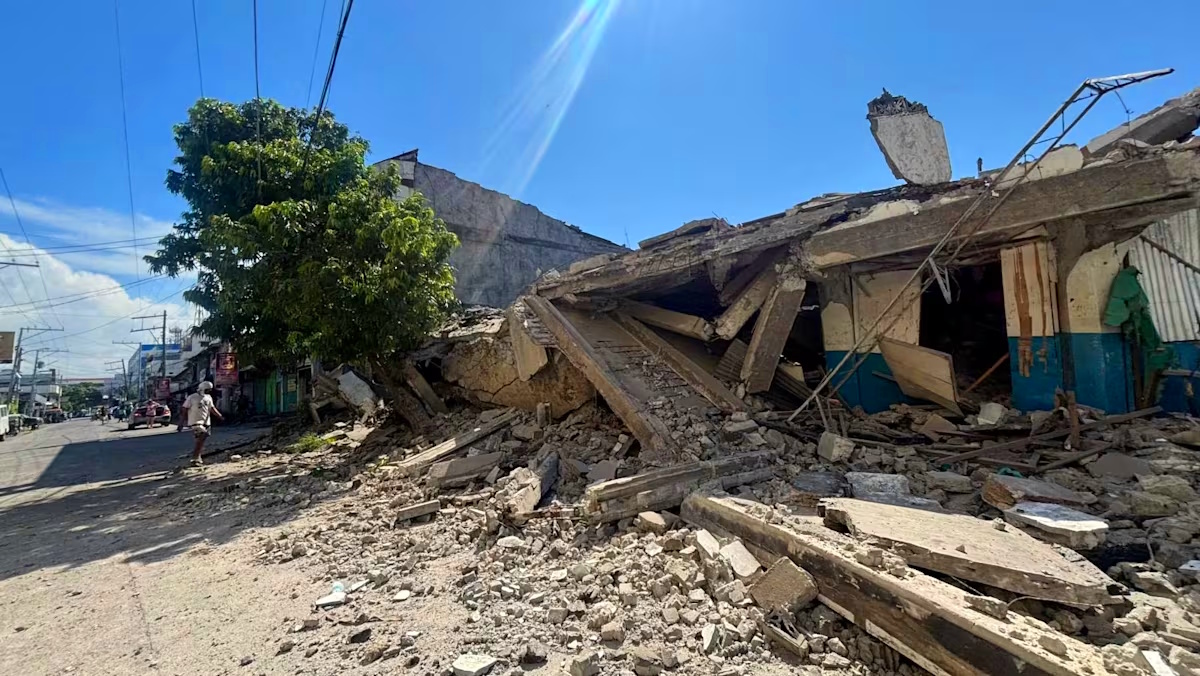
A powerful 7.8-magnitude earthquake struck off the southern Philippines, killing at least 15 people, injuring scores more, and prompting widespread tsunami alerts that briefly put millions on edge across Southeast Asia.
The latest tremors come just eight months after the Philippines suffered its strongest and deadliest earthquake in over a decade, underscoring the nation’s chronic vulnerability to natural disasters.
Where and when did the earthquake hit?
The quake struck early on Monday morning, shortly before 7:40 a.m. local time (23:40 GMT Sunday), according to the United States Geological Survey (USGS).
The epicenter was located offshore, approximately 32 kilometers (20 miles) west of Maasim in Sarangani province, at the southern tip of Mindanao island. The earthquake occurred at an estimated depth of 33 kilometers (21 miles), classified as a shallow tremor, which typically causes more surface damage.
Schools across the Philippines were reopening after a long break, and the shaking was felt strongly in at least a dozen provinces, reaching as far as 420 kilometers (261 miles) away in the city of Manado on the Indonesian island of Sulawesi.
By late morning local time, the Philippine Institute of Volcanology and Seismology had recorded 138 aftershocks, the strongest of which measured a magnitude 6.7 — powerful enough to cause additional damage on its own.
What do we know about the casualties and damage?
At least 15 people are confirmed dead, according to the Philippine Office of Civil Defence, which is still working to verify initial reports of 129 injuries, mostly caused by falling debris and collapsed structures. Authorities fear the death toll may rise as search and rescue efforts continue in isolated coastal areas.
The full extent of the damage remains unclear, but early reports paint a grim picture:
-
General Santos City (population over 700,000) was among the hardest-hit areas. A building housing a fast-food restaurant collapsed completely, sending panicked onlookers fleeing as a cloud of dust filled the air. Part of St. Elizabeth Hospital was evacuated after suffering significant structural cracks, and a building at Notre Dame of Dadiangas University collapsed though no one was inside at the time.
-
Sarangani province saw damaged shop fronts, shattered windows, and piles of rubble from crumbled concrete walls.
-
Alabel town police chief Benjie Ancheta said the quake struck during a flag-raising ceremony, causing some attendees to faint. “This is the strongest earthquake we’ve experienced,” he told reporters by phone.
-
In a video shared by a local school, a large group of children sitting on the floor can be seen swaying violently, hugging teachers for support, before fleeing en masse as a makeshift shelter collapses behind them.
Philippine President Ferdinand Marcos Jr. has ordered emergency response agencies to mobilize fully, including the deployment of military disaster response units. He also ordered the immediate closure of schools in affected areas, affecting approximately 3.2 million students and 128,000 teachers and staff many of whom were scheduled to begin the first day of the academic year.
Where were tsunami risks reported, and were they realized?
Tsunami alerts were issued across several countries, triggering evacuations and widespread fear.
-
The Philippines: Authorities ordered evacuations in several coastal provinces, urging residents to move to higher ground. The Pacific Tsunami Warning Center initially warned that waves of up to three meters (nearly 10 feet) could affect parts of the southern Philippines.
-
Indonesia and Malaysia: Smaller waves were forecast for northern Indonesia and the Malaysian state of Sabah on Borneo island. In Indonesia’s North Sulawesi, a tsunami with a wave height of up to 0.75 meters (2.5 feet) was detected. Residents of the remote Sangihe Islands among the closest to the epicenter fled to higher ground. “They are now evacuating away from the coast to avoid the potential tsunami,” resident Jufry Dalita told state news agency Antara.
-
Japan: Japan’s meteorological agency issued an advisory, observing tsunami waves of 0.2 meters (8 inches) or lower, leading to some ferry disruptions and precautionary beach closures.
-
Australia: The Australian government initially warned of potential tsunami waves on its northern coasts but later lifted the alert.
By midday Monday, officials confirmed that the primary tsunami threat had largely passed. Alerts were lifted across all countries, though residents were advised to remain cautious of strong currents and unusual sea levels.
How are authorities responding?
President Ferdinand Marcos Jr. has pledged a swift and comprehensive disaster response. “The national government is moving, and we will not leave Mindanao behind,” he said in a statement.
Relief supplies and evacuation centers are being prepared, and emergency shelters have been opened for displaced families. The Philippine military has deployed disaster response units to the worst-affected areas, while local governments coordinate search-and-rescue operations.
International support has also been offered. Malaysian Prime Minister Anwar Ibrahim posted on X: “I pray for the safety and wellbeing of all those affected, wishing them strength and courage in the difficult days ahead.”
Why is the Philippines so prone to earthquakes?
The Philippines is one of the world’s most disaster-prone countries. It sits squarely on the Pacific “Ring of Fire” a tectonically volatile belt stretching from South America to the Russian Far East, where dozens of tectonic plates grind against each other, causing frequent earthquakes, volcanic eruptions, and tsunamis.
The nation experiences hundreds of measurable quakes each year, most of them minor. However, major tremors are a recurring threat:
-
Eight months ago: A shallow magnitude 6.9 quake off the island of Cebu killed 79 people the country’s deadliest in 12 years.
-
Two weeks after that: Two powerful quakes struck Mindanao again, the strongest at magnitude 7.4.
Aid agencies warn that major earthquakes can quickly overwhelm local health systems, disrupt education for months, and leave tens of thousands in need of emergency shelter, food, and medical care. Humanitarian organizations continue to stress the importance of disaster preparedness, early warning systems, and resilient infrastructure to reduce casualties and economic losses from future catastrophes.
What’s next?
Authorities are continuing to assess remote coastal areas where communication has been cut off. Aftershocks remain a significant concern, and residents in affected zones are urged to stay vigilant, avoid damaged buildings, and follow official guidance.
Our Pashto-Dari Website

Support Dawat Media Center
If there were ever a time to join us, it is now. Every contribution, however big or small, powers our journalism and sustains our future. Support the Dawat Media Center from as little as $/€10 – it only takes a minute. If you can, please consider supporting us with a regular amount each month. Thank you
DNB Bank AC # 0530 2294668
Account for international payments: NO15 0530 2294 668
Vipps: #557320

Comments are closed.