
Venezuela Earthquakes: Death Toll Climbs to 235 as Rescuers Battle Aftershocks to Find Survivors

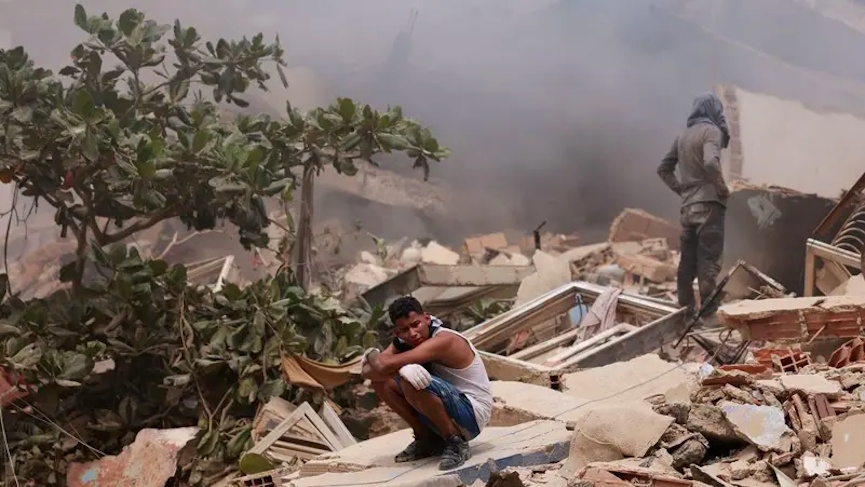
Rescuers are engaged in a desperate race against time, digging through mountains of shattered concrete and twisted steel in search of survivors after two devastating earthquakes struck Venezuela in rapid succession, killing at least 235 people and injuring more than 4,300 others.
The first 7.2-magnitude tremor struck at 18:04 local time (22:04 GMT) on Wednesday, followed seconds later by an even more powerful 7.5-magnitude quake, according to the US Geological Survey (USGS). Both were shallow the first centered just 20.3 kilometers below the surface and the second at a depth of only 10 kilometers making the ground-shaking considerably more destructive than deeper earthquakes of similar magnitude.
‘I Thought the Building Was Going to Fall on Top of Me’
The epicenters were located near the northern coastal region of La Guaira, just west of the capital Caracas, where most casualties have been recorded. In the capital’s upscale Los Palos Grandes neighborhood one of the worst-hit areas residents described scenes of sheer terror.
“It was the strongest quake I’ve ever felt in my life,” said BBC Mundo’s Nicole Kolster, who lives on the seventh floor of an apartment building in Los Palos Grandes. “It was so strong that I thought the building was going to fall on top of me.”
In Caracas and the nearby coastal city of La Guaira, anguished voices could be heard calling for help from beneath the debris of collapsed buildings as rescue workers scrambled to reach them. Throughout the night and into Thursday, teams worked by floodlight, using heavy machinery, jackhammers, and their bare hands to clear rubble.
State of Emergency Declared as Airport Closed
Acting President Delcy Rodríguez has declared a state of emergency, reporting that Simón Bolívar International Airport in Maiquetía the country’s main international gateway, serving the capital has been closed indefinitely due to serious structural damage. Video from inside the terminal showed dust and debris raining down from cracked ceilings as panicked passengers fled.
Jorge Rodríguez, president of Venezuela’s National Assembly, confirmed Thursday that the death toll had risen overnight as rescue teams reached more affected areas. Interior Minister Diosdado Cabello reported that buildings had also collapsed in the states of Trujillo, Yaracuy, Carabobo, Aragua, and Miranda.
In the hard-hit Chacao municipality, part of greater Caracas, Mayor Gustavo Duque said 11 people had died in a single ruined building and 23 had been rescued. “We’re trying to clear the rubble so specialists can go in to reach people who are hopefully still alive,” he said in a video update. “We’re trying to rescue as many people alive as possible.”
La Guaira: The Epicenter of Devastation
The coastal state of La Guaira home to an estimated 480,000 people has borne the brunt of the catastrophe. Sandwiched precariously between the Caribbean Sea to the north and the steep Venezuelan Coastal Range to the south, the state is particularly vulnerable to natural disasters, including earthquakes and landslides. Many residential and commercial buildings are constructed on foothills and slopes overlooking the coast, leaving them exposed to the violent shaking.
Cabello said more than 100 buildings have collapsed in La Guaira alone, and more than 70,000 families have been affected. The BBC verified footage showing a 10-story hotel in the state reduced to a pancaked heap of concrete slabs. In the coastal town of Tucacas, approximately 250 kilometers northwest of Caracas, another verified video showed a multi-story building reportedly also a hotel completely collapsed.
On Thursday, distraught residents searched for missing loved ones among the ruins. Juan Ortiz, a medical student in Caracas, told the BBC that one close friend had been confirmed dead, another was believed to be trapped under rubble, and around 20 people he knew who lived in the coastal area were missing. “I’m in shock and confusion, and frustrated that I can’t help,” he said.
Aftershocks and Fears of Rising Death Toll
Aftershocks have continued to ripple through the region, with at least 30 recorded since the two main quakes, according to Delcy Rodríguez. The tremors have left many survivors too terrified to return to damaged buildings, with hundreds sleeping in parks, plazas, and streets.
The USGS warned that “high casualties and extensive damage are probable and the disaster is likely widespread.” Based on factors including the size and depth of the quakes, the density of the nearby population, and historical data from similar events, the agency issued stark probabilistic estimates: a 42% chance of more than 10,000 deaths and a 33% chance of more than 100,000 fatalities. These figures intended to guide emergency response planning are not exact predictions but underscore the gravity of the situation.
The timing of the quakes compounded the tragedy. Wednesday was a national holiday in Venezuela, meaning more people than usual were at home rather than at workplaces or schools, which may have increased the number of people trapped indoors when buildings collapsed.
International Aid Pours In
International offers of support have flooded in, with the United States pledging $150 million (£113 million) in aid. President Donald Trump said he had instructed his government “to get ready to move quickly,” writing on Truth Social: “The two major earthquakes that just hit the great people of Venezuela are both massive in scale and have left a devastating number of deaths. The US stands ready, willing and able to help!”
Secretary of State Marco Rubio confirmed that the US was “immediately deploying search and rescue teams, medical resources, and humanitarian assistance.” The US military is sending transport ships and aircraft to support search-and-rescue operations and “rapid relief efforts,” according to a State Department statement.
Support has also been pledged by the Dominican Republic, El Salvador, Mexico, and Qatar. The disaster marks the first major test of Venezuela’s newly thawed relationship with the US since President Trump ordered the capture of President Nicolás Maduro in January. The Trump administration has sought to reshape ties with Venezuela, throwing its support behind Maduro’s former lieutenant, Delcy Rodríguez, who now leads the interim government.
Venezuelan opposition leader María Corina Machado expressed solidarity on social media, writing on X: “My heart, my infinite embrace, and my prayers are with every Venezuelan home in these hours of anguish.”
Challenges Hamper Rescue Efforts
Caracas-based journalist Luis Hernandez told BBC Newsday that assessing the true scale of the damage would be difficult due to widespread power cuts and internet failures. “Due to the economic crisis in the country, it is very difficult for us to assess,” he said.
The earthquakes are the strongest to hit Venezuela since 1900, according to USGS records. The country lies over the meeting point of two tectonic plates, and the quakes were likely caused by the sudden release of friction between them. The last major earthquake to strike the capital in 1967 killed 200 people and heavily damaged the same Altamira and Los Palos Grandes neighborhoods that were hit again this week.
What Happens Next
As rescue operations continue into their second day, the focus remains on extracting survivors from the ruins. But with each passing hour, hopes of finding people alive begin to fade. The international community is mobilizing resources, but the scale of destruction coupled with Venezuela’s ongoing economic crisis poses immense challenges to relief and recovery efforts.
For now, the people of Venezuela wait some for news of loved ones, others for the ground to stop trembling. And in the rubble of La Guaira and Caracas, rescuers press on, listening for the faintest sound of life beneath the debris.
Our Pashto-Dari Website

Support Dawat Media Center
If there were ever a time to join us, it is now. Every contribution, however big or small, powers our journalism and sustains our future. Support the Dawat Media Center from as little as $/€10 – it only takes a minute. If you can, please consider supporting us with a regular amount each month. Thank you
DNB Bank AC # 0530 2294668
Account for international payments: NO15 0530 2294 668
Vipps: #557320

Comments are closed.