

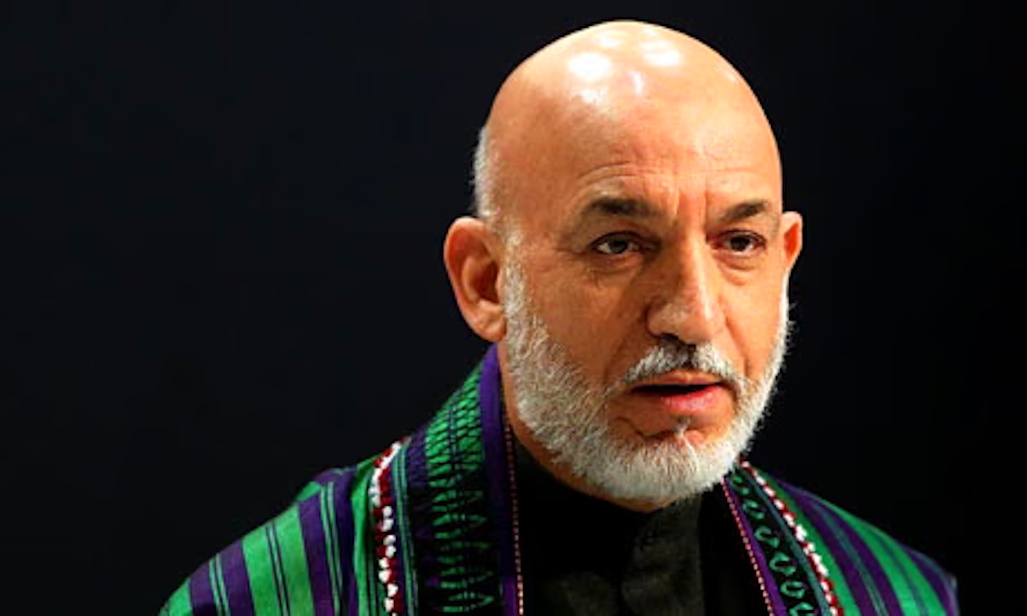
Former Afghan President Hamid Karzai has accused Pakistan of exerting military and economic pressure on Afghanistan in an apparent effort to force recognition of the disputed Durand Line as the official international border between the two countries.
In a statement posted on X on Saturday, Karzai warned that the pressure campaign posed a direct threat to Afghanistan’s sovereignty and territorial integrity. He argued that such measures appeared designed to compel border communities to seek assistance from Pakistani authorities for resolving security and administrative matters, gradually normalizing Islamabad’s authority over disputed frontier areas.
Karzai also pointed to recent reports indicating that tribal elders from both sides of the border had signed documents described as “peace agreements” following cross-border tensions. He noted that Pakistan’s Foreign Ministry had publicly welcomed the agreements, raising concerns about their broader political implications.
Calling for greater transparency, Karzai urged the Taliban authorities to provide a clear explanation of the agreements, including their legal and political significance, and to clarify whether any commitments had been made that could affect Afghanistan’s long-standing position on the border dispute.
His comments come amid renewed tensions along the frontier after recent clashes between Taliban forces and Pakistani border troops. The incidents prompted tribal elders from Afghanistan’s Kunar Province and Pakistan’s Bajaur District to hold talks aimed at de-escalating the situation and preventing further violence.
The Durand Line, drawn in 1893 under British colonial rule through an agreement between British India and Afghan ruler Abdur Rahman Khan, has remained one of the most contentious issues in Afghan-Pakistani relations. Successive Afghan governments have refused to formally recognize it as a permanent international border, arguing that the agreement was imposed under unequal conditions and divided ethnic Pashtun communities across both sides.
Relations between the Taliban administration and Pakistan have grown increasingly strained in recent years over border security, militant activity, and repeated clashes along the frontier, despite the historically close ties that once linked Islamabad and the Taliban leadership. Analysts say the latest dispute reflects deepening mistrust between the two sides and underscores the unresolved status of one of South Asia’s most sensitive geopolitical fault lines.
Our Pashto-Dari Website
Support Dawat Media Center
If there were ever a time to join us, it is now. Every contribution, however big or small, powers our journalism and sustains our future. Support the Dawat Media Center from as little as $/€10 – it only takes a minute. If you can, please consider supporting us with a regular amount each month. Thank you
DNB Bank AC # 0530 2294668
Account for international payments: NO15 0530 2294 668
Vipps: #557320

Comments are closed.