

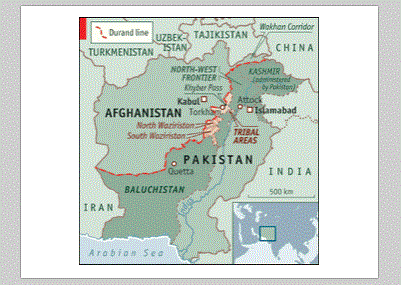
KABUL, Afghanistan — In a dramatic and dangerous escalation of hostilities, Afghanistan’s Taliban-led Ministry of Defense has claimed that its air forces conducted overnight airstrikes targeting Pakistani military positions in the border regions of Miranshah and Spinwam, on the Pakistani side of the disputed Durand Line.
The Taliban described the pre-dawn operation as a resounding success, stating it was a direct retaliatory measure against what it termed “aggressive” Pakistani aerial bombardments on Afghan territory just hours earlier.
According to a defiant statement released by the ministry, the strikes—carried out around midnight local time—successfully “destroyed” Pakistani military headquarters in both locations. The statement further asserted that the attacks inflicted “heavy casualties” on Pakistani forces, though it refrained from providing specific numbers or details regarding the scale of the assault or the type of aircraft used.
There has been no independent verification of the Taliban’s claims, and the region remains largely inaccessible to international media. Pakistani military and government officials have yet to issue any formal comment or acknowledgment of the alleged strikes, leaving a information vacuum that is fueling speculation.
This reported cross-border raid marks a significant and perilous turning point in the already fraught relationship between Islamabad and the Taliban administration in Kabul. The move suggests a willingness by the Taliban to take the conflict beyond its borders in a manner not seen since they took power in 2021.
The Spark: Pakistani Airstrikes Inside Afghanistan
The Taliban’s announcement came just hours after they accused Pakistani forces of conducting multiple airstrikes within Afghanistan over the preceding 24 hours. According to Taliban officials, Pakistani warplanes targeted specific military positions of the Taliban’s Defense Ministry. Key among the alleged targets was the 201st Khalid bin Walid Corps, a major military formation based in the eastern province of Nangarhar.
Sources within Afghanistan also reported that Pakistani jets struck locations in the southern province of Kandahar, the spiritual heartland of the Taliban. Notably, these strikes reportedly included the former residence of the late Taliban founder, Mullah Mohammad Omar, as well as a facility alleged by Islamabad to be linked to a Taliban-affiliated suicide unit.
A Relationship on the Brink
The exchange of fire represents the collapse of an already fragile détente between the two neighbors. Relations have been on a steady decline for months, primarily over the volatile issue of cross-border militancy. Islamabad has long accused the Taliban government of harboring armed groups, specifically the Tehreek-e-Taliban Pakistan (TTP)—a separate militant entity known as the Pakistani Taliban—which uses Afghan soil to plan and launch attacks on Pakistani security forces and civilians.
Pakistan has repeatedly demanded that the Taliban reign in the TTP, a request that has gone largely unheeded. The Taliban, for their part, deny the allegations, insisting they do not allow any group to use Afghanistan as a launchpad for attacks against other countries, and they view Pakistan’s cross-border military operations as a violation of their national sovereignty.
Heightened Alert and Fears of a Wider War
The situation on both sides of the border is now described as highly volatile. With both nations possessing capable, albeit asymmetric, military forces, observers warn that the current tit-for-tat dynamic could spiral out of control.
“The shift from covert operations and cross-border shelling to claimed, acknowledged airstrikes by both sides is a significant escalation,” said a regional security analyst based in Islamabad, speaking on condition of anonymity. “If the Taliban’s claim of using airpower inside Pakistan is true, it shatters the previous rules of engagement. We could be looking at the beginning of a prolonged and bloody cross-border conflict.”
As dawn broke over the frontier region, a tense quiet settled in, but the rhetoric from Kabul suggests that the Taliban stands ready to respond forcefully to any future Pakistani actions. The international community is watching with growing alarm as two nuclear-armed neighbors edge closer to what could become a devastating open conflict.
Our Pashto-Dari Website

Support Dawat Media Center
If there were ever a time to join us, it is now. Every contribution, however big or small, powers our journalism and sustains our future. Support the Dawat Media Center from as little as $/€10 – it only takes a minute. If you can, please consider supporting us with a regular amount each month. Thank you
DNB Bank AC # 0530 2294668
Account for international payments: NO15 0530 2294 668
Vipps: #557320

Comments are closed.