

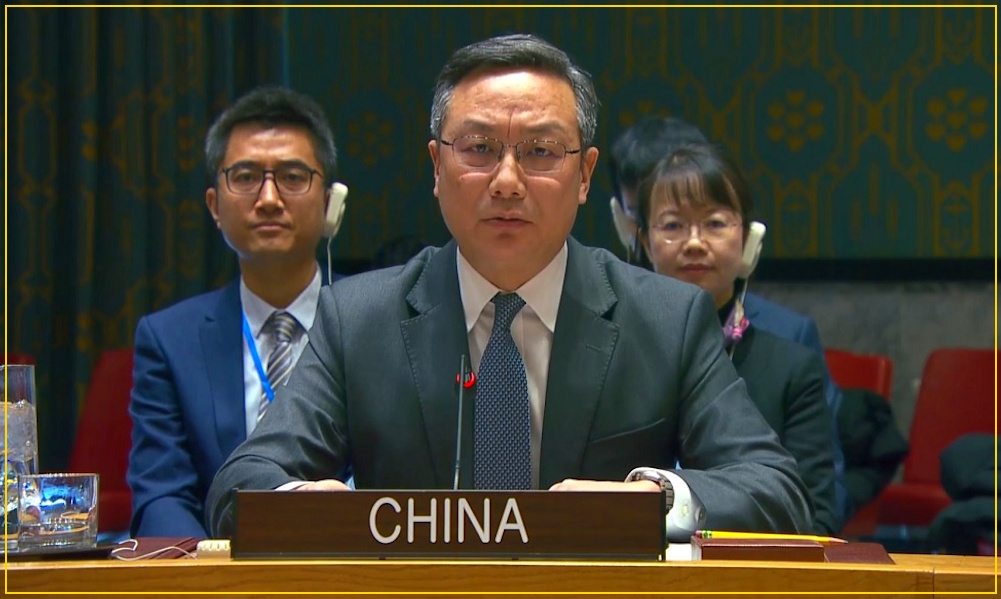
China has warned the United Nations Security Council (UNSC) that the terrorist threat emanating from Afghanistan remains acute and demands sustained international attention, citing the continued presence and activities of multiple extremist organizations operating within the country.
Speaking at a UNSC meeting focused on threats to international peace and security caused by terrorist acts, China’s Deputy Permanent Representative to the UN, Sun Lei, said that groups including ISIL (Daesh), al-Qaeda, and the East Turkestan Islamic Movement (ETIM) continue to maintain a foothold in Afghanistan. He described their activities as “persistent threats” not only to Afghanistan’s internal stability but also to regional and global security.
Sun pointed to last month’s deadly attack on a Chinese restaurant in Afghanistan, which killed seven people and was claimed by ISIL-Khorasan (ISIL-K), as a stark reminder of the group’s ongoing operational capacity. The incident, he said, underscores the urgent need for effective counterterrorism measures and highlights the risks posed to foreign nationals and diplomatic interests in the country.
Urging Afghanistan’s de facto authorities to take the issue seriously, Sun called on them to “attach great importance” to counterterrorism efforts and to adopt concrete, verifiable measures to ensure that Afghan territory is not once again used as a safe haven or operational base for extremist networks.
China, he added, supports enhanced regional cooperation to address cross-border terrorist threats, particularly among Central Asian states and through multilateral platforms such as the Shanghai Cooperation Organization (SCO). He emphasized that counterterrorism efforts should go hand in hand with initiatives to support Afghanistan’s economic stabilization and development, arguing that poverty and instability can exacerbate security risks.
Pakistan’s Permanent Representative to the UN, Asim Iftikhar Ahmad, echoed these concerns, warning that Afghan authorities continue to provide a “permissive environment” for militant groups such as Tehreek-e-Taliban Pakistan (TTP), al-Qaeda, ISIL-K, and ETIM—also known as the Turkistan Islamic Party (TIP). He said the presence of these groups poses a direct threat to Pakistan and undermines security across the wider region.
Ahmad also drew attention to the danger posed by advanced military equipment left behind in Afghanistan following the U.S. and NATO withdrawal, cautioning that such weapons could fall into the hands of militant organizations and further strengthen their operational capabilities.
The United States representative, Mike Waltz, broadened the discussion by highlighting the global nature of the terrorist threat. He noted the expansion of al-Qaeda affiliates and ISIL-linked groups in West Africa and the Sahel, as well as the continued resilience of ISIL cells in Syria and Iraq. In this context, he stressed that ISIL-K remains a serious and persistent threat in Afghanistan, reinforcing the need for sustained, coordinated international counterterrorism efforts.
Regional countries have repeatedly voiced alarm over the security situation in Afghanistan and its potential spillover effects. The Islamic Emirate of Afghanistan, however, has consistently dismissed these concerns, insisting that it has full control over the country’s territory and reiterating its pledge not to allow Afghan soil to be used for attacks against other nations.
Our Pashto-Dari Website

Support Dawat Media Center
If there were ever a time to join us, it is now. Every contribution, however big or small, powers our journalism and sustains our future. Support the Dawat Media Center from as little as $/€10 – it only takes a minute. If you can, please consider supporting us with a regular amount each month. Thank you
DNB Bank AC # 0530 2294668
Account for international payments: NO15 0530 2294 668
Vipps: #557320

Comments are closed.