

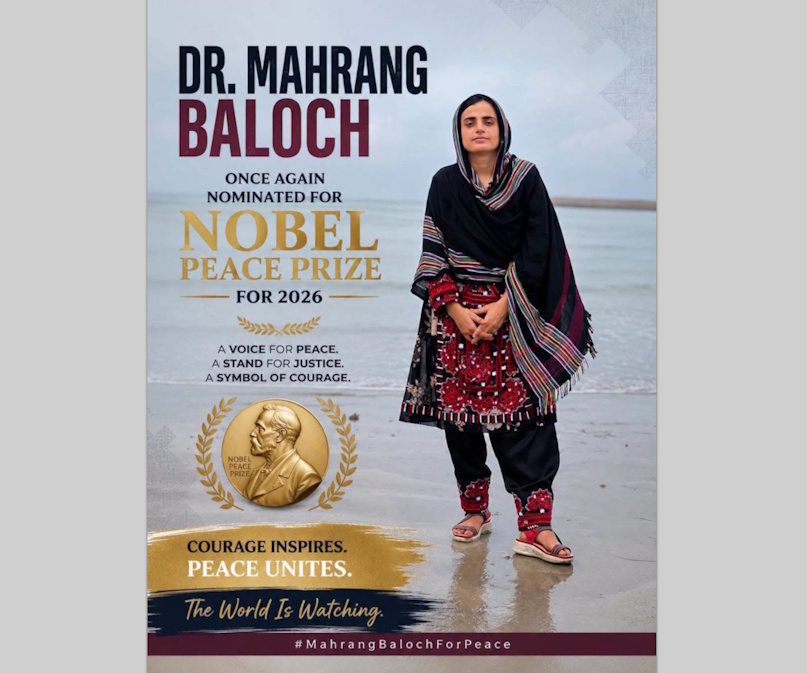
The Legal Defense of Dr. Mahrang Baloch
Remove one stone from the wall of Dr. Mahrang Baloch’s prison
and let every voice that seeks justice remove a stone from that wall.
The path to Dr. Mahrang Baloch’s freedom
runs through the law, through human conscience, and through international pressure.
Summary and Statement of the Case
The case of Dr. Mahrang Baloch ٫ a thirty-three-year-old physician, leader of the Baloch Yakjehti Committee, and nominee for the Nobel Peace Prize ٫ who in 2026 was sentenced to life imprisonment by the Anti-Terrorism Court of Quetta, stands as an instructive example of the systematic misuse of anti-terrorism legislation to silence peaceful civic activism. Drawing on international human rights instruments, comparative judicial practice, and the documented reports of monitoring bodies, this article argues that the verdict is void and unenforceable ٫ not only under Pakistan’s domestic law, but also under the international obligations to which Pakistan is bound.
The Factual Background of the Case and the Context of the Charges
The charges against Dr. Baloch arise from the 2024 Gwadar protest gathering, convened in response to the killing of Baloch activists by security forces. The prosecution alleges that a border-security officer named Shabbir Baloch was injured during this gathering and subsequently died of his injuries. Yet, according to the official report of Amnesty International, the trial in this case was conducted “confidentially and expeditiously inside the prison,” without the presentation of any direct evidence linking the accused to violence or to the killing. The charge against Dr. Baloch rests not on participation in a violent act, but solely on “participation in the gathering and the delivery of a speech.”
This is a foundational legal distinction. Modern legal systems draw a decisive line between individual criminal responsibility and collective or symbolic liability. The principle of personal criminal responsibility (nullum crimen sine actu) enshrined in Article 25 of the Rome Statute of the International Criminal Court and affirmed in the jurisprudence of the International Criminal Tribunals for the former Yugoslavia and for Rwanda ٫ explicitly prohibits holding an individual responsible for the violent acts of others merely on the basis of presence at a gathering or the delivery of a speech, unless a direct causal nexus or a proven joint criminal enterprise (with an established mens rea element) is conclusively demonstrated.
Violation of the Presumption of Innocence and Fair Trial Standards
Article 14 of the International Covenant on Civil and Political Rights (ICCPR) ٫ to which Pakistan acceded in 2010 ٫ explicitly guarantees the presumption of innocence and the right to a public, independent, and impartial trial. The UN Human Rights Committee, in its General Comment No. 32 on this Article, has emphasized that military or quasi-military proceedings against civilians — particularly in cases bearing political dimensions ٫ are structurally incompatible with the standards of independence and impartiality.
In the present case, several manifest violations may be identified:
First, the confidentiality of the in-camera trial conducted within the prison, without the full access of independent counsel to the case file, violates Article 10 of the Universal Declaration of Human Rights and Article 14 of the ICCPR, both of which mandate a public trial except in narrow, exceptional circumstances that must be reasoned and justified by the court ٫ a justification wholly absent in this case.
Second, the absence of direct evidence establishing a causal link between Dr. Baloch’s presence at the gathering and the death of the security officer violates the “beyond reasonable doubt” standard recognized both in common-law systems and in the jurisprudence of the International Criminal Court. The imposition of a life sentence on the basis of mere presence and speech, without an evidentiary nexus to a specific criminal act, exemplifies what legal scholars term “status-based liability” ٫ a concept that, within modern criminal law, represents a regression to the pre-modern notion of the “political crime” (delicto politico), and stands in direct conflict with the principle of legality (nullum crimen, nulla poena sine lege).
Third, the deployment of anti-terrorism statutes to prosecute civic activism violates Articles 19 and 21 of the ICCPR, which respectively guarantee freedom of expression and the freedom of peaceful assembly. The Human Rights Committee, in its General Comment No. 37, has explicitly affirmed that protest gatherings ٫even where sporadic violence is committed by certain participants ٫ must not give rise to disproportionate punishment against peaceful organizers or speakers, unless direct incitement to violence is established: a standard shaped by jurisprudence such as Brandenburg v. Ohio in American law and the doctrine of “imminent lawless action,” which has since evolved into a near-universal benchmark.
Gendered Dimensions and Structural Discrimination
Dr. Mahrang Baloch is not merely a human rights activist; she is a symbol of the Baloch women’s struggle against structural state violence. The Convention on the Elimination of All Forms of Discrimination Against Women (CEDAW), to which Pakistan acceded in 1996, obligates state parties under Article 2 to refrain from any discriminatory act or practice against women, including such acts committed by state institutions. The coercive and punitive treatment of a female activist at the helm of a peaceful protest movement ٫ while male activists within the same movement, who have acted with equal or greater intensity, have not faced prosecution of comparable severity ٫ reveals a pattern of institutionalized gender discrimination repeatedly noted by the UN Special Rapporteurs on violence against women.
Beyond this, the ethnic dimension of the case cannot be overlooked. The UN Special Rapporteur on minority issues has, in numerous reports, observed that the disproportionate application of security legislation against the Baloch ethnic minority in Pakistan constitutes a pattern that may properly be examined under the framework of systemic ethnic discrimination ٫ the subject matter of the International Convention on the Elimination of All Forms of Racial Discrimination (ICERD).
The Framework of Arbitrary Detention and Enforced Disappearance
Dr. Baloch has remained in custody since March 2025 ٫ a detention which, according to the reports of human rights bodies, bears the hallmarks of arbitrary detention as defined by the UN Working Group on Arbitrary Detention (UNWGAD). This Working Group’s categorization of arbitrary detention includes: detention without a clear legal basis (Category I); detention resulting from the exercise of rights and freedoms guaranteed under international covenants, such as freedom of expression (Category II); and detention arising from serious violations of fair trial standards (Category III). Dr. Baloch’s case may simultaneously be classified under all three categories.
Furthermore, the personal background of this case ٫ the abduction and killing of Dr. Baloch’s father by security forces following years of enforced disappearance ٫ situates this case within the broader and systematic pattern of enforced disappearance in Balochistan, a phenomenon repeatedly flagged by the UN Working Group on Enforced or Involuntary Disappearances (WGEID).
Legal Avenues at the National and International Levels
At the national level, an appeal before the Supreme Court of Pakistan ٫ grounded in the violation of fair trial principles, the absence of material evidence, and the disproportion between the act attributed (presence and speech) and the punishment imposed (life imprisonment) ٫ must be pursued immediately. This argument rests upon the doctrine of proportionality, which has been recognized in numerous constitutional systems, including in the Supreme Court of Pakistan’s own prior jurisprudence concerning freedom of expression.
At the international level, the following avenues should be pursued in parallel:
• A formal complaint to the UN Human Rights Committee under the First Optional Protocol to the ICCPR, invoking violations of Articles 9 (liberty and security of person), 14 (fair trial), and 19 (freedom of expression);
• An urgent referral to the Working Group on Arbitrary Detention for the issuance of an Opinion on the legality of the detention; and
• A request to the UN Special Rapporteurs on human rights defenders and on freedom of expression for a joint statement.
The Optional Protocol to CEDAW likewise provides an individual complaint mechanism that should be employed.
At the level of diplomatic pressure and public opinion, the role of institutions such as Amnesty International, Human Rights Watch, the International Federation for Human Rights (FIDH), and the International Bar Association (IBA) is vital in mobilizing volunteer counsel, international trial observers, and media campaigns. The historical experience of cases such as those of Aung San Suu Kyi, Nelson Mandela, and Narges Mohammadi demonstrates that simultaneous legal and media pressure can open a path toward judicial review even within otherwise closed systems.
Legal Conclusion: A Test of the Global Legal Conscience
The case of Dr. Mahrang Baloch is, beyond a single criminal proceeding, a test of the international human rights system’s fidelity to the very principles upon which it was founded: the presumption of innocence, proportionality, freedom of expression, and equality before the law regardless of gender or ethnicity. The conviction of a physician and human rights defender to life imprisonment ٫ based solely on presence at a peaceful gathering and the delivery of a speech, without proof of causal connection to any criminal act ٫ constitutes not only a violation of her individual rights, but a threat to the entire architecture of international human rights law: an architecture that, should it remain silent in the face of such cases, will forfeit its own legitimacy as a system for the protection of human dignity.
The call of this article to the international legal community, to United Nations monitoring bodies, and to global public opinion is therefore simple and unequivocal: the immediate and unconditional release of Dr. Mahrang Baloch is not merely a moral imperative ٫ it is a legal duty arising from Pakistan’s binding international obligations.
Our Pashto-Dari Website

Support Dawat Media Center
If there were ever a time to join us, it is now. Every contribution, however big or small, powers our journalism and sustains our future. Support the Dawat Media Center from as little as $/€10 – it only takes a minute. If you can, please consider supporting us with a regular amount each month. Thank you
DNB Bank AC # 0530 2294668
Account for international payments: NO15 0530 2294 668
Vipps: #557320

Comments are closed.