
Iran President Declares ‘Full-Scale War’ with US as Strikes Intensify Across the Islamic Republic

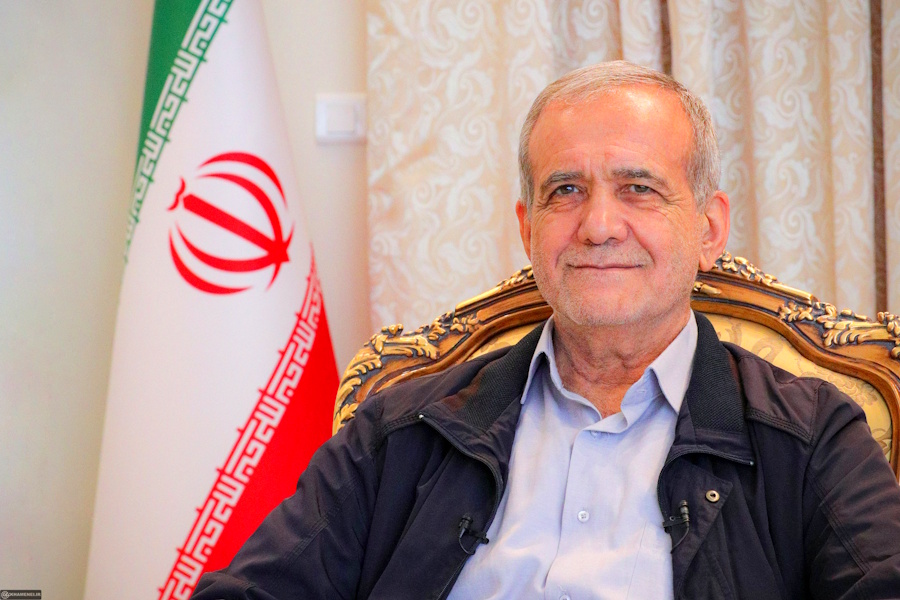
Iranian President Masoud Pezeshkian declared on Monday that the Islamic Republic is now engaged in a “full-scale war” with the United States, as Washington dramatically expanded its military strikes deep into Iranian territory including areas near the country’s sole operational nuclear power plant. The escalation marks a sharp deterioration in tensions that had briefly eased following a June truce, and has sent global oil prices surging to a one-month high.
“The reality is that today the Islamic Republic of Iran is engaged in a full-scale war,” Pezeshkian said in a presidency statement. He urged the nation to confront the gravity of the situation, adding: “We must be realistic and accept the natural consequences of this resistance.” His remarks came as state media and local authorities confirmed US airstrikes on Monday in both the northern and central provinces strikes that reached far beyond the previously contested coastal areas near the strategically vital Strait of Hormuz, through which roughly one-fifth of the world’s oil supplies transited before the conflict resumed.
The resumption of hostilities followed a weeks-long lull brokered by an agreement signed in June, but that fragile calm collapsed as both sides accused each other of violations. In response to the renewed US offensive, Tehran swiftly reimposed its blockade of the Strait of Hormuz, a choke point for global energy exports. Washington retaliated by reestablishing its own naval blockade of Iran’s major ports, effectively strangling the country’s non-oil trade routes and heightening fears of a broader regional conflagration.
Iran Strikes Back Across the Region
Undeterred by the US bombardment, Iran’s Islamic Revolutionary Guard Corps (IRGC) announced it had launched retaliatory strikes against targets in Bahrain, Jordan, and Syria. While the IRGC did not specify the nature of those targets, Bahrain’s government swiftly countered, alleging that Tehran had directly targeted its air navigation systems a claim that raises concerns about potential disruption to civilian aviation and regional military coordination. The exchanges have drawn widespread international alarm, with the United Nations Security Council scheduling an emergency session to address the spiraling violence.
Nuclear Site City Among Targets
All of the Iranian provinces struck on Monday host military installations and air defense networks, but the inclusion of Bushehr—home to Iran’s only operational civilian nuclear power plant has provoked particular unease. Governor Mohammad Mozaffari confirmed to the state-run IRNA news agency that “a few minutes ago, several locations in Bushehr city were hit by American enemy’s projectiles.” While initial reports indicated the plant itself was not damaged, the proximity of the strikes to a nuclear facility has drawn sharp rebukes from international non-proliferation watchdogs and raised the specter of radioactive contamination should future attacks come closer.
In East Azerbaijan province, in the country’s northwest, the head of the local crisis management unit, Majid Farshi, told IRNA that at least “one person was martyred and several others injured” in an attack there. Casualty figures remain unverified, and both Iranian and US military sources have offered conflicting accounts of the scale and precision of the strikes.
Diplomatic Channels Remain Open For Now
Despite the dramatic military escalation, Iranian foreign ministry spokesman Esmaeil Baghaei struck a more conciliatory note during a press conference in Tehran attended by AFP. He confirmed that diplomatic exchanges with the United States, conducted through third-party mediators, were still ongoing. “Ideas have been conveyed to us by certain mediators,” Baghaei said, without elaborating on the substance of those proposals or identifying the go-betweens. The remarks suggest that neither side has entirely closed the door on a negotiated de-escalation, even as their forces trade blows across multiple fronts.
Global Impact and Market Jitters
The resurgence of open conflict has rattled global energy markets, with Brent crude futures climbing sharply to their highest level in over a month. Analysts warn that a prolonged blockade of the Strait of Hormuz could push oil prices toward $100 a barrel, reigniting inflationary pressures just as major economies were beginning to stabilize post-pandemic. Meanwhile, neighboring Gulf states have placed their militaries on high alert, and both Saudi Arabia and the United Arab Emirates have called for an immediate ceasefire, fearing that the Iran-US confrontation could spill over into their own territories.
As night fell over Tehran, the mood was tense but defiant. State television broadcast patriotic anthems interspersed with air-raid sirens, while officials vowed to continue resisting what they termed “American aggression.” Whether the diplomatic back-channels can salvage a new truce—or whether the region is hurtling toward an even wider war—remains the most urgent question hanging over the Middle East.
Our Pashto-Dari Website

Support Dawat Media Center
If there were ever a time to join us, it is now. Every contribution, however big or small, powers our journalism and sustains our future. Support the Dawat Media Center from as little as $/€10 – it only takes a minute. If you can, please consider supporting us with a regular amount each month. Thank you
DNB Bank AC # 0530 2294668
Account for international payments: NO15 0530 2294 668
Vipps: #557320

Comments are closed.