

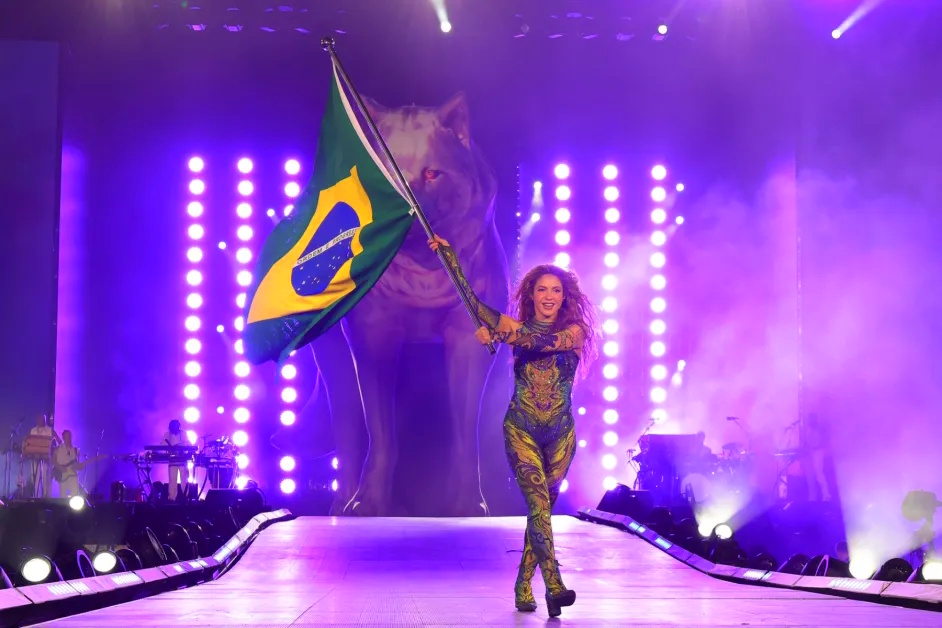
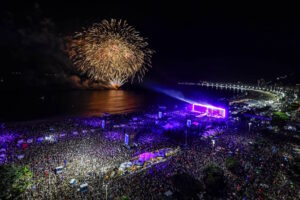
Rio de Janeiro – Colombian superstar Shakira delivered a historic free concert on Copacobana Beach in Rio de Janeiro on Saturday night, drawing what the city’s mayor called an astonishing 2 million people to one of the world’s most iconic waterfront stages. The massive turnout placed Shakira alongside pop royalty, following similar record-breaking beach performances by Madonna in 2024 and Lady Gaga last year both of which transformed the sprawling sands into a pulsating, open-air dance floor.
The spectacle marked Shakira’s first major Brazilian beach concert and served as a special stop on her “Las Mujeres Ya No Lloran” (“Women No Longer Cry”) world tour, named after her 2024 album. The album, which explores themes of heartbreak, resilience, and empowerment following her highly publicized separation from Spanish soccer player Gerard Piqué, has been hailed as a comeback triumph.
Shakira finally took the stage around 11 p.m., more than an hour after the scheduled start, but the delay only amplified the anticipation. Fans screamed with excitement and broke into frantic applause as a fleet of skywriting drones whirred overhead, spelling out in Portuguese the message: “Eu te amo Brasil” (“I love you Brazil”). The night air was thick with humidity and the smell of sea salt, as concertgoers many draped in Colombian and Brazilian flags packed the beach as far as the eye could see.
Early in the set, Shakira spoke fondly of her first visit to Brazil nearly three decades ago. “I arrived here when I was 18 years old, dreaming about singing for you,” she told the crowd, her voice thick with emotion. “And now look at this. Life is magical.”
The setlist was a career-spanning showcase of fan favorites, including the irresistible “Hips Don’t Lie,” the gritty reggaeton-infused “La Tortura,” and the sun-drenched “La Bicicleta.” She closed the night with the searing “BZRP Music Sessions #53,” a cathartic breakup anthem that became a global viral sensation and which she performed with palpable intensity a nod to her personal healing journey. Notably, she followed it with “BZRP #66,” a more reflective continuation of the collaboration.
Beyond the hits, Shakira took time to celebrate women’s resilience, turning the concert into an empowering manifesto. “Us women, every time we fall we get up a little wiser,” she said to thunderous cheers from the predominantly female and LGBTQ+ crowd.
Rio Mayor Eduardo Cavaliere confirmed the unprecedented attendance on X (formerly Twitter), writing: “The She-Wolf made history in Rio,” referring to Shakira’s 2009 hit single. According to The Associated Press, local authorities deployed over 1,000 extra security personnel and set up hydration stations due to the summer heat, but no major incidents were reported.
The deep connection between Shakira and her Brazilian fans is no accident, according to Felipe Maia, an ethnomusicologist pursuing a doctoral degree in popular music and digital technologies at Paris Nanterre University. “When Shakira first performed in Brazil in the 1990s, she established an amazing connection with the Brazilian public,” Maia said. “That success has a lot to do with the fact that she comes from Colombia, a country whose culture shares many similarities with Brazil—from the rhythms of the Caribbean coast to the warmth of its people.” He added that Saturday’s performance “crowns the relationship she has had with Brazil for a very long time.”
For fans like Erica Monteiro, a 38-year-old accountant who said she has listened to Shakira since childhood, the concert carried deeper cultural meaning. “For me, she represents the strength of our Latino community,” Monteiro said before the show. “We’re treated as if we were inferior, but in fact we have much more strength.”
Heading home after the concert, Hellem Souza da Silva drew a broader connection between Shakira’s show and other recent Latin music milestones, such as Bad Bunny’s concerts in São Paulo in February. “These artists are making it clear that Brazil, Puerto Rico, Colombia, and other countries are part of Latin America. And that America is not the United States,” da Silva said. “That’s a powerful message to send to the world from this beach.”
With the final notes of the night fading into the Atlantic breeze, Shakira bowed to a sea of cellphone lights a moment not just of pop spectacle, but of cultural affirmation. For one night on Copacabana, Latin America’s rhythms and resilience took center stage, and 2 million voices sang along.
Our Pashto-Dari Website

Support Dawat Media Center
If there were ever a time to join us, it is now. Every contribution, however big or small, powers our journalism and sustains our future. Support the Dawat Media Center from as little as $/€10 – it only takes a minute. If you can, please consider supporting us with a regular amount each month. Thank you
DNB Bank AC # 0530 2294668
Account for international payments: NO15 0530 2294 668
Vipps: #557320

Comments are closed.