

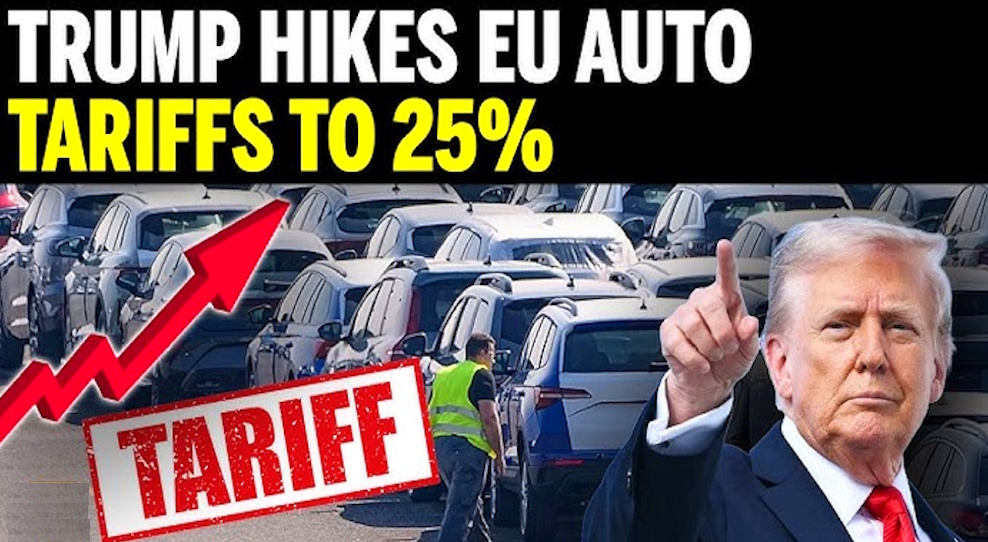
WASHINGTON/BRUSSELS – President Donald Trump announced Friday that he will raise U.S. tariffs on cars and trucks imported from the European Union to 25% next week, accusing the bloc of failing to comply with a previously agreed trade deal.
The move marks a sharp escalation in transatlantic trade tensions, targeting one of the EU’s most vital export sectors.
Background of the Trade Deal
The original trade pact, struck in July 2025, capped U.S. tariffs on EU autos and auto parts at 15% significantly lower than the 25% duties Trump imposed on many other trading partners. These sector-specific tariffs were not affected by a U.S. Supreme Court ruling earlier this year that struck down a broad range of Trump’s global levies.
However, writing on his Truth Social platform, Trump said: “Based on the fact the European Union is not complying with our fully agreed to Trade Deal, next week I will be increasing Tariffs charged to the European Union for Cars and Trucks coming into the United States. The Tariff will be increased to 25%.”
Trump did not specify how the EU had allegedly violated the agreement, nor did he provide further justification for the planned hike.
EU Response: Options Remain Open
Reacting to the announcement, a European Commission spokesperson told AFP: “Should the U.S. take measures inconsistent with the joint statement, we will keep our options open to protect EU interests.”
The spokesperson added that the bloc is implementing its commitments “in line with standard legislative practice” and has been keeping the Trump administration informed throughout the process.
Notably, the EU had already laid the groundwork for potential retaliation last July, preparing a list of U.S. goods that could be targeted if trade talks with Washington collapsed.
Conditional Approval from European Parliament
In late March, the European Parliament gave its conditional green light to the EU-U.S. tariff deal. A large majority of EU lawmakers agreed to cut EU tariffs on select U.S. imports as a first step toward implementing the 2025 agreement. However, they also demanded additional safeguards. Before the deal can be fully implemented by the bloc, it still requires negotiation with EU member states.
Business Reaction: Uncertainty and Caution
The renewed tariff threat has raised concerns among small businesses. Dan Anthony, head of “We Pay the Tariffs,” a coalition of nearly 1,200 small U.S. businesses, said the announcement “explains why many small businesses expect to be cautious” regarding Trump’s trade policy. “You never know what might trigger the next tariff threat,” he added.
Impact on Germany and Recent Trade Talks
Germany, as the EU’s largest auto exporter, would be particularly hard hit. According to the VDA industry group, Germany exported some 450,000 vehicles to the United States in 2024 a figure that has since declined. Germany alone accounts for a significant share of total EU auto exports to the U.S., which ranks as the second-largest market for new EU vehicles after the United Kingdom. A 2025 fact sheet from the European Automobile Manufacturers’ Association noted that over one-fifth of all EU vehicle exports go to the United States.
In April, EU trade chief Maroš Šefčovič traveled to Washington for meetings with U.S. Commerce Secretary Howard Lutnick and trade envoy Jamieson Greer. At the time, Šefčovič said talks were progressing positively, adding that the EU was also seeking progress in easing the effects of still-high U.S. steel tariffs.
Political Context: Criticism of Germany’s Chancellor
Trump’s latest trade threat came just a day after he renewed criticism of German Chancellor Friedrich Merz, telling Merz to focus on ending the Ukraine war instead of “interfering” on Iran. The remark adds a diplomatic layer to the trade dispute, suggesting broader friction between Washington and Berlin.
Outlook
With the 25% tariff set to take effect next week unless a last-minute agreement is reached, the EU now faces a critical decision: respond with proportional retaliation, seek further negotiations, or challenge the measure through the World Trade Organization. Either way, the move threatens to reignite a transatlantic trade war that had only recently shown signs of de-escalation.
Our Pashto-Dari Website

Support Dawat Media Center
If there were ever a time to join us, it is now. Every contribution, however big or small, powers our journalism and sustains our future. Support the Dawat Media Center from as little as $/€10 – it only takes a minute. If you can, please consider supporting us with a regular amount each month. Thank you
DNB Bank AC # 0530 2294668
Account for international payments: NO15 0530 2294 668
Vipps: #557320

Comments are closed.