

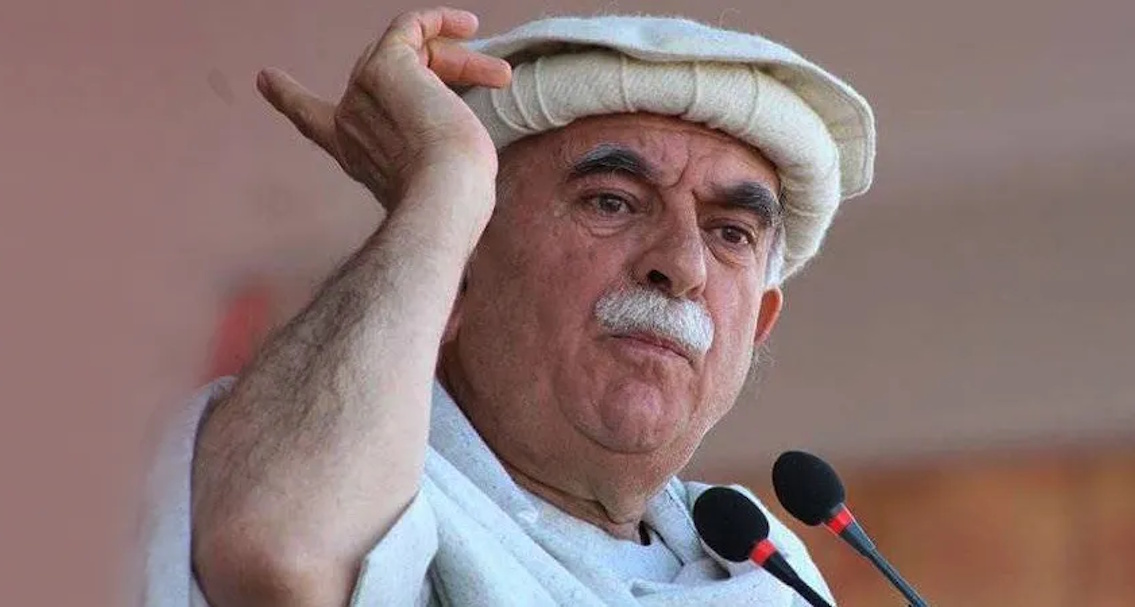
Mehmood Khan Achakzai, chairman of the Pashtunkhwa Milli Awami Party (PkMAP), has asserted that Afghanistan currently enjoys greater security and justice than Pakistan, arguing that Islamabad lacks the moral or political standing to impose demands on its neighbor. His remarks, made during a detailed podcast interview with a Pakistani program, delivered a sweeping critique of Pakistan’s historic and contemporary policies toward Afghanistan.
Achakzai framed his analysis within a historical perspective, tracing decades of foreign intervention. He stated that following the Soviet invasion of Afghanistan, the United States—operating with Pakistan’s pivotal support—transformed the country into a prolonged intelligence and military battlefield. “In this conflict,” Achakzai argued, “the strategic benefits were largely reaped by Pakistan and the U.S., while the Afghan people paid the ultimate price in human suffering and economic devastation.”
He extended this criticism to Pakistan’s domestic sphere, contending that the country’s internal political system is crippled by a weak democratic culture and an absence of justice, thus limiting its legitimacy as a regional model. “Pakistan uses its own people and has moved away from justice,” he said, contrasting this with his claim that Afghanistan, despite its challenges, retains a stronger inherent “republican and democratic spirit.”
A central focus of Achakzai’s criticism was Pakistan’s treatment of Afghan refugees. He noted a stark contradiction: while Pakistani parliamentary committees have formally advocated for providing facilities to refugees, they have instead been “politically exploited and used for strategic objectives.” Achakzai accused Pakistan of historically viewing Afghans, particularly poor Pashtuns, as a source of cheap labor and expressed unease with Afghanistan’s independent international engagements. He strongly condemned the ongoing forced deportation campaign, describing it as a “clear injustice,” and warned that Pakistan would eventually be held accountable for such actions.
On social issues, including the contentious topic of girls’ education in Afghanistan, Achakzai diverted blame from Afghan authorities, arguing that the country is still reeling from the systematic dismantling of its institutions and social structures by successive foreign interventions, notably by Russia and the United States. “These powers later abandoned the country,” he said, “without providing meaningful support for reconstruction.”
Achakzai also dismissed Pakistan’s policy regarding the Tehreek-e-Taliban Pakistan (TTP) as misguided, asserting that Pakistan itself militarized religious seminaries in the past and now wrongly shifts blame onto the Islamic Emirate of Afghanistan. He interpreted Pakistan’s attempts to pressure Afghanistan on issues like water rights and refugees as manifestations of political weakness in Islamabad.
In his conclusion, Achakzai emphasized self-determination, stating that Afghanistan’s future reconstruction depends solely on the will of its own people. He argued that foreign powers have historically preferred a weak and dependent Afghanistan to serve their own interests, a pattern he implored must end. His commentary presents a direct challenge to Pakistan’s regional narrative, positioning Afghanistan not as a subordinate entity but as a peer whose current governance, in his view, surpasses Pakistan’s in key aspects of justice and security.
Our Pashto-Dari Website

Support Dawat Media Center
If there were ever a time to join us, it is now. Every contribution, however big or small, powers our journalism and sustains our future. Support the Dawat Media Center from as little as $/€10 – it only takes a minute. If you can, please consider supporting us with a regular amount each month. Thank you
DNB Bank AC # 0530 2294668
Account for international payments: NO15 0530 2294 668
Vipps: #557320

Comments are closed.