

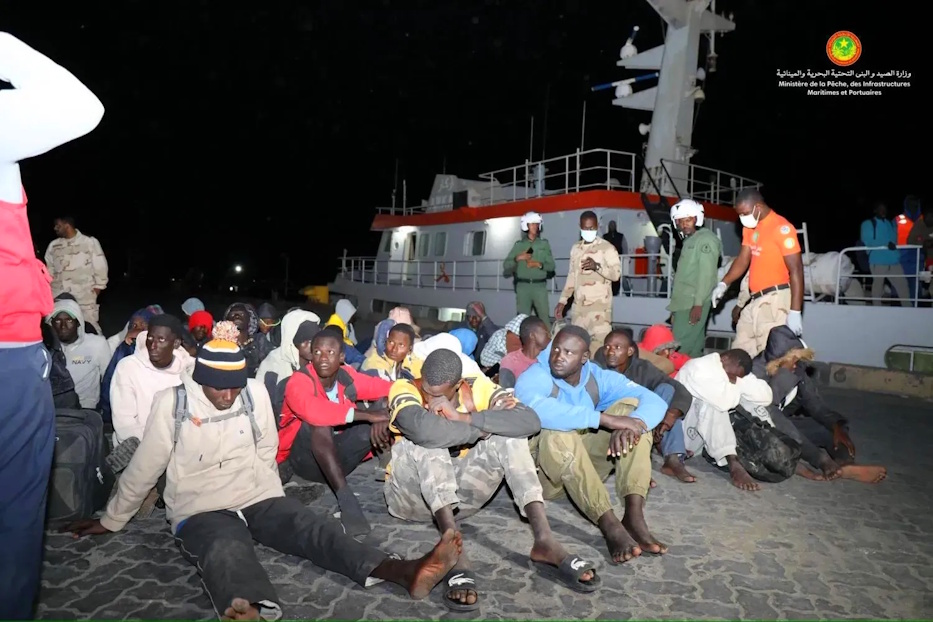
More than 1,100 migrants have been rescued off the coast of Mauritania in less than two weeks, the Mauritanian coastguard announced Tuesday, signaling a sharp resurgence in one of the world’s deadliest but increasingly popular migration routes to Europe. The sudden spike follows a months-long lull and coincides with renewed departures after a major religious holiday.
The rescued individuals mostly young men, though women and children are also among those making the journey were intercepted aboard eight traditional fishing boats, known as pirogues, between May 28 and June 11. According to Ahmed Moulaye, director of the Mauritanian coastguard’s irregular migration unit, “At this rate, arrivals could reach an unprecedented level this year.”
Details of the Rescues
The latest interception occurred around 2:00 a.m. Tuesday off the coast of Mamghar, approximately 200 kilometers (120 miles) north of the capital, Nouakchott. The eight pirogues originated from neighboring Gambia and Senegal, though the nationalities of those on board have not yet been specified, according to Pierre Beziz, a European diplomat stationed in Nouakchott.
Rescued migrants are being transported to newly established temporary reception centers in Nouakchott and the northwestern port city of Nouadhibou. These facilities, funded by the European Union, are designed to register and screen arrivals to determine whether individuals are vulnerable (such as unaccompanied minors, pregnant women, or trafficking victims) or eligible for international protection or asylum.
Why the Sudden Uptick?
The surge in departures appears to have been triggered shortly after the major Muslim festival of Tabaski (Eid al-Adha), which fell at the end of May. Such holidays often see a spike in migration attempts as families, already under economic pressure, pool resources to pay smugglers.
However, deeper structural factors are at play. The recent tightening of maritime patrols by Senegal, Mauritania, and Morocco has pushed smuggling networks to shift their launch points further south particularly to the coasts of Gambia and Guinea-Bissau. This shift has inadvertently lengthened sea journeys to the Canary Islands (Spain), sometimes to more than 1,000 kilometers (620 miles) and up to 10 days at sea, dramatically increasing the risks of dehydration, starvation, and boat failure.
The Atlantic Route: A Growing Crisis
The Canary Islands route has seen a resurgence since 2019, becoming a primary alternative to the more heavily policed Mediterranean crossings. According to Spanish data, arrivals to the islands have risen steadily, with many boats now departing from West African countries as far south as Senegal and Guinea.
European migration policies have also played a role. As EU nations have drastically reduced visa issuance for African nationals and strengthened border controls at Mediterranean entry points (e.g., Morocco’s northern coast), many migrants have been forced to take the longer, more dangerous Atlantic route. Unlike the Mediterranean, where nearby shipping lanes increase rescue chances, the Atlantic route has fewer patrol vessels and harsher weather conditions.
Human Cost and Future Outlook
The International Organization for Migration (IOM) estimates that thousands of people have died or disappeared on this route in recent years, with many boats vanishing without a trace. The Mauritanian coastguard, despite its recent successes, is under-resourced to handle a major surge. If the current pace of departures continues, humanitarian organizations warn that reception centers could be overwhelmed, and deaths at sea may rise sharply.
For now, the rescued 1,187 are the fortunate ones. But with Moulaye’s warning of “unprecedented” numbers, the Atlantic route is fast becoming the new frontline of Europe’s migration crisis one that the EU, Mauritania, and neighboring countries are struggling to manage.
Our Pashto-Dari Website

Support Dawat Media Center
If there were ever a time to join us, it is now. Every contribution, however big or small, powers our journalism and sustains our future. Support the Dawat Media Center from as little as $/€10 – it only takes a minute. If you can, please consider supporting us with a regular amount each month. Thank you
DNB Bank AC # 0530 2294668
Account for international payments: NO15 0530 2294 668
Vipps: #557320

Comments are closed.