
Colombia Earthquake: Magnitude 7.4 Quake Strikes Near Bogota; Death Toll Rises to 111

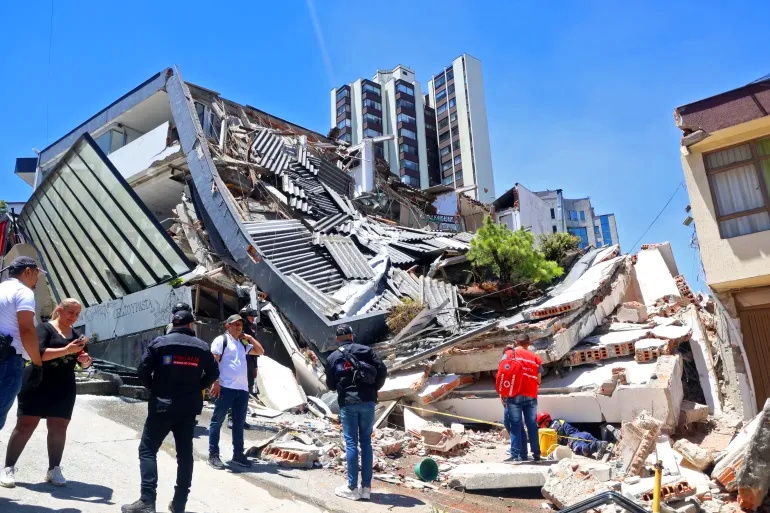
A powerful 7.4-magnitude earthquake struck western Colombia on Monday morning, causing widespread devastation across multiple cities and killing at least 111 people, according to President Abelardo de la Espriella. The quake, which struck at 7:34 a.m. local time, has left 87 others injured and many more trapped beneath collapsed buildings .
The epicentre was located near San Jose Del Palmar, a remote municipality in the Choco region approximately 400 kilometres (250 miles) west of the capital, Bogota, the U.S. Geological Survey reported. The tremor, which registered at a depth of 107 kilometres, was felt strongly across much of the country and in neighbouring Ecuador and Panama, though minimal damage was reported there .
Widespread Damage and Cities Affected
Cities to the west of the country have suffered the most severe damage. Pereira, Quibdo, Cali and Manizales have been left ravaged, with residents and search teams picking through rubble as concerns over aftershocks persist . More than 20 municipalities across the country have been hit, according to Colombia’s interior minister .
Local officials confirmed that at least 40 people were killed in the Risaralda department, where the hard-hit city of Pereira is located, and 27 people in the Valle del Cauca department, home to Colombia’s third-biggest city, Cali. Two people also died in Manizales, with at least three of those killed in Valle del Cauca being children . In Choco, nine deaths were confirmed, along with two more in the Caldas region and a 73-year-old in the Antioquia region .
In Cali, a city of two million people, Mayor Alejandro Eder said residents were trapped in at least 19 buildings that had collapsed . Jorge Moncayo, a 64-year-old taxi driver in Cali, described the scene: “My entire house shook. I’ve never lived through such a powerful earthquake. We’re thanking God we’re alive” .
In Pereira, dramatic footage showed pieces of the airport ceiling falling on travellers taking shelter, while people ran through rubble in panic. Pereira’s mayor, Mauricio Salazar, confirmed that many more were trapped under “a massive quantity of collapsed buildings” . In Manizales, one of the towers of the neo-Gothic cathedral collapsed onto the nave, prompting the mayor to urge residents to stay outside in case of aftershocks .
Airports Suspended and Infrastructure Damage
The civil aeronautics agency has confirmed that six damaged airports have suspended operations: Pereira, Manizales, Quibdo, Armenia, Cartago and Buenaventura. Operations at these terminals remain suspended until structural assessments can be completed, authorities said . The Colombian Aviation Authority said damage had been incurred at multiple airports across the country, with Pereira, Manizales and Armenia among the worst affected .
In the capital Bogota, authorities activated emergency protocols to verify structural integrity of buildings. Mayor Carlos Fernando Galan reported no deaths or serious structural damage in the city, though some cracks were observed in buildings . The earthquake follows two back-to-back devastating quakes in neighbouring Venezuela in late June, which killed more than 5,000 people and destroyed hundreds of buildings .
Presidential Response and ‘Ring of Fire’ Context
President Abelardo de la Espriella, who was sworn in just over the weekend, has personally taken charge of the government’s emergency response . “You are not alone. The state is present and acting,” he said in a message to the nation . He has ordered the installation of a Unified Command Post to coordinate damage assessment and aid for victims, and will travel to Pereira to personally oversee the response . The newly inaugurated president now faces his first major challenge as leader of the Andean nation .
Colombia’s Pacific region around the epicentre lies along the “Ring of Fire”, the line of seismic faults encircling the Pacific Ocean where most of the world’s earthquakes occur . The Pacific region, particularly the Choco department, is one of the poorest in Colombia, and much of it is highly rural and only reachable by boat or plane, which may pose significant challenges for authorities in assessing the full extent of the disaster .
Colombia’s Geological Service confirmed this was “the highest magnitude earthquake registered in Colombia in the last decade”, and that it had been followed by at least two aftershocks measuring 2.8 and 4.8 magnitude . While small earthquakes are common in central and western Colombia, those above 6.0 magnitude are rare. In 1999, a 6.2 magnitude quake near Armenia killed more than 1,100 people .
Messages of support have poured in from leaders across the Americas, including Mexico, Brazil, and Ecuador . As rescue operations continue and the full scale of the disaster becomes clearer, authorities have warned that the death toll may rise as search teams comb through the ruins of collapsed buildings .
Latin America’s Deadliest Earthquakes: A Look Back at Catastrophic Seismic Disasters
Latin America is no stranger to earthquakes. The region is historically vulnerable to devastating seismic events as it lies along a highly active tectonic zone, with the Pacific coast forming part of the “Ring of Fire” . Here is a quick look at some of the region’s deadliest earthquakes:
The 2010 Haiti Earthquake
-
Magnitude: 7.0
-
Death toll: 316,000
The 2010 Haiti earthquake was deadlier than almost every other quake ever recorded, ranking second only to the massive 1556 Shaanxi earthquake in China, which killed an estimated 830,000 people . Poor building practices, concrete structures without adequate reinforcement, and a lack of emergency services all contributed to the exceptionally high death toll. The earthquake struck the densely populated capital of Port-au-Prince, causing an estimated $8 billion in losses—nearly 120% of the country’s GDP .
The 1868 Ecuador-Colombia Earthquakes
-
Magnitude: 7.7
-
Death toll: 70,000
A devastating sequence of earthquakes starting early on August 15 and peaking with a 7.7 magnitude shock the next morning flattened multiple towns, resulting in an estimated 40,000 deaths in Ecuador and 30,000 in Colombia . In a book published that year documenting the disaster, a government commission wrote that the city of Ibarra was asleep when the earthquake struck at 1:15 a.m. “In less than three seconds (Ibarra) was turned into a large and dismal burial ground. Almost all of its population buried under the ruins of their own bedrooms” .
The 1970 Peru Earthquake
-
Magnitude: 7.9
-
Death toll: 66,794
This undersea earthquake triggered the deadliest landslide in history after it destabilised the northern wall of Peru’s tallest mountain . The mass of glacial ice and rock, estimated at 80 million cubic metres, hurtled toward the towns of Yungay and Ranrahirca at speeds of up to 335 kmph (208 mph). An estimated 19,000 people died in Yungay, with just 2,500 surviving. Up to 70% of other towns like Chimbote and Huaras were destroyed, and nearly one million people were left homeless .
The 1797 Ecuador Earthquake
-
Magnitude: 8.3
-
Death toll: 40,000
The most powerful known earthquake to strike Ecuador, this temblor reached the second-highest level on the Modified Mercalli intensity scale, which measures effects experienced by people . The quake triggered landslides and caused widespread destruction across Ecuador, including in Quito, Riobamba, Latacunga and Ambato. Historians and witness accounts described violent shaking that levelled buildings within seconds .
Additional Major Earthquakes
-
The 1939 Chile Earthquake (Magnitude: 8.3, Death toll: 30,000) – The deadliest in Chile’s history, destroying the cities of Chillan and Concepcion. Weak construction materials like adobe and the absence of earthquake-resistant design contributed to the high death toll .
-
The 1812 Venezuela Earthquake (Death toll: 26,000) – Destroyed around 90% of Caracas and caused thousands of deaths across multiple cities. The disaster struck during Venezuela’s revolutionary war against Spain .
-
The 1999 Colombia Earthquake (Magnitude: 6.0, Death toll: 1,170) – Devastated the city of Armenia, a reminder of the deadly potential of even moderate quakes in the region .
Our Pashto-Dari Website

Support Dawat Media Center
If there were ever a time to join us, it is now. Every contribution, however big or small, powers our journalism and sustains our future. Support the Dawat Media Center from as little as $/€10 – it only takes a minute. If you can, please consider supporting us with a regular amount each month. Thank you
DNB Bank AC # 0530 2294668
Account for international payments: NO15 0530 2294 668
Vipps: #557320

Comments are closed.