
Bangladesh Halts Controversial Relocation of Rohingya Refugees to Remote Island, Citing Unsustainability

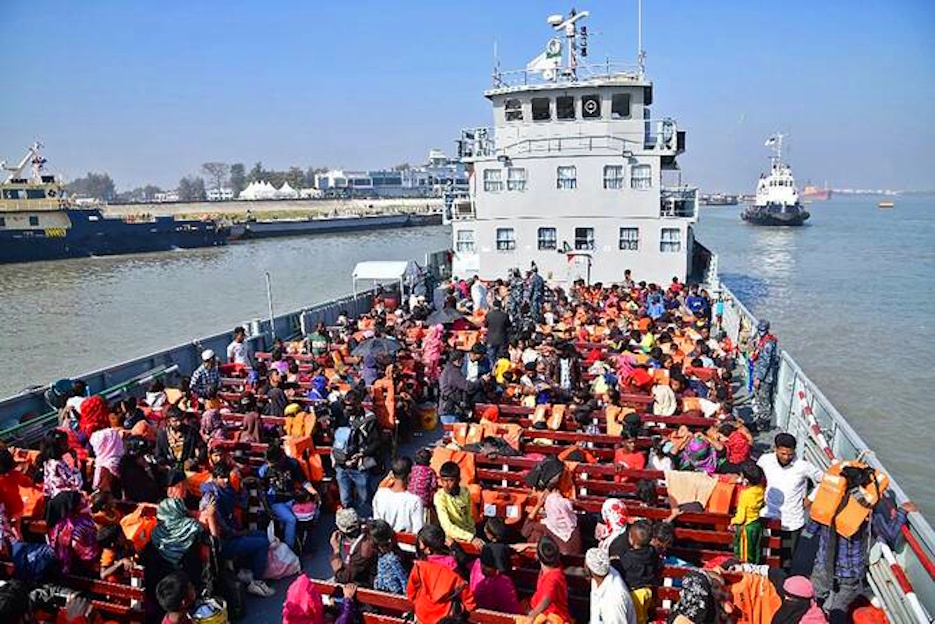
DHAKA: When Bangladesh launched a multi-million-dollar project to relocate Rohingya refugees to a remote island, it promised a safer, more dignified life away from the world’s most overcrowded camps. Five years on, the controversial plan has effectively ground to a halt, with authorities declaring it economically unviable and unsustainable as refugees flee back to the mainland.
The focus of the failed initiative, Bhasan Char—a 40 sq. km island that emerged from river sediments in the Bay of Bengal roughly two decades ago—was developed to house 100,000 refugees. Located over 60 km from the mainland, the never-inhabited site was transformed with concrete housing, cyclone shelters, and infrastructure at an estimated cost of $350 million, funded by the Bangladeshi government.
Despite warnings from the United Nations and humanitarian groups that the island was dangerously vulnerable to cyclones, flooding, and isolation, relocations began in December 2020 under the administration of then-Prime Minister Sheikh Hasina. By October 2024, over 38,000 Rohingya had been moved in 25 transfers conducted by the Bangladesh Navy.
However, following the political ouster of Sheikh Hasina last year, the new administration has suspended the project indefinitely.
“The Bangladesh government will not conduct any further relocation of the Rohingya to Bhasan Char island,” Mizanur Rahman, Refugee Relief and Repatriation Commissioner in Cox’s Bazar, confirmed to Arab News. “The main reason is that the country’s present government considers the project not viable.”
The decision follows analyses from UN agencies indicating that operational costs on Bhasan Char are 30 percent higher than in the mainland camps of Cox’s Bazar. Compounding the issue is a lack of willingness among the refugee population to move.
“The Rohingya are not voluntarily coming forward for relocation to the island. Many of those previously relocated have fled,” Rahman explained. Current estimates suggest only about 29,000 refugees remain on Bhasan Char, with nearly 10,000 having independently returned to the congested camps in Cox’s Bazar.
The Rohingya, a predominantly Muslim ethnic minority from Myanmar’s Rakhine State, have faced decades of systemic persecution and were stripped of citizenship in the 1980s. A brutal military crackdown in 2017 forced approximately 750,000 to flee to Bangladesh, joining hundreds of thousands already there. Today, about 1.3 million live in 33 camps in Cox’s Bazar.
While Bhasan Char offered improved physical infrastructure compared to the sprawling, makeshift mainland settlements, it failed to provide essential freedoms and opportunities. Residents reported a lack of regular transport, severe restrictions on movement, and scarce livelihood options, rendering them almost entirely dependent on aid shuttled from the mainland.
“Considering all aspects, we can say that Rohingya relocation to Bhasan Char is currently halted,” Commissioner Rahman stated, noting that only one transfer had occurred since the change in government. “The relocation was conducted with government funding, but the government is no longer allowing any funds for this purpose.”
He concluded, “The Bangladeshi government has spent around $350 million on it from its own funds… It seems the project has not turned out to be successful.”
The suspension leaves critical questions unanswered regarding the future of those still on the island and the long-term strategy for managing the refugee crisis. Humanitarian groups continue to advocate for voluntary, safe, and sustainable solutions, emphasizing that any relocation must guarantee rights, safety, and access to services, in line with international standards. The costly experiment of Bhasan Char now stands as a stark lesson in the complexities of refugee policy and the perils of isolated settlements.
Our Pashto-Dari Website


Support Dawat Media Center
If there were ever a time to join us, it is now. Every contribution, however big or small, powers our journalism and sustains our future. Support the Dawat Media Center from as little as $/€10 – it only takes a minute. If you can, please consider supporting us with a regular amount each month. Thank you
DNB Bank AC # 0530 2294668
Account for international payments: NO15 0530 2294 668
Vipps: #557320

Comments are closed.