
Deadly Philippines Earthquake Raised Seabed by Up to 2 Meters, Causing Widespread Coastal Uplift

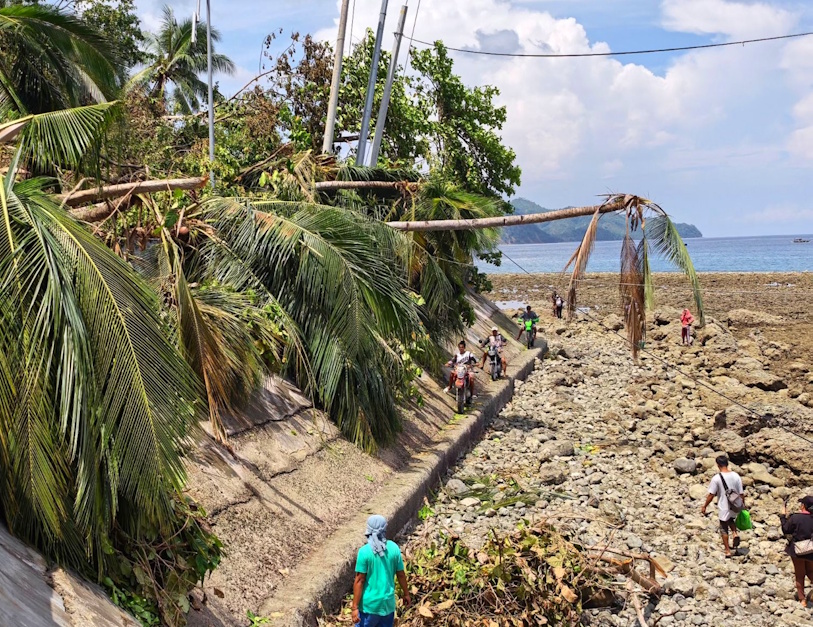
MANILA – A powerful earthquake that killed at least 61 people in the southern Philippines last week also dramatically altered the region’s coastline, raising the seabed by as much as two meters (6.6 feet), according to government scientists. The phenomenon, known as “coastal uplift,” has exposed vast stretches of coral reefs, killed off marine life, and in some areas, extended shorelines by up to 200 meters (656 feet).
The 7.8-magnitude tremor struck Mindanao Island on Monday, and the country’s disaster agency now reports that at least 40 people remain missing. The search for survivors continues amid the rubble of collapsed buildings and landslide-hit villages.
A Changed Coastline: From Seabed to Shore
Residents first noticed the dramatic geological changes two days after the quake, when they observed familiar shorelines had inexplicably moved seaward. According to the Department of Environment and Natural Resources, the most striking changes occurred in the provinces of Sarangani and Davao Occidental, where the coast has been permanently redrawn.
“Approximately two meters was the mapped uplift,” the Philippine Institute of Volcanology and Seismology (Phivolcs) said in a statement. The agency attributed the deformation to a sudden shift in the Cotabato Trench, an active subduction zone located as close as 50 kilometers (31 miles) off the southern coast of Mindanao. The trench is known for frequent seismic activity, including a “swarm” of thousands of mostly small earthquakes recorded as recently as January.
Environmental Devastation Beneath the Surface
While the newly exposed rock and coral may appear fascinating, the environmental cost has been severe. A team dispatched to the affected area found that long stretches of shoreline, coral reef, and seagrass beds have been left high and dry.
“These exposed corals and seagrass beds had begun dying off alongside their resident organisms such as reef fishes, eels, clams, and shells,” the environment department reported. Images released by the department’s regional office showed a bleak tableau: a broad, cracked expanse of bleached coral, dotted with dead fish, eels, and other sea life now decaying under the tropical sun.
An official who spoke to AFP on Sunday noted that they could not yet precisely determine the total area affected, given the rugged and extensive coastline that still needs to be surveyed.
Community Fears and Health Concerns
For local residents, the changed landscape is not just a scientific curiosity it has become a health concern. Villagers initially reported the coastal uplift out of fear that fumes from the widespread rotting marine life could poison them. Decaying organic matter thousands of clams, sea urchins, and fish can release hydrogen sulfide and other noxious gases, posing risks to those living nearby.
Local governments have since advised residents to avoid the affected areas and have begun organizing clean-up efforts. Fisherfolk, meanwhile, face a double blow: not only have they lost boats and gear to the earthquake and tsunami fears, but the destruction of inshore marine habitats will likely impact fish stocks for years to come.
A Region Accustomed to Shifting Ground
The Cotabato Trench is part of the Pacific “Ring of Fire,” where tectonic plates collide with frequent and often violent results. Coastal uplift, while less common than liquefaction or landslides, is a well-documented aftereffect of large subduction-zone earthquakes. Similar uplifts occurred during the 2010 Maule earthquake in Chile and the 2018 Sulawesi earthquake in Indonesia.
As the Philippines continues to dig out from the rubble, the newly risen seabed stands as a silent, stark monument to the immense forces that shape and reshape life on this archipelago nation. Recovery efforts are ongoing, with the government and international aid agencies providing food, water, and medical supplies to the tens of thousands displaced by the disaster.
Our Pashto-Dari Website

Support Dawat Media Center
If there were ever a time to join us, it is now. Every contribution, however big or small, powers our journalism and sustains our future. Support the Dawat Media Center from as little as $/€10 – it only takes a minute. If you can, please consider supporting us with a regular amount each month. Thank you
DNB Bank AC # 0530 2294668
Account for international payments: NO15 0530 2294 668
Vipps: #557320

Comments are closed.