
Heavy Rain Triggers Catastrophic Flooding Near Tokyo, Killing at Least 5 and Stranding Thousands

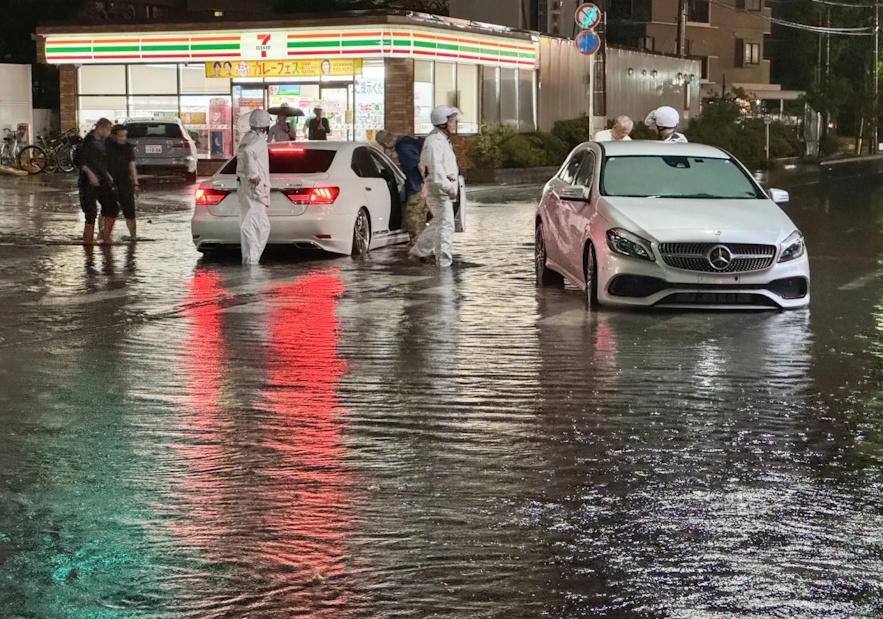
Record-breaking torrential rains pounded cities east of Tokyo overnight, triggering widespread flooding that submerged roads, inundated dozens of homes, and left thousands of travelers stranded. The deluge, described by officials as “unprecedented,” has claimed at least five lives, with one person still missing, while rescue and recovery efforts continue across Chiba prefecture.
The Japan Meteorological Agency (JMA) downgraded its most severe heavy-rain warning for more than a dozen municipalities in Chiba as the rain subsided Friday morning. However, forecasters cautioned that additional downpours were expected later in the day, raising fears of further flooding in already saturated areas.
Widespread Damage and Desperate Rescues
As daylight broke, photos and television footage revealed the scale of the devastation: homes submerged up to their rooftops, cars swept into ditches or half-buried in mud, and railway tracks twisted or completely covered by brown floodwaters. In some neighborhoods, rescue teams used boats to reach elderly residents trapped on the second floors of their homes, while volunteers waded through waist-deep water to distribute food and blankets.
Travel Chaos and Stranded Commuters
The Ground Self-Defense Force dispatched buses to Soga train station, where roughly 4,000 stranded passengers had spent a harrowing night after train services were suspended. The station, which also serves the Tokyo Disney Resort area, became an impromptu shelter, with travelers huddled in waiting rooms and corridors. The military operation to evacuate them was completed later Friday, according to defense officials. Tokyo Disneyland and DisneySea, which are connected to the line, reported no damage or injuries, though the park remained closed for inspection.
At Narita International Airport, one of Japan’s busiest gateways, thousands of passengers who had been stuck overnight gradually made their way out as limited train service resumed Friday morning, albeit with significant delays. Airport terminals had been packed with weary travelers sleeping on floors and queuing for information. By midday, flights in and out of Narita were operating normally a small relief for those returning home at the end of Japan’s Bon Buddhist holiday week, one of the busiest travel periods of the year.
Meanwhile, hundreds of residents and commuters sought refuge at the Chiba prefectural government building, which opened its doors as an emergency shelter, according to The Associated Press. Local community centers and schools also housed displaced families, many of whom had fled their homes with little more than the clothes on their backs.
Casualties and Missing Persons
Chiba prefecture officials confirmed that five people had died in the flooding. Among the victims was a man found floating on a submerged road in Ichikawa city, and a woman who became trapped inside her car as floodwaters rapidly rose in Sakura city. Two other individuals were pulled from flooded vehicles in Kashiwa city and in Chiba city but were pronounced dead at the scene; authorities are treating these as probable drowning cases. Search teams continued to look for one person reported missing, with divers and helicopters scouring rivers and retention basins.
Infrastructure and Power Outages
The sheer volume of water overwhelmed drainage systems and caused at least 170 homes to be flooded across the prefecture. By Friday afternoon, more than 300 people remained in public shelters, with many unable to return home due to unsafe conditions and continuing weather warnings.
Power outages added to the misery. At the peak of the storm, approximately 68,000 households were without electricity. That number had been reduced to about 18,000 by Friday morning, according to TEPCO Power Grid, though restoration efforts were hampered by flooded roads and ongoing rain.
Historic Rainfall Records
The intensity of the rainfall shattered local records. In Chiba City, an astonishing 11.5 centimeters (4.5 inches) of rain fell in a single hour, while Sakura recorded 9.7 centimeters (3.8 inches) in the same timeframe both all-time highs for the region. During an emergency televised news conference, JMA official Takuya Hosomi stressed that “this level of rainfall has never been recorded before,” warning residents to remain vigilant even as the immediate threat appeared to ease.
Government Response and Ongoing Concerns
Prime Minister Fumio Kishida has directed disaster response teams to coordinate with local authorities, and the Cabinet Secretary confirmed that emergency funds would be released to support recovery efforts. Evacuation orders remain in effect for several high-risk zones, and meteorologists are monitoring new storm systems that could bring additional rain over the weekend.
For now, rescue workers and volunteers are racing against time to reach isolated communities, restore essential services, and prevent further loss of life in what is shaping up to be one of the most devastating weather events to hit the Tokyo region in recent memory.
Our Pashto-Dari Website

Support Dawat Media Center
If there were ever a time to join us, it is now. Every contribution, however big or small, powers our journalism and sustains our future. Support the Dawat Media Center from as little as $/€10 – it only takes a minute. If you can, please consider supporting us with a regular amount each month. Thank you
DNB Bank AC # 0530 2294668
Account for international payments: NO15 0530 2294 668
Vipps: #557320

Comments are closed.