
Death Toll in Pakistan Protests Over Iranian Leader’s Killing Rises to 25; Stocks Plunge

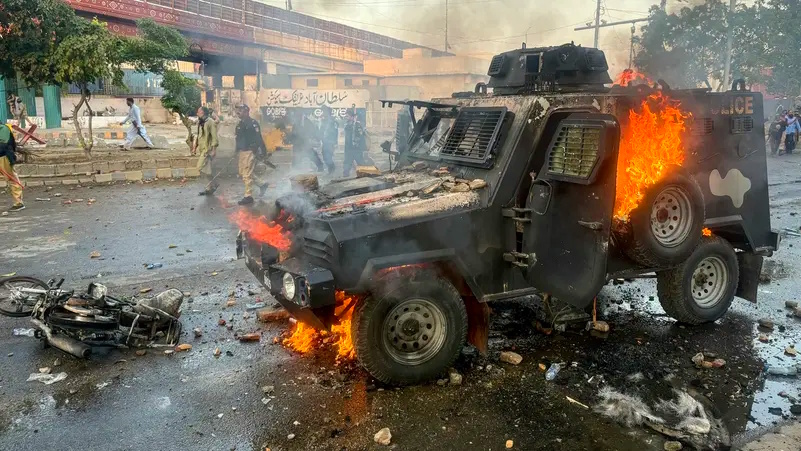
ISLAMABAD – The death toll from violent weekend protests in Pakistan against the killing of Iran’s supreme leader in US-Israeli strikes has risen to at least 25, according to an AFP tally on Monday. The demonstrations, which erupted in several major cities, have plunged the nation into a security crisis and triggered a historic crash on the stock market.
The protests were sparked by the death of Iran’s long-ruling leader, Ali Khamenei, who was killed in US-Israeli military operations on Saturday. The event has prompted outrage in neighboring Pakistan, where thousands took to the streets.
In the southern metropolis of Karachi, hundreds of protesters attempted to storm American diplomatic buildings, leading to fierce clashes with police, an AFP journalist witnessed. At least ten people died and over 70 were injured in those rallies, according to the office of the Karachi police surgeon. A hospital toll seen by AFP indicated that nine of those deaths were due to gunshot wounds.
The violence was even deadlier in the northern Gilgit-Baltistan region, where officials confirmed at least 13 people were killed in clashes between protesters and police. A rescue official reported seven deaths in Gilgit, while a doctor in Skardu told AFP on Monday that six others had died there. In response to the escalating violence, authorities have imposed a late-night curfew until Wednesday in Gilgit and Skardu, and the army has been deployed on the streets.
In the capital, Islamabad, two more people were killed as thousands gathered, many holding portraits of Khamenei. On Sunday afternoon, AFP journalists observed police firing tear gas to disperse crowds near the diplomatic enclave, which houses the US embassy.
The political turmoil has had a severe economic impact. Pakistani stocks plunged on Monday, with the benchmark KSE-100 Index declining by 9.6 percent. The index shed 16,089 points in what Karachi-based Topline Securities described as its “highest ever one-day fall.” Sanie Khan, executive director of Floret Capitals, told AFP, “It was a historic low today. It’s an alarming and challenging situation for Pakistan.”
‘Grief and sorrow’
Pakistan’s Prime Minister Shehbaz Sharif, who maintains close ties with both the United States and Iran, addressed the situation on Sunday, condemning the strike that killed Khamenei as a “violation” of international law.
“It is an age old convention that the Heads of State/Government should not be targeted,” Sharif wrote on X. He added that the “people of Pakistan join the people of Iran in their hour of grief and sorrow and extend the most sincere condolences on the martyrdom” of Khamenei.
The sentiment on the streets, however, was one of direct anger toward the US and its allies. At Sunday’s Karachi protest, people chanted slogans against the United States and Israel. “We don’t need anything in Pakistan that is linked with the US,” a protester, Sabir Hussain, told AFP.
Earlier, a crowd of young people had climbed over the main gate of a consular building in Karachi, gaining access to the driveway and smashing some windows before being dispersed by police tear gas.
In light of the violent demonstrations, the embassies of the United States and Britain both urged their citizens in Pakistan to exercise caution.
Our Pashto-Dari Website

Support Dawat Media Center
If there were ever a time to join us, it is now. Every contribution, however big or small, powers our journalism and sustains our future. Support the Dawat Media Center from as little as $/€10 – it only takes a minute. If you can, please consider supporting us with a regular amount each month. Thank you
DNB Bank AC # 0530 2294668
Account for international payments: NO15 0530 2294 668
Vipps: #557320

Comments are closed.