

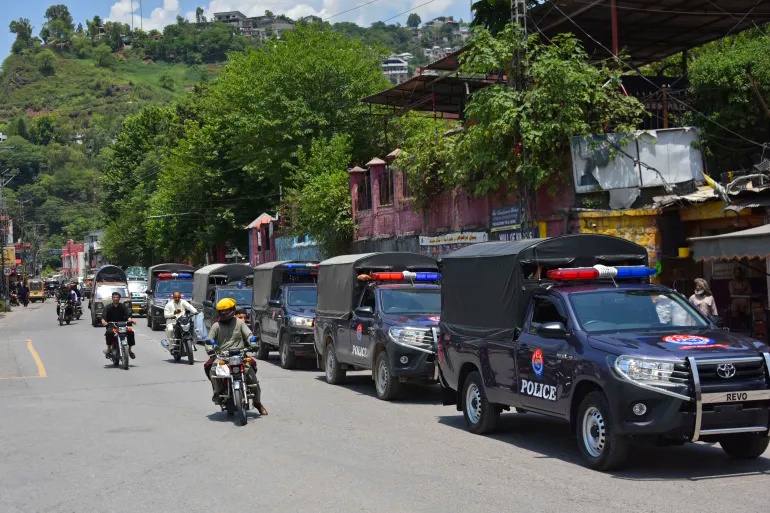
Islamabad, Pakistan – A planned protest march towards the capital of Pakistan-administered Kashmir remained stalled on Wednesday after at least nine people were killed in violent clashes a day earlier, underscoring the deepening political crisis that has gripped the disputed region for more than two months.
The latest bloodshed brings the death toll since the current wave of protests began in early June to at least 28 people, according to officials, with dozens more injured, as authorities tighten security ahead of elections later this month.
The demonstrations are being led by the Jammu Kashmir Joint Awami Action Committee (JAAC), which was outlawed by authorities under anti-terrorism legislation on June 5. Despite the ban, thousands of supporters have continued to mobilise, demanding political reforms and challenging what they describe as Islamabad’s influence over the region’s governance.
Deadly clashes
Violence erupted on Tuesday in separate incidents across the region.
In Rawalakot, the main town of Poonch district, security forces raided a house on the outskirts of the town after receiving intelligence about a suspected weapons cache. Officials said officers came under gunfire during the operation, leaving one security officer dead.
In a separate confrontation in neighbouring Sudhnoti district, protesters blocked the movement of a security convoy. Authorities said demonstrators attacked personnel with stones before gunfire broke out. According to officials, seven protesters and one police officer were killed.
Police maintained that security personnel acted in self-defence during both incidents. Protest organisers, however, have repeatedly accused authorities of using excessive force against demonstrators, allegations officials deny.
The violence marked one of the deadliest days since the unrest began.
March delayed amid communications blackout
Thousands of protesters had planned to begin a march from Rawalakot to Muzaffarabad, the capital of Pakistan-administered Kashmir, at 2pm on Wednesday.
However, by Wednesday evening, demonstrators remained gathered in Rawalakot without setting off, according to officials who spoke to Al Jazeera. The delay came as the government imposed sweeping restrictions on internet and mobile phone services across much of the region, making communication with protest organisers difficult.
Officials said the communications blackout was intended to prevent violence and curb the spread of misinformation, although rights groups have frequently criticised such measures for limiting access to information during periods of unrest.
Munir Qureshi, the deputy commissioner of Muzaffarabad, said the capital remained peaceful despite heightened security.
“Muzaffarabad and its adjoining areas are all clear, and there is no disturbance to public life,” he told Al Jazeera. “Internet access is limited due to the security situation, but otherwise the situation is normal and there is no protest or violence.”
Liaqat Ali Malik, inspector general of police for Azad Jammu and Kashmir (AJK), estimated the crowd in Rawalakot at between 3,000 and 4,000 protesters.
“There has been no violence today,” Malik said on Wednesday.
Heavy security deployment
Authorities have deployed approximately 4,000 police officers and paramilitary personnel across the region in anticipation of the planned march, with checkpoints established on major roads leading to Muzaffarabad.
Poonch Commissioner Khan said protesters would not be permitted to proceed through Rawalakot along the main highway. Instead, if they chose to continue their journey, they would have to travel through mountain routes, significantly complicating efforts to reach the capital.
The large-scale security deployment reflects official concerns that the demonstrations could escalate into broader unrest after weeks of mounting tensions.
Political dispute at the heart of the protests
The current movement centres on a long-running constitutional dispute over 12 reserved seats in the legislative assembly of Pakistan-administered Kashmir.
The seats are allocated to Kashmiri refugees who migrated to Pakistan after the partition of British India in 1947 and who now reside outside the territory.
The JAAC argues that the arrangement enables Pakistan-based political parties to exercise disproportionate influence over the region’s government while allowing development resources intended for local residents to be diverted elsewhere. Protest leaders have demanded electoral reforms and greater political autonomy for the territory.
The controversy intensified last month when the Supreme Court of Pakistan-administered Kashmir ruled that the refugee seats are constitutionally protected and cannot be abolished without a constitutional amendment. The decision further energised the protest movement and hardened the group’s demands.
Elections approach amid rising tensions
The unrest comes just weeks before legislative elections scheduled for July 27, raising concerns about security and voter participation.
Officials say at least 28 people have been killed and 79 injured since demonstrations began on June 4, making the current wave of unrest one of the deadliest episodes in the region in recent years.
With protesters still gathered in Rawalakot, heavy security deployments in place, and communications restrictions continuing across much of the territory, the situation remains volatile as both authorities and protest organisers prepare for the next phase of the standoff.
زموږ انګلیسي ویبپاڼه:

Support Dawat Media Center
If there were ever a time to join us, it is now. Every contribution, however big or small, powers our journalism and sustains our future. Support the Dawat Media Center from as little as $/€10 – it only takes a minute. If you can, please consider supporting us with a regular amount each month. Thank you
DNB Bank AC # 0530 2294668
Account for international payments: NO15 0530 2294 668
Vipps: #557320

Comments are closed.