

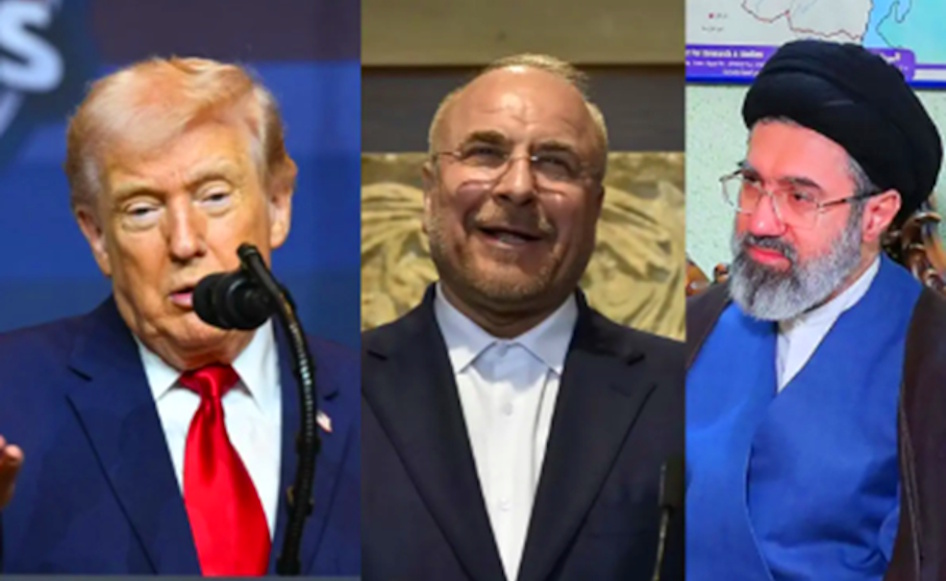
US president threatens to restart bombing campaign in phone calls and social media posts; Tehran lodges formal complaint with mediators
Iranian negotiators dramatically walked out of peace talks with the United States in Switzerland after President Donald Trump unleashed a profanity-filled tirade, vowing to “blow the s— out of them” and “take over the rest of the country” if Tehran did not comply with US demands .
The walkout came as Vice President JD Vance began negotiations with Iranian officials at the scenic Qatari-owned Swiss mountain resort of Burgenstock, marking the first face-to-face talks in more than ten weeks . The discussions were intended to build on a memorandum of understanding signed last week at the Palace of Versailles in France, which outlined a 60-day framework for reaching a final agreement on Iran’s nuclear programme and regional hostilities .
However, Trump’s intervention swiftly unravelled diplomatic efforts. In a phone call with Iranian officials, the president warned: “You close the Strait of Hormuz, and you won’t have a country. You won’t even make it back to your f—ing country… we’ll take over the rest of the country” . He later told Fox News: “We may take over the Strait, if we have to. I’ll blow the s— out of them” .
Taking to Truth Social, Trump further escalated his rhetoric, posting: “Iran must immediately stop their highly paid proxies in Lebanon from causing trouble. If they don’t, we’ll hit Iran very hard again, just like we did last week, only harder” .
Tehran’s Response
Iran’s delegation, led by chief negotiator Mohammad Bagher Ghalibaf and including government, security, bank and oil officials, refused to pose for photographs with their American counterparts before exiting the talks . Tehran immediately lodged a formal complaint with Pakistani and Qatari mediators, who had been facilitating the negotiations .
Ghalibaf later issued a defiant statement, warning the US against further threats. “We do not take American threats into account. They would do better to be careful with their statements; our armed forces are ready to respond to them in a different manner,” he said. “No matter what they say, we are the ones who act” .
The Iranian president, Masoud Pezeshkian, had previously insisted that Tehran would not relinquish its right to uranium enrichment, telling reporters: “What the United States demands is that Iran not build an atomic bomb. This is nothing new, and we can also state in writing that we have no intention of building a bomb. However, we will not relinquish our right to enrichment” .
Trump responded by telling Fox News: “He better watch his mouth. He better shape up, or we will take over the rest of the country” .
Fragile Agreement Unravelling
The collapse of talks represents a significant setback for the fragile diplomatic process that had appeared to be making progress. Under the terms of the June 17 memorandum of understanding, the Strait of Hormuz was to be reopened and there would be a ceasefire “on all fronts,” including Lebanon . The US had also committed to securing at least $300 billion to rebuild Iran following the war, with all US and UN sanctions to be withdrawn after a final agreement was reached .
However, the framework has been plagued by instability. Hezbollah and Israel have continued attacking each other, and Tehran’s Islamic Revolutionary Guard Corps (IRGC) declared the Strait of Hormuz closed, defying the terms of the agreement .
The breakdown in Switzerland follows weeks of escalating tensions. On June 10, the US launched new airstrikes targeting Iran’s radar, air defence, and drone command and control systems in response to the downing of a US Apache helicopter in the Strait of Hormuz . President Trump, who had grown frustrated with Tehran’s repeated delays in responding to Washington’s proposals, accused Iran of “tapping us along” .
Defense Secretary Pete Hegseth defended the administration’s approach, stating: “If we need to negotiate with bombs, we will negotiate with bombs” .
International Implications
The collapse of the talks and Trump’s aggressive rhetoric have raised serious concerns about the stability of the region. The Trump administration had been under pressure from Republican lawmakers and the American public to reach a deal with Iran, while the president’s approval ratings have suffered due to the ongoing conflict and the global energy crisis triggered by the closure of the Strait of Hormuz .
Analysts have warned that the renewed escalation could have far-reaching consequences for global security and the economy. Iran retains the capacity to destroy energy infrastructure in the United Arab Emirates or Qatar in retaliatory attacks, and could also order allied Houthi rebels in Yemen to cut Red Sea oil exporting routes .
The walkout from peace talks leaves the future of US-Iran relations hanging in the balance, with the 60-day window for reaching a final agreement now in serious jeopardy.
Our Pashto-Dari Website

Support Dawat Media Center
If there were ever a time to join us, it is now. Every contribution, however big or small, powers our journalism and sustains our future. Support the Dawat Media Center from as little as $/€10 – it only takes a minute. If you can, please consider supporting us with a regular amount each month. Thank you
DNB Bank AC # 0530 2294668
Account for international payments: NO15 0530 2294 668
Vipps: #557320

Comments are closed.