

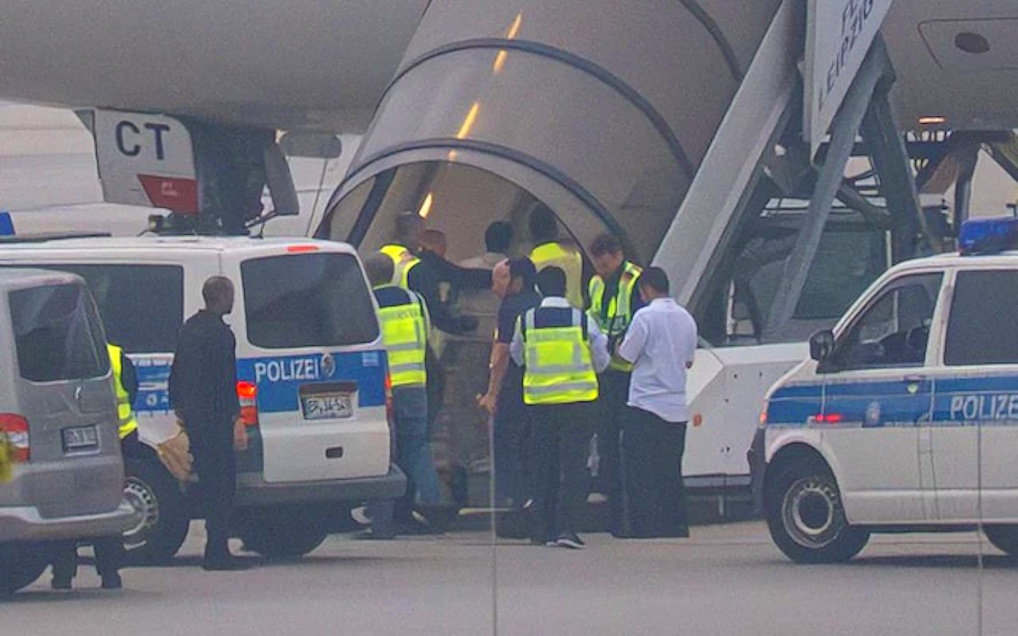
Germany has deported approximately 30 Afghan men to Kabul on a charter flight, continuing Berlin’s controversial policy of returning foreign nationals convicted of serious criminal offenses. The operation, which took place overnight, underscores Germany’s intensified efforts to resume direct deportations to Afghanistan despite the country’s fragile humanitarian and political situation.
According to Germany’s Interior Ministry, the deportees were all adult males convicted of grave crimes, including rape, manslaughter, child abuse, drug trafficking, extortion, and sexual assault. The group was assembled from five federal states and flown from Leipzig/Halle Airport in eastern Germany, with the aircraft expected to land in Kabul on Tuesday. The flight was organized under federal supervision and carried out as a charter operation, rather than through commercial means.
This latest deportation follows a practical arrangement reached between the German government and Afghanistan’s de facto Taliban-led authorities, which enables Berlin to conduct regular return flights without relying on third-country mediation. German officials have stressed that this cooperation is strictly limited to migration-related matters and does not imply political recognition of the Taliban regime. The first such deportation since the Taliban’s return to power in 2021 occurred in August 2024, when 28 convicted offenders were sent to Kabul with the assistance of Qatar. Since then, Germany has organized additional removals, including both individual returns on commercial routes and larger group deportations via chartered aircraft.
The move is part of a broader shift in German migration policy, which has grown increasingly assertive in the wake of public concern over rising asylum applications and high-profile crimes committed by foreign nationals. Chancellor Olaf Scholz’s government has faced mounting pressure from opposition parties and regional states to accelerate the return of rejected asylum seekers and criminal offenders. This approach mirrors a wider European trend, with several EU member states pushing for stricter border controls and faster repatriation procedures. The European Union has also been exploring the establishment of regional return and processing hubs in third countries as part of a collective strategy to manage irregular migration and ease the burden on frontline member states.
However, the resumption of deportations to Afghanistan has drawn sharp criticism from human rights organizations, legal advocates, and opposition politicians. Critics argue that European governments are effectively cooperating with authorities they continue to condemn for systemic human rights abuses, particularly the Taliban’s sweeping restrictions on women and girls, including bans on secondary and higher education, employment, and public participation. Amnesty International and other groups have warned that returning individuals to Afghanistan even convicted criminals raises serious concerns about due process, access to fair trials, and the risk of torture or ill-treatment in a country where the rule of law remains tenuous.
The deportations also occur against the backdrop of Afghanistan’s deepening humanitarian crisis. More than two years after the Taliban takeover, the country remains mired in economic collapse, widespread poverty, and unemployment, with over two-thirds of the population dependent on international aid to meet basic needs. The combination of severe drought, food insecurity, and the near-total exclusion of women from public life has fueled one of the world’s most acute humanitarian emergencies, driving millions of Afghans to seek safety and livelihoods abroad.
Despite these compounding challenges, German officials have indicated that further removals of convicted criminals and individuals deemed security threats are likely to continue as part of the country’s migration enforcement agenda. The government maintains that the deportations are legally justified and proportionate, emphasizing that only individuals with final criminal convictions and no outstanding protection status are affected.
As European capitals grapple with the dual pressures of humanitarian obligation and domestic security concerns, Germany’s approach to Afghanistan represents a test case for how liberal democracies reconcile their human rights commitments with the practical demands of migration control. The coming months will reveal whether Berlin expands this policy to include broader categories of returnees, and whether other European nations follow suit in resuming direct deportations to a country still largely isolated from the international community.
Our Pashto-Dari Website

Support Dawat Media Center
If there were ever a time to join us, it is now. Every contribution, however big or small, powers our journalism and sustains our future. Support the Dawat Media Center from as little as $/€10 – it only takes a minute. If you can, please consider supporting us with a regular amount each month. Thank you
DNB Bank AC # 0530 2294668
Account for international payments: NO15 0530 2294 668
Vipps: #557320

Comments are closed.