

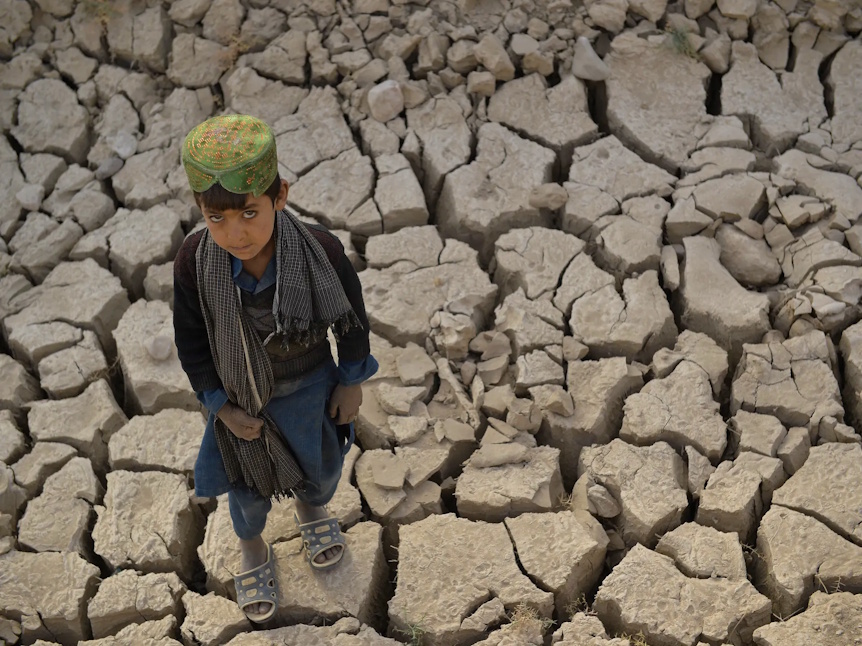
KABUL / NEW YORK – Afghanistan, already reeling from decades of war, poverty, and political instability, is now facing an existential threat from climate change, according to a report released Wednesday by the United Nations Development Program (UNDP). Despite contributing almost nothing to global greenhouse gas emissions, the country ranks among the world’s most climate-vulnerable nations, suffering from rising temperatures, intensifying droughts, and increasingly destructive floods.
Since 1950, average temperatures in Afghanistan have risen by approximately 1.8 degrees Celsius, the report notes a rate significantly higher than the global average. This warming is fueling more frequent and severe weather extremes, including flash floods, unseasonal avalanches, and prolonged droughts, which collectively affect more than 200,000 people every year.
A Double Burden: Climate Shocks on a Fragile State
The UNDP report emphasizes that climate shocks are compounding the hardships of a population already grappling with widespread poverty, acute food insecurity, and the lingering effects of four decades of armed conflict and chronic underinvestment.
“Countries like Afghanistan have contributed the least to global warming yet bear its heaviest costs,” the report states, underscoring a global injustice that leaves fragile states least equipped to respond.
Between February and July 2025 alone, heavy rains and flash floods killed and injured dozens of Afghans, displaced thousands, and destroyed homes, farmland, and critical infrastructure across multiple provinces. Flooding has become a major driver of poverty, as damaged irrigation systems and submerged croplands wipe out entire harvests, pushing vulnerable families deep into debt.
Local Solutions: Canals, Walls, and Community Resilience
Despite the grim outlook, the UNDP highlights several community-based adaptation projects that are yielding tangible results.
In Kapisa province, where repeated flooding had long devastated rural livelihoods, the agency helped construct irrigation canals, flood-protection walls, and water-control structures. These now provide reliable irrigation access to 25 villages in the Nejrab district, benefiting an estimated 80,000 people including 28,800 women and 24,000 children.
Similarly, in Guldara district, just outside the capital Kabul, drought had reduced river flows by as much as 40 percent. Following rehabilitation projects that restored local irrigation networks, agricultural yields have increased by 25 to 40 percent, with fruit production doubling in some areas. In Baghlan province, a rehabilitated canal now supplies year-round water to five villages, serving 1,330 households and enabling cultivation of wheat, corn, rice, beans, melons, potatoes, and tomatoes.
Farming Smarter in a Drying Climate
As rainfall becomes increasingly erratic, adapting agriculture to a changing climate is no longer optional. In Kandahar province, one grape farmer reduced post-harvest losses from nearly 9 percent to just 3 percent after adopting improved farming methods and equipment provided through a UNDP-supported project—a small but powerful example of how targeted interventions can build resilience.
An Energy Crisis Meets a Solar Solution
Afghanistan’s energy infrastructure remains severely underdeveloped. Annual electricity consumption stands at about 700 kilowatt-hours per person roughly 30 times below the global average and only about 35 percent of households are connected to the national power grid.
Since 2021, however, the UNDP has installed solar power systems at more than 6,000 facilities across the country, including over 5,420 health centers, more than 800 schools, and 850 businesses. These projects reduce carbon emissions by over 33,000 metric tons annually and cut diesel consumption by more than 12 million liters per year.
More than two million Afghan women now have access to cleaner, more reliable energy through these initiatives, according to the report. Solar-powered health facilities have improved services for nearly 601,000 people. In 106 health facilities and 241 schools, solar systems provide reliable electricity to more than 1.87 million people 61 percent of them women generating nearly 5,000 kilowatts of power and saving an estimated 2.58 million liters of diesel annually.
A Warning for the Future
The UNDP concludes that Afghanistan’s experience offers important lessons for other climate-vulnerable nations: climate adaptation, renewable energy, and community-based resilience projects can indeed help vulnerable communities cope with severe shocks. But the agency warns that the country’s exposure to climate risks is likely to grow as global temperatures continue to rise and extreme weather events become more frequent.
Without sustained international investment and humanitarian access, millions more Afghans could be pushed into displacement and destitution not by war, but by the slow, relentless pressure of a changing climate.
Our Pashto-Dari Website

Support Dawat Media Center
If there were ever a time to join us, it is now. Every contribution, however big or small, powers our journalism and sustains our future. Support the Dawat Media Center from as little as $/€10 – it only takes a minute. If you can, please consider supporting us with a regular amount each month. Thank you
DNB Bank AC # 0530 2294668
Account for international payments: NO15 0530 2294 668
Vipps: #557320

Comments are closed.