

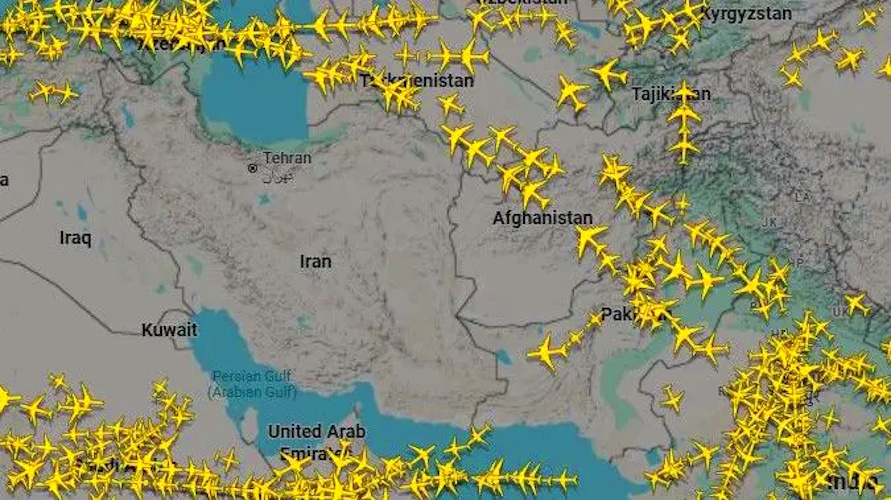
Nearly two years after the Taliban’s return to power, Afghanistan is quietly benefiting from a shift in global air traffic. As conflicts reroute international flights, the country has seen a sharp rise in overflight revenue, collecting millions of dollars annually from airlines crossing its skies.
According to industry estimates, nearly 2,000 flights now pass through Afghan airspace each week roughly five times more than a year ago. With a reported overflight fee of about $700 per aircraft, this translates to approximately $1.4 million in weekly revenue, or more than $70 million on an annualized basis.
The surge follows significant adjustments to international flight routes driven by ongoing conflicts in other regions. Airspace restrictions linked to the war in Ukraine to the north, combined with instability in parts of the Middle East, have narrowed traditional corridors between Europe and Asia. As a result, airlines have increasingly turned to routes over Afghanistan and other countries, such as Saudi Arabia and Turkmenistan, to maintain efficient connections.
Charging for the use of national airspace is standard international practice. These fees often referred to as route charges are typically calculated based on distance flown and aircraft weight. In Europe, for example, they are coordinated through organizations like Eurocontrol and distributed to national air navigation service providers, including Switzerland’s Skyguide, to support air traffic management and infrastructure.
Afghanistan currently applies a flat fee per aircraft a simplified structure that has been in place since 2017. By comparison, countries such as Saudi Arabia calculate overflight charges based on distance and aircraft weight, with average fees reported at around $800 per flight.
Aviation experts note that while overflight arrangements are functioning, operational procedures in Afghan airspace differ from those in more developed systems. Airlines are required to submit flight plans well in advance and maintain close coordination while transiting the area. Some carriers have also reported that communication with Afghan air traffic control remains efficient but less automated than in neighboring jurisdictions.
Beyond routing, broader regional tensions have directly affected airline operations. Several carriers have suspended or reduced services to destinations in parts of the Middle East. Switzerland’s national carrier, Swiss International Air Lines, has confirmed ongoing cancellations to destinations such as Dubai and Tel Aviv. Travel company TUI Suisse has also temporarily scaled back offerings to several countries in the region, citing shifting demand and operational considerations.
Industry observers say passenger demand is now trending toward alternative destinations, including parts of Southern Europe and the Caribbean, as travel patterns continue to adapt to the evolving geopolitical situation.
For Afghanistan, the windfall from overflight fees offers a rare economic bright spot. However, questions remain over how the revenue is managed and whether international monitoring mechanisms are in place issues that are likely to draw continued scrutiny as more airlines return to its skies.
Our Pashto-Dari Website

Support Dawat Media Center
If there were ever a time to join us, it is now. Every contribution, however big or small, powers our journalism and sustains our future. Support the Dawat Media Center from as little as $/€10 – it only takes a minute. If you can, please consider supporting us with a regular amount each month. Thank you
DNB Bank AC # 0530 2294668
Account for international payments: NO15 0530 2294 668
Vipps: #557320

Comments are closed.